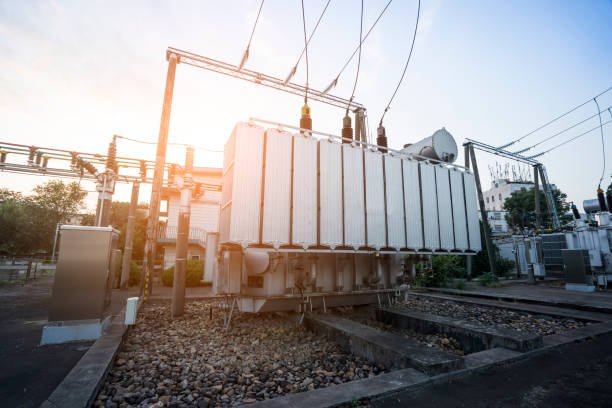
Power transformers naturally produce some level of noise and vibration during normal operation, but excessive levels can indicate underlying design flaws, installation problems, or developing mechanical faults. Persistent transformer noise not only affects nearby communities and workplaces but may also signal conditions that reduce equipment reliability and shorten service life. Understanding the root causes of transformer noise and vibration helps operators diagnose problems early, improve maintenance planning, and select transformers designed for quieter, more reliable operation.
Noise and vibration in power transformers are primarily caused by core magnetostriction, electromagnetic forces in the windings, cooling equipment such as fans and pumps, loose structural components, harmonic distortion, overloading, and installation-related resonance. Proper transformer design, high-quality manufacturing, secure mechanical construction, and regular maintenance can significantly reduce noise levels while improving long-term operational reliability.
Although some transformer humming is unavoidable, excessive noise or abnormal vibration should never be ignored. Identifying the source allows operators to address potential issues before they lead to mechanical damage or costly outages.
What Causes Noise and Vibration Issues in Power Transformers?

Noise and vibration are normal characteristics of power transformer operation, but excessive levels often indicate design deficiencies, improper installation, mechanical looseness, or developing internal faults. While a low humming sound is expected due to alternating magnetic fields, abnormal vibration or increased noise can reduce equipment reliability, accelerate mechanical wear, create environmental concerns, and signal potential problems within the transformer. As utilities, industrial facilities, commercial buildings, and renewable energy projects place greater emphasis on operational reliability and environmental compliance, understanding the causes of transformer noise and vibration has become increasingly important for both manufacturers and end users.
Power transformer noise and vibration are primarily caused by core magnetostriction, electromagnetic forces acting on the windings, cooling equipment operation, structural resonance, loose mechanical components, and installation conditions. Proper core design, winding support, mechanical construction, vibration isolation, and regular maintenance significantly reduce noise levels and improve long-term transformer reliability.
Transformer noise is caused only by cooling fans, while the transformer core produces almost no sound during normal operation.False
The primary source of transformer noise during normal operation is core magnetostriction, which causes the core laminations to expand and contract slightly with each alternating magnetic cycle. Cooling fans are additional noise sources but are not the primary cause in most transformers.
Why do power transformers produce noise?
Every energized transformer generates some level of sound because alternating current creates continuously changing magnetic fields inside the core.
Normal transformer noise is typically characterized by:
- Low-frequency humming
- Continuous operation
- Stable sound levels
When noise becomes louder, irregular, or changes over time, it may indicate mechanical or electrical problems that require investigation.
The primary sources of transformer noise include:
- Core magnetostriction
- Winding electromagnetic forces
- Cooling equipment
- Mechanical vibration
- Structural resonance
| Noise Source | Typical Contribution |
|---|---|
| Core magnetostriction | Primary source |
| Winding vibration | Moderate under load |
| Cooling fans | Significant in forced-air systems |
| Oil pumps | Present in forced-oil cooling |
| Structural resonance | Amplifies existing vibration |
How does core magnetostriction generate noise?
The transformer core is the largest contributor to normal operating noise.
Magnetic flux continuously changes direction as alternating current flows through the windings.
This causes microscopic expansion and contraction of the electrical steel laminations, a phenomenon known as magnetostriction.
Because this occurs at twice the supply frequency, transformers operating at:
- 50 Hz typically produce a fundamental vibration around 100 Hz.
- 60 Hz typically produce a fundamental vibration around 120 Hz.
Although the dimensional changes are extremely small, they occur millions of times during the transformer's service life and generate the familiar humming sound.
Why does core design influence noise levels?
Modern transformer manufacturers reduce noise through improved core construction.
Important design improvements include:
- High-grade grain-oriented electrical steel
- Step-lap core joints
- Optimized magnetic flux density
- Precision lamination stacking
- Strong core clamping systems
These features reduce magnetic stress and minimize vibration.
| Core Design Feature | Noise Reduction Benefit |
|---|---|
| Step-lap joints | Smoother magnetic flux |
| Low-loss electrical steel | Lower magnetostriction |
| Accurate clamping | Reduced vibration |
| Optimized flux density | Less magnetic stress |
How do winding electromagnetic forces create vibration?
Current flowing through transformer windings produces electromagnetic forces.
These forces increase as load current increases.
During normal operation they generate small vibrations.
During short circuits they become extremely large and may cause:
- Winding movement
- Mechanical deformation
- Increased vibration
- Insulation damage
Well-supported windings remain mechanically stable and generate minimal operational vibration.
Why is winding support important?
The winding support structure prevents movement during electrical loading.
Reliable designs include:
- Pressboard spacers
- Axial supports
- Radial supports
- Clamping systems
- Reinforced insulation cylinders
Strong mechanical support reduces:
- Coil movement
- Mechanical fatigue
- Noise generation
| Winding Support Feature | Reliability Benefit |
|---|---|
| Axial clamping | Prevents movement |
| Radial spacers | Maintains alignment |
| End supports | Resists fault forces |
| Compression system | Reduces vibration |
How do cooling systems contribute to transformer noise?
Transformers using forced cooling generate additional sound.
Common sources include:
- Cooling fans
- Oil circulation pumps
- Airflow through radiators
Cooling system noise generally increases with:
- Higher transformer loading
- Increased cooling stages
- Fan operating speed
Although cooling equipment contributes to total sound levels, it is usually secondary to core noise.
Can loose components increase vibration?
Yes.
Loose mechanical components are a common cause of abnormal transformer vibration.
Possible sources include:
- Loose core clamps
- Loose tank panels
- Worn mounting bolts
- Loose radiators
- Loose cooling equipment
Mechanical looseness allows vibration to spread throughout the transformer structure, increasing overall noise.
What is structural resonance?
Every mechanical structure has natural vibration frequencies.
If transformer vibration matches these frequencies, resonance may occur.
Structural resonance can greatly amplify sound levels even when the original vibration is relatively small.
Resonance may occur in:
- Transformer tanks
- Radiators
- Mounting structures
- Building foundations
- Support frames
Proper structural design minimizes resonance effects.
| Resonance Source | Possible Effect |
|---|---|
| Tank panels | Increased radiated noise |
| Radiators | Amplified vibration |
| Steel support frames | Structural resonance |
| Building floors | Noise transmission |
How does installation affect transformer noise?
Even a well-designed transformer may become noisy if installed incorrectly.
Installation factors include:
- Foundation rigidity
- Mounting alignment
- Anchor bolt condition
- Vibration isolation
- Clearance from surrounding structures
Rigid connections between the transformer and building structure may transmit vibration into nearby rooms.
Proper vibration isolation significantly reduces transmitted noise.
Does transformer loading affect noise?
Yes.
As transformer loading increases:
- Winding current increases.
- Electromagnetic forces become stronger.
- Cooling equipment operates more frequently.
This may produce:
- Slightly higher vibration
- Increased cooling fan noise
- Greater mechanical stress
However, sudden increases in noise under normal loading conditions may indicate developing problems.
How does voltage affect transformer noise?
Core noise is strongly influenced by operating voltage.
Higher voltage increases magnetic flux density inside the core.
If voltage exceeds design limits:
- Magnetostriction increases.
- Core vibration increases.
- Audible noise becomes more pronounced.
Maintaining the correct operating voltage helps control transformer sound levels.
Can aging increase transformer vibration?
As transformers age, several factors may increase noise:
- Insulation shrinkage
- Reduced clamping pressure
- Mechanical wear
- Corrosion
- Component loosening
These changes may gradually increase vibration over many years of operation.
Routine inspections help identify these issues before they become serious.
How do manufacturers reduce transformer noise?
Modern transformer manufacturers apply numerous engineering techniques, including:
- Low-noise magnetic core design
- Precision winding assembly
- Optimized clamping pressure
- Improved tank stiffness
- Vibration damping structures
- Computational electromagnetic analysis
These methods reduce both vibration generation and sound transmission.
| Engineering Method | Noise Reduction Effect |
|---|---|
| Low-loss core materials | Reduced magnetostriction |
| Strong winding supports | Less vibration |
| Reinforced tank design | Reduced resonance |
| Precision manufacturing | Improved structural stability |
How is transformer noise measured?
Manufacturers typically measure sound levels during factory testing.
Measurements help verify compliance with project specifications and applicable standards.
Testing evaluates:
- Overall sound pressure level
- Background noise correction
- Operating conditions
- Measurement distance
Consistent testing ensures predictable field performance.
How can monitoring identify vibration problems?
Condition monitoring systems can detect abnormal vibration before failures occur.
Modern monitoring technologies include:
- Vibration sensors
- Acoustic monitoring
- Temperature monitoring
- Dissolved gas analysis
- Online condition monitoring
Changes in vibration patterns may indicate:
- Loose components
- Winding displacement
- Core movement
- Mechanical deterioration
Early detection allows maintenance before major failures develop.
What should buyers evaluate before purchasing?
Buyers should ask manufacturers:
| Evaluation Question | Purpose |
|---|---|
| What is the guaranteed sound level? | Compare acoustic performance |
| What core design is used? | Assess noise reduction technology |
| How are windings mechanically supported? | Evaluate vibration resistance |
| What factory noise tests are performed? | Verify compliance |
| Are vibration isolation options available? | Improve installation performance |
| What monitoring systems are recommended? | Support predictive maintenance |
Which standards address transformer noise?
Power transformer acoustic performance is evaluated according to internationally recognized standards published by organizations such as:
- International Electrotechnical Commission
- Institute of Electrical and Electronics Engineers
These standards provide guidance for:
- Noise measurement procedures
- Test conditions
- Performance evaluation
- Design verification
Why Does the Transformer Core Produce a Humming Sound?

A low humming sound is one of the most recognizable characteristics of a power transformer in operation. While this sound is often noticeable near substations, industrial plants, and electrical facilities, it is usually a normal part of transformer operation rather than a sign of malfunction. The humming originates primarily from the transformer core, where alternating magnetic fields continuously cause microscopic changes in the dimensions of the core steel. Although these movements are extremely small, they occur many times every second and generate vibrations that are transmitted through the transformer structure as audible sound. Understanding why transformer cores produce this humming helps operators distinguish between normal operating noise and abnormal conditions that may require maintenance.
The transformer core produces a humming sound mainly because of magnetostriction, a property of electrical steel that causes the core laminations to expand and contract slightly as the alternating magnetic field changes direction. These microscopic vibrations occur at twice the power system frequency and are transmitted through the transformer tank as the familiar humming sound. Proper core design, precision manufacturing, and secure mechanical clamping help minimize this noise.
The humming sound from a power transformer is mainly caused by electrical arcing inside the transformer core during normal operation.False
Under normal operating conditions, the primary source of transformer humming is magnetostriction in the core laminations. Electrical arcing is an abnormal condition and is not responsible for the normal humming sound of a healthy transformer.
Why is transformer humming considered normal?
Every energized power transformer generates a certain amount of sound.
This sound is generally:
- Continuous
- Stable
- Low-frequency
- Predictable
A steady humming noise usually indicates that the transformer is operating normally.
Only when the sound becomes:
- Significantly louder
- Irregular
- Intermittent
- Accompanied by unusual vibration
should further investigation be considered.
What is magnetostriction?
Magnetostriction is a natural physical property of ferromagnetic materials such as the grain-oriented electrical steel used in transformer cores.
When magnetic flux passes through the core:
- The steel changes shape slightly.
- The material expands and contracts microscopically.
- The dimensional changes reverse as the magnetic field reverses.
Although the movement is extremely small—typically only a few micrometers—it occurs continuously while the transformer is energized.
These repeated movements generate mechanical vibrations that become audible as humming.
How does alternating current create the humming sound?
The transformer operates with alternating current (AC).
As AC changes direction, the magnetic field inside the core also changes direction.
During each electrical cycle:
- The magnetic flux increases.
- The magnetic flux decreases.
- The magnetic polarity reverses.
Because magnetostriction depends on the magnitude rather than the direction of magnetic flux, the steel expands and contracts twice during each electrical cycle.
As a result:
- A 50 Hz power system produces a primary vibration frequency of approximately 100 Hz.
- A 60 Hz power system produces a primary vibration frequency of approximately 120 Hz.
These frequencies create the familiar low-frequency transformer hum.
| Power System Frequency | Primary Humming Frequency |
|---|---|
| 50 Hz | Approximately 100 Hz |
| 60 Hz | Approximately 120 Hz |
Why does the transformer core vibrate?
The transformer core consists of many thin laminated sheets of electrical steel.
Although these laminations are tightly clamped together, each experiences tiny dimensional changes due to magnetostriction.
These microscopic movements create:
- Core vibration
- Mechanical oscillation
- Audible sound
The vibration is transmitted through:
- Core clamps
- Structural frames
- Transformer tank
- Surrounding air
The tank acts as a sounding board, amplifying the vibrations into the humming noise people hear.
Why are laminated cores used?
Transformer cores are constructed from thin insulated laminations instead of solid steel blocks.
Laminated construction provides several advantages:
- Reduces eddy current losses
- Improves efficiency
- Lowers operating temperature
- Limits unwanted magnetic effects
It also helps reduce vibration because the laminations can be assembled with high precision.
| Core Feature | Benefit |
|---|---|
| Laminated electrical steel | Reduces eddy current losses |
| Thin insulated sheets | Improves efficiency |
| Precision stacking | Reduces vibration |
| Strong clamping | Minimizes movement |
Does magnetic flux density affect humming?
Yes.
Core noise increases as magnetic flux density increases.
If magnetic flux becomes too high:
- Magnetostriction becomes stronger.
- Core vibration increases.
- Noise levels rise.
Transformer designers carefully optimize magnetic flux density to balance:
- Efficiency
- Core size
- Material cost
- Noise performance
Operating above the designed voltage can increase flux density and make the transformer noticeably louder.
How does core design reduce humming?
Modern transformer manufacturers use advanced engineering techniques to minimize core noise.
These include:
- High-grade grain-oriented electrical steel
- Step-lap core joints
- Optimized magnetic flux distribution
- Precision lamination cutting
- Uniform clamping pressure
These improvements reduce magnetic stress and vibration while maintaining high efficiency.
| Core Design Technique | Noise Reduction Benefit |
|---|---|
| Grain-oriented electrical steel | Lower magnetostriction |
| Step-lap joints | Smoother magnetic flux |
| Optimized flux density | Reduced vibration |
| Precision assembly | Better mechanical stability |
Why is core clamping important?
The transformer core must remain mechanically stable throughout decades of operation.
Strong clamping systems:
- Hold laminations securely
- Reduce relative movement
- Minimize vibration transmission
- Improve structural rigidity
If clamping pressure decreases over time, vibration may increase, producing louder humming.
Does transformer loading affect core humming?
Core noise depends primarily on voltage rather than load current.
During normal operation:
- Core noise changes very little with loading.
- Winding vibration increases as load current increases.
- Cooling equipment may become louder as loading rises.
Therefore, if humming increases dramatically without a corresponding voltage change, further inspection may be necessary.
Can cooling equipment add to the humming sound?
Yes.
In transformers equipped with forced cooling systems, additional sound may come from:
- Cooling fans
- Oil pumps
- Airflow through radiators
However, these sounds differ from the steady low-frequency hum generated by the core.
Core magnetostriction remains the primary source of transformer humming.
Can abnormal humming indicate a problem?
Although a steady hum is normal, changes in sound may indicate developing faults.
Possible causes include:
- Loose core clamps
- Loose tank panels
- Structural resonance
- Winding movement
- Excessive operating voltage
- Mechanical deterioration
Signs that require investigation include:
- Sudden increases in noise
- Metallic rattling
- Irregular vibration
- Intermittent sounds
How does structural resonance increase noise?
The transformer tank and supporting structures have natural vibration frequencies.
If core vibration matches these frequencies, resonance may occur.
Resonance can amplify otherwise small vibrations, making the transformer sound significantly louder without changing the magnetic forces inside the core.
Proper mechanical design minimizes this effect.
| Source of Vibration | Possible Result |
|---|---|
| Core magnetostriction | Normal humming |
| Loose components | Increased vibration |
| Structural resonance | Amplified sound |
| Cooling equipment | Additional operational noise |
How do manufacturers verify transformer noise levels?
Reliable manufacturers perform acoustic testing during factory acceptance testing.
Typical evaluations include:
- Overall sound pressure level
- Operating voltage conditions
- Background noise correction
- Measurement at specified distances
These tests confirm that the transformer meets contractual and industry noise requirements before shipment.
How can operators reduce transformer noise?
Several methods can reduce transformer humming in service:
- Maintain proper operating voltage
- Tighten loose mechanical components during maintenance
- Install vibration isolation pads
- Use sound barriers where appropriate
- Select low-noise transformer designs for noise-sensitive locations
Routine inspections also help identify mechanical issues before they increase noise levels.
Which standards address transformer acoustic performance?
Transformer noise measurement and evaluation are guided by internationally recognized standards published by organizations such as:
- International Electrotechnical Commission
- Institute of Electrical and Electronics Engineers
These standards establish requirements for:
- Acoustic measurement procedures
- Test conditions
- Performance verification
- Noise evaluation methods
What should buyers ask manufacturers?
Before purchasing a transformer, buyers should discuss acoustic performance with the manufacturer.
| Question | Purpose |
|---|---|
| What is the guaranteed sound level? | Compare acoustic performance |
| What core material is used? | Assess magnetostriction performance |
| Is step-lap core construction used? | Evaluate noise reduction design |
| What factory acoustic tests are performed? | Verify compliance |
| Are low-noise designs available? | Meet site-specific requirements |
| How is core vibration minimized? | Assess mechanical quality |
How Do Windings and Electromagnetic Forces Create Transformer Vibration?
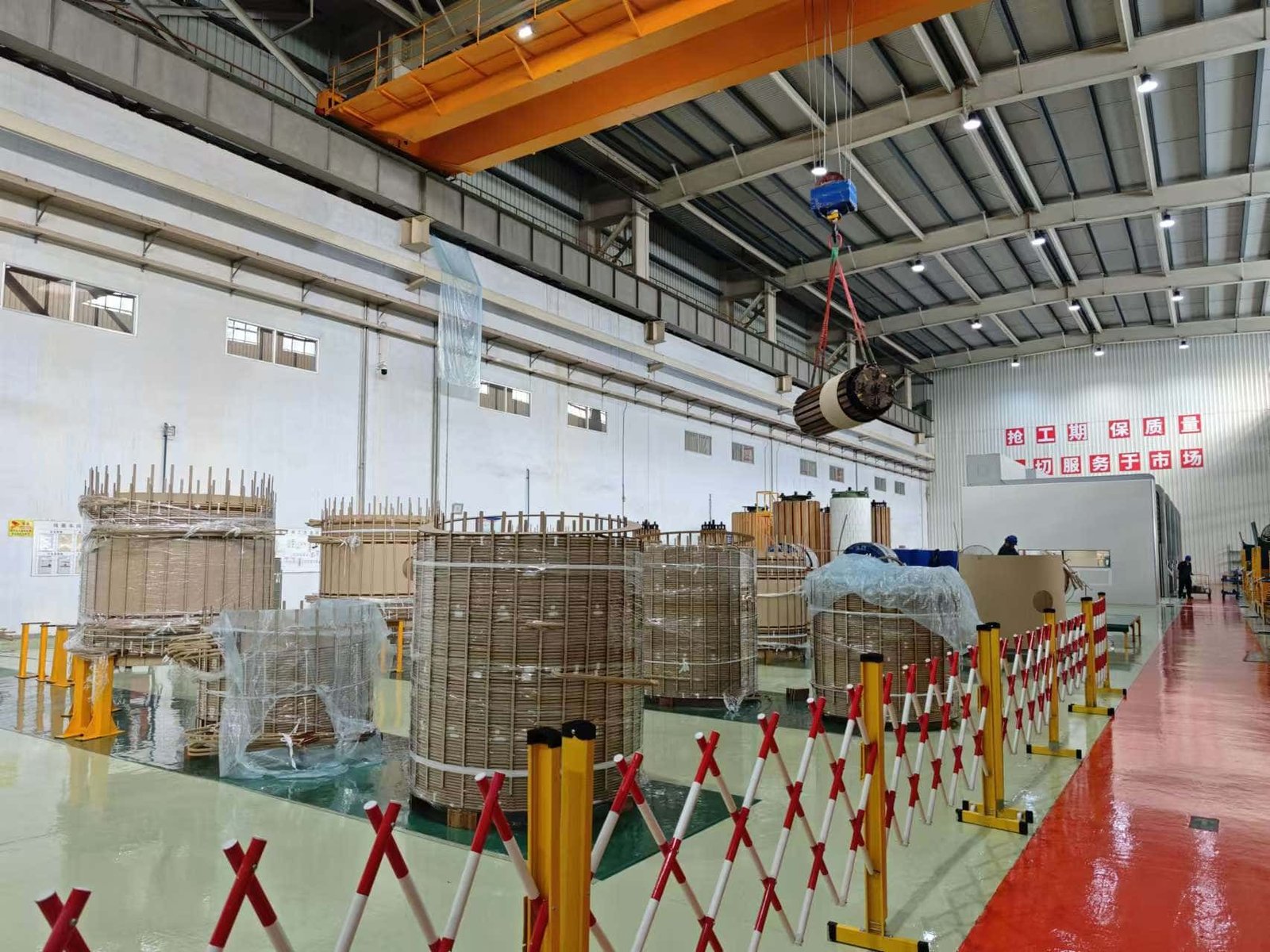
Power transformers operate under constantly changing electromagnetic fields that generate mechanical forces throughout the winding structure. While the transformer core is responsible for most of the characteristic humming sound, the windings also produce vibration whenever electrical current flows through them. These vibrations are usually small during normal operation, but they increase with load current and can become extremely large during short-circuit events. If the winding support system is not sufficiently strong, excessive electromagnetic forces may cause winding movement, insulation damage, mechanical deformation, and ultimately transformer failure. Understanding how windings and electromagnetic forces create vibration is essential for designing reliable transformers and preventing long-term mechanical deterioration.
Transformer windings create vibration because alternating current flowing through the conductors generates electromagnetic forces that act on the winding structure. These forces increase with load current and become extremely high during short circuits. Robust winding construction, reinforced clamping systems, proper insulation support, and optimized electromagnetic design minimize vibration, protect the insulation system, and improve transformer reliability.
Transformer winding vibration remains constant regardless of transformer loading because electromagnetic forces do not change with current.False
Electromagnetic forces are directly related to current. As transformer load increases, winding current increases, producing stronger electromagnetic forces and greater mechanical vibration.
Why do transformer windings vibrate?
Whenever electrical current flows through a conductor, it produces a magnetic field.
Inside a power transformer:
- Current flows through the primary winding.
- A magnetic field is created.
- Energy is transferred through the transformer core.
- Current flows through the secondary winding.
The interaction between magnetic fields and current-carrying conductors generates electromagnetic forces.
These forces continuously act on the windings during operation, producing small mechanical vibrations.
How are electromagnetic forces generated?
Electromagnetic forces arise because each conductor carrying current interacts with the surrounding magnetic field.
These interactions create mechanical forces in different directions.
The magnitude of these forces depends on:
- Current magnitude
- Magnetic flux density
- Winding geometry
- Conductor arrangement
As operating current increases, the electromagnetic forces also increase.
| Operating Condition | Electromagnetic Force |
|---|---|
| Light load | Low |
| Rated load | Moderate |
| Heavy load | High |
| Short circuit | Extremely high |
Why does transformer loading affect winding vibration?
Unlike core vibration, which depends mainly on voltage, winding vibration is closely related to load current.
As electrical demand increases:
- Current through the windings increases.
- Electromagnetic forces become stronger.
- Mechanical vibration becomes more noticeable.
Although this vibration is generally small during normal operation, proper mechanical support remains essential to prevent long-term fatigue.
What types of electromagnetic forces act on transformer windings?
Transformer windings experience two principal mechanical forces.
Radial forces
Radial forces act outward or inward from the center of the winding.
They may cause:
- Expansion
- Compression
- Conductor displacement
Axial forces
Axial forces act along the height of the winding.
They may cause:
- Compression
- Stretching
- End winding movement
Both force types become especially severe during electrical faults.
| Force Type | Direction | Possible Effect |
|---|---|---|
| Radial | Toward or away from the core | Coil expansion or compression |
| Axial | Along winding height | Winding displacement |
Why are short circuits especially dangerous?
Short-circuit conditions generate extremely large fault currents.
Because electromagnetic force increases rapidly with current, a short circuit can produce forces many times greater than those experienced during normal operation.
These forces may cause:
- Winding deformation
- Insulation damage
- Mechanical displacement
- Internal faults
A transformer that survives repeated short circuits requires exceptional mechanical strength.
How do winding support structures reduce vibration?
Mechanical support systems hold the windings firmly in position throughout the transformer's operating life.
Important support components include:
- Pressboard cylinders
- Radial spacers
- Axial spacers
- End blocks
- Clamping rings
These components prevent conductor movement while maintaining insulation clearances.
| Support Component | Function |
|---|---|
| Pressboard cylinder | Provides structural support |
| Radial spacer | Maintains conductor spacing |
| Axial spacer | Controls axial movement |
| End block | Resists fault forces |
| Clamping ring | Maintains compression |
Why is winding clamping important?
Proper clamping maintains constant mechanical pressure on the winding assembly.
Effective clamping systems:
- Reduce vibration
- Prevent conductor movement
- Protect insulation
- Improve short-circuit withstand capability
If clamping pressure decreases over time due to aging or thermal cycling, winding vibration may gradually increase.
How does conductor design influence vibration?
Conductor design affects both electrical performance and mechanical stability.
Manufacturers consider:
- Conductor shape
- Cross-sectional area
- Material selection
- Mechanical rigidity
Copper conductors are commonly preferred because they provide:
- Excellent conductivity
- High mechanical strength
- Good resistance to repeated mechanical stress
How do winding arrangements reduce electromagnetic stress?
Different transformer ratings require different winding configurations.
Common winding types include:
- Layer windings
- Helical windings
- Disc windings
- Continuous disc windings
Proper winding arrangement helps:
- Balance electromagnetic forces
- Improve cooling
- Reduce localized stress
- Increase mechanical stability
| Winding Type | Typical Application |
|---|---|
| Layer winding | Lower-voltage transformers |
| Helical winding | High-current windings |
| Disc winding | High-voltage applications |
| Continuous disc winding | Large power transformers |
How does insulation contribute to mechanical strength?
Transformer insulation is not only an electrical barrier.
It also provides structural support.
Insulation components help:
- Maintain conductor spacing
- Absorb mechanical forces
- Prevent conductor contact
- Stabilize winding geometry
Mechanical support and electrical insulation work together to improve long-term reliability.
Can thermal expansion increase vibration?
Yes.
During normal operation:
- Windings heat up.
- Conductors expand.
- Cooling cycles cause contraction.
Repeated thermal cycling may gradually affect:
- Clamping pressure
- Mechanical alignment
- Support structure performance
Modern transformer designs compensate for thermal expansion while maintaining adequate mechanical compression.
How do manufacturers analyze winding vibration?
Advanced engineering tools are used before manufacturing begins.
These include:
- Electromagnetic analysis
- Mechanical stress simulation
- Thermal modeling
- Short-circuit force calculations
These analyses allow engineers to optimize:
- Winding geometry
- Support locations
- Clamping pressure
- Mechanical strength
How are winding designs verified?
Manufacturers perform several factory tests to confirm winding integrity.
Typical tests include:
- Winding resistance measurement
- Short-circuit impedance measurement
- Applied voltage testing
- Induced voltage testing
- Mechanical inspection
Although factory testing cannot reproduce every operating condition, it confirms that manufacturing quality meets design requirements.
| Factory Test | Purpose |
|---|---|
| Winding resistance | Verify conductor continuity |
| Impedance test | Confirm winding geometry |
| Dielectric test | Verify insulation integrity |
| Mechanical inspection | Confirm assembly quality |
Can vibration monitoring detect winding problems?
Modern condition monitoring systems can identify abnormal winding vibration before major failures occur.
Monitoring technologies include:
- Vibration sensors
- Acoustic monitoring
- Frequency analysis
- Online condition monitoring
Changes in vibration characteristics may indicate:
- Loose winding clamps
- Mechanical deterioration
- Winding displacement
- Internal structural problems
Early detection supports predictive maintenance and reduces the risk of unexpected outages.
How do manufacturers reduce winding vibration?
Modern transformer manufacturers apply numerous engineering improvements, including:
- Reinforced winding support structures
- Optimized conductor arrangements
- High-strength clamping systems
- Improved insulation materials
- Precision winding assembly
- Controlled manufacturing tolerances
These techniques minimize mechanical movement throughout the transformer's operating life.
| Engineering Improvement | Reliability Benefit |
|---|---|
| Stronger clamping systems | Reduced winding movement |
| Improved support structures | Greater mechanical stability |
| Precision winding assembly | Better force distribution |
| Optimized electromagnetic design | Lower vibration levels |
What should buyers evaluate before purchasing?
Buyers should ask manufacturers the following questions:
| Question | Reason |
|---|---|
| How is short-circuit strength verified? | Assess mechanical reliability |
| What winding construction is used? | Evaluate design quality |
| How are windings mechanically supported? | Confirm vibration resistance |
| What factory tests are performed? | Verify manufacturing quality |
| Are vibration monitoring options available? | Support predictive maintenance |
| Which standards are followed? | Confirm compliance |
Which standards support winding reliability?
Transformer winding design and mechanical performance are developed according to internationally recognized standards established by:
- International Electrotechnical Commission
- Institute of Electrical and Electronics Engineers
These standards provide guidance for:
- Mechanical strength
- Short-circuit withstand capability
- Factory testing
- Performance verification
- Reliability evaluation
What External Factors Increase Power Transformer Noise Levels?
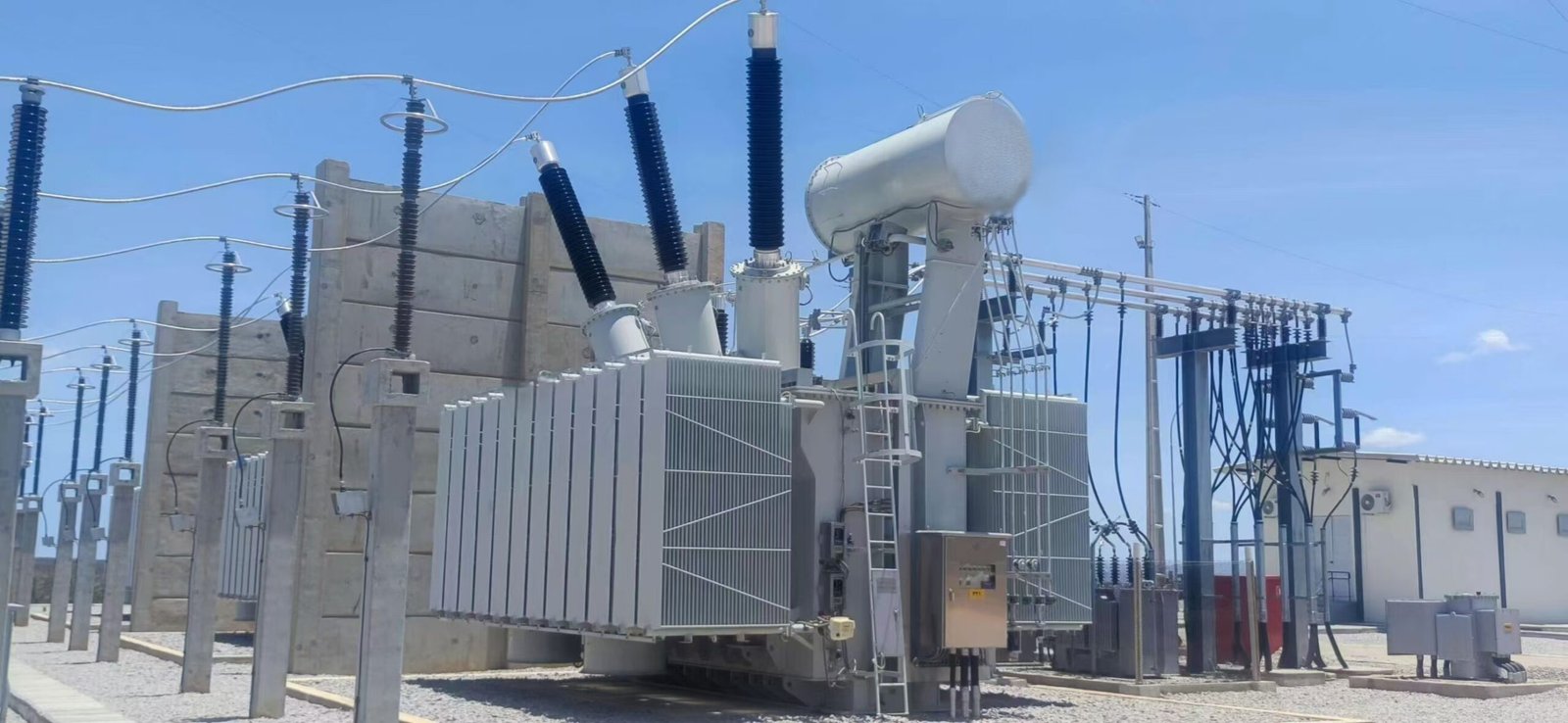
Power transformer noise is influenced not only by its internal design but also by the surrounding operating environment. Even a transformer engineered for low acoustic emissions can appear much louder if external conditions amplify sound or vibration. Factors such as installation quality, foundation design, ambient temperature, operating voltage, loading conditions, nearby structures, weather, and maintenance practices all affect perceived and measured transformer noise. Identifying these external influences helps utilities, industrial facilities, and commercial operators reduce noise complaints, improve equipment reliability, and extend transformer service life.
External factors that increase power transformer noise levels include improper installation, structural resonance, inadequate foundations, excessive operating voltage, heavy loading, cooling equipment operation, high ambient temperatures, loose external components, surrounding reflective surfaces, and poor maintenance. Managing these factors through proper installation, vibration isolation, routine inspections, and optimized operating conditions can significantly reduce transformer noise and vibration.
Transformer noise is determined entirely by the factory design and cannot be affected by installation conditions or the surrounding environment.False
Although transformer design has a major influence on sound levels, external factors such as installation quality, structural resonance, operating conditions, cooling equipment, and nearby buildings can significantly increase perceived transformer noise.
Why do external factors affect transformer noise?
Every transformer generates mechanical vibration during normal operation.
If surrounding conditions amplify these vibrations, the transformer may appear much louder than expected.
External influences can:
- Amplify vibration
- Reflect sound waves
- Increase cooling equipment operation
- Create structural resonance
- Raise operating temperatures
As a result, transformers with identical designs may produce different noise levels at different installation sites.
| External Factor | Effect on Noise |
|---|---|
| Installation quality | Can increase vibration transmission |
| Foundation design | May amplify structural vibration |
| Operating voltage | Can increase core noise |
| Cooling equipment | Adds mechanical noise |
| Surrounding buildings | Reflect sound waves |
How does installation quality influence transformer noise?
Proper installation is one of the most important factors affecting acoustic performance.
Poor installation may result in:
- Uneven support
- Misalignment
- Loose anchor bolts
- Direct vibration transmission
When vibration is transmitted into surrounding structures, nearby rooms or buildings may experience higher noise levels than expected.
Good installation practices include:
- Level foundations
- Proper bolt torque
- Vibration isolation where appropriate
- Correct structural alignment
Why is foundation design important?
The transformer foundation supports the entire weight of the equipment while absorbing vibration.
If the foundation is:
- Too flexible
- Uneven
- Poorly constructed
it may resonate with transformer vibration.
Well-designed foundations:
- Increase structural stability
- Reduce vibration transmission
- Improve long-term mechanical reliability
| Foundation Condition | Noise Impact |
|---|---|
| Rigid and level | Lower vibration |
| Uneven support | Increased vibration |
| Weak structure | Structural resonance |
How do nearby buildings increase perceived noise?
Transformer sound does not always travel directly away from the equipment.
Nearby surfaces may reflect sound, including:
- Concrete walls
- Steel structures
- Building facades
- Sound barriers with poor design
Multiple reflections may increase perceived noise levels at specific locations.
Site planning should consider:
- Building spacing
- Equipment orientation
- Acoustic reflections
How does structural resonance amplify transformer noise?
Every structure has one or more natural vibration frequencies.
If transformer vibration matches these frequencies, resonance can occur.
Resonance may develop in:
- Transformer support frames
- Cable trays
- Steel platforms
- Building floors
- Radiators
Although the transformer itself may operate normally, resonance can make vibration and noise much more noticeable.
| Structure | Possible Result |
|---|---|
| Steel platform | Amplified vibration |
| Building floor | Increased transmitted noise |
| Support frame | Structural resonance |
| Radiator assembly | Additional sound radiation |
Does operating voltage affect transformer noise?
Yes.
Core noise depends primarily on magnetic flux density, which is directly influenced by operating voltage.
If voltage exceeds the design value:
- Magnetic flux increases.
- Core magnetostriction becomes stronger.
- Audible humming increases.
Maintaining voltage within the specified operating range helps control transformer sound levels.
How does heavy loading increase noise?
Although core humming depends mainly on voltage, higher loading affects several other noise sources.
As load current increases:
- Electromagnetic forces acting on windings increase.
- Cooling fans operate more frequently.
- Oil pumps may run continuously.
- Overall heat generation increases.
Consequently, the total sound level may become noticeably higher during periods of heavy demand.
Why does ambient temperature matter?
High ambient temperatures reduce natural cooling effectiveness.
As transformer temperature rises:
- Additional cooling stages may activate.
- Fans operate longer.
- Oil pumps run more frequently.
These auxiliary systems increase overall operational noise.
Conversely, lower ambient temperatures often reduce cooling equipment operation and associated sound.
How do weather conditions affect transformer noise?
Environmental conditions may influence how sound travels.
Examples include:
- Wind direction
- Humidity
- Temperature inversions
- Rain
Wind may carry sound toward nearby buildings, while certain atmospheric conditions can allow low-frequency transformer noise to travel farther than usual.
Although weather does not increase the transformer's actual sound output, it can significantly affect how the noise is perceived.
Can loose external components increase noise?
Yes.
External components may become loose because of:
- Thermal expansion
- Mechanical vibration
- Aging
- Insufficient maintenance
Common sources include:
- Radiator panels
- Cooling fan guards
- Pipe supports
- Cable trays
- Mounting hardware
Loose components often create:
- Rattling
- Metallic vibration
- Intermittent noise
Routine inspections help identify these issues before they become serious.
| Loose Component | Possible Noise |
|---|---|
| Radiator | Panel vibration |
| Fan guard | Metallic rattling |
| Pipe support | Structural vibration |
| Mounting bolts | Mechanical noise |
How do cooling systems contribute to external noise?
Transformers equipped with forced cooling systems produce additional sound from:
- Cooling fans
- Oil circulation pumps
- Air movement through radiators
Cooling equipment may operate automatically depending on:
- Oil temperature
- Winding temperature
- Transformer loading
As cooling demand increases, the overall sound level rises accordingly.
Can poor maintenance increase transformer noise?
Yes.
Maintenance problems that may increase noise include:
- Loose fasteners
- Worn fan bearings
- Dirty cooling equipment
- Reduced clamping pressure
- Mechanical wear
Regular preventive maintenance helps maintain original acoustic performance throughout the transformer's service life.
How does site layout influence noise?
Transformer placement plays an important role in acoustic performance.
Good site planning considers:
- Distance from occupied buildings
- Equipment orientation
- Natural terrain
- Acoustic barriers
- Ventilation requirements
Proper spacing reduces both direct sound transmission and reflected noise.
How can vibration isolation reduce noise?
Vibration isolation prevents mechanical energy from being transmitted into surrounding structures.
Common methods include:
- Elastomeric pads
- Spring isolators
- Flexible pipe connections
- Isolated cable supports
These solutions are especially valuable in:
- Commercial buildings
- Hospitals
- Data centers
- Urban substations
| Isolation Method | Benefit |
|---|---|
| Rubber isolation pads | Reduce vibration transmission |
| Spring mounts | Absorb mechanical vibration |
| Flexible connectors | Prevent structural coupling |
| Isolated supports | Lower transmitted noise |
How do monitoring systems help identify external noise problems?
Modern monitoring systems assist operators by detecting changes in vibration and operating conditions.
Useful monitoring technologies include:
- Vibration sensors
- Acoustic monitoring
- Temperature sensors
- Cooling equipment monitoring
- Online condition monitoring
These systems help distinguish between:
- Normal operating noise
- Mechanical deterioration
- Cooling equipment problems
- Installation-related vibration
Early detection supports timely maintenance and minimizes unnecessary downtime.
What should buyers evaluate before installation?
Before purchasing or installing a transformer, buyers should discuss environmental and installation considerations with the manufacturer.
| Evaluation Question | Purpose |
|---|---|
| What is the guaranteed sound level? | Compare transformer designs |
| Are vibration isolation options available? | Reduce structural transmission |
| What foundation requirements are recommended? | Improve installation quality |
| How should the transformer be positioned? | Minimize reflected noise |
| What maintenance is required for cooling equipment? | Maintain acoustic performance |
| What monitoring options are available? | Detect abnormal vibration early |
Which standards address transformer noise evaluation?
Power transformer acoustic performance is evaluated according to internationally recognized standards developed by organizations including:
- International Electrotechnical Commission
- Institute of Electrical and Electronics Engineers
These standards provide guidance for:
- Noise measurement methods
- Test environments
- Acoustic performance evaluation
- Factory acceptance testing
How Can Manufacturers Reduce Noise and Vibration Through Transformer Design?
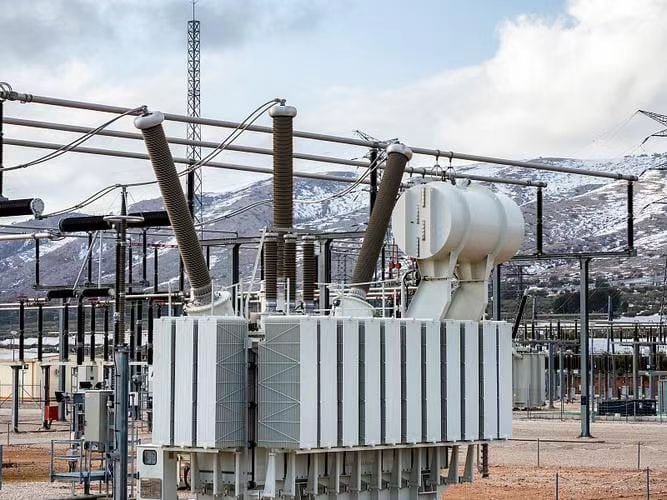
Noise and vibration are unavoidable byproducts of power transformer operation, but their magnitude depends greatly on the quality of the transformer's design and manufacturing. Excessive acoustic emissions can create environmental concerns, increase mechanical stress, reduce equipment reliability, and lead to higher maintenance costs. Modern transformer manufacturers therefore incorporate specialized engineering techniques to minimize both internally generated vibration and externally radiated noise. By optimizing the magnetic core, strengthening winding support systems, improving mechanical construction, selecting advanced materials, and applying precision manufacturing processes, manufacturers can significantly reduce transformer noise while extending service life and improving overall operational performance.
Manufacturers reduce transformer noise and vibration through optimized core design, premium magnetic materials, precision core assembly, reinforced winding support systems, rigid tank construction, vibration isolation, advanced cooling equipment, accurate manufacturing tolerances, and comprehensive factory testing. These design improvements minimize magnetostriction, reduce electromagnetic vibration, prevent structural resonance, and ensure long-term mechanical stability.
The only practical way to reduce transformer noise is to install external sound barriers after installation.False
Although sound barriers can reduce environmental noise, manufacturers primarily reduce transformer noise through optimized core design, improved winding construction, stronger mechanical structures, vibration isolation, and precision manufacturing during transformer production.
Why is noise reduction important in transformer design?
Modern transformers are frequently installed near:
- Residential communities
- Commercial buildings
- Hospitals
- Data centers
- Renewable energy facilities
- Industrial plants
Low-noise transformer designs provide several advantages:
- Improved environmental compliance
- Better workplace conditions
- Reduced structural vibration
- Longer mechanical life
- Lower maintenance requirements
Reducing vibration also decreases long-term mechanical fatigue within the transformer.
| Design Objective | Benefit |
|---|---|
| Lower acoustic emissions | Improved environmental performance |
| Reduced vibration | Higher mechanical reliability |
| Stable mechanical structure | Longer service life |
| Improved cooling efficiency | Better operating performance |
How does core design reduce transformer noise?
The transformer core is the primary source of normal operating noise because of magnetostriction.
Manufacturers reduce core vibration by optimizing:
- Magnetic flux distribution
- Core geometry
- Lamination assembly
- Mechanical clamping
These improvements reduce microscopic dimensional changes in the electrical steel and minimize vibration.
Why is high-quality electrical steel important?
Modern transformer cores use premium grain-oriented electrical steel with improved magnetic properties.
Advantages include:
- Lower magnetostriction
- Lower core losses
- Higher efficiency
- Reduced vibration
Improved magnetic materials allow designers to reduce acoustic emissions without sacrificing electrical performance.
| Core Material Feature | Noise Reduction Benefit |
|---|---|
| Grain-oriented steel | Lower magnetostriction |
| Low-loss material | Reduced heat generation |
| Uniform magnetic properties | More stable operation |
How do step-lap core joints reduce humming?
Traditional core joints create localized magnetic disturbances.
Step-lap construction improves magnetic continuity by staggering the joints between laminations.
Benefits include:
- Smoother magnetic flux paths
- Lower magnetic stress
- Reduced vibration
- Lower audible noise
Step-lap technology is widely used in modern low-noise transformer designs.
Why is magnetic flux density carefully controlled?
Core noise increases as magnetic flux density increases.
Manufacturers optimize flux density to achieve:
- High efficiency
- Acceptable temperature rise
- Low acoustic emissions
- Reliable long-term operation
Operating below excessive magnetic saturation significantly reduces humming.
How does precision core assembly reduce vibration?
Core laminations must be assembled with extremely high accuracy.
Precision manufacturing minimizes:
- Lamination gaps
- Uneven compression
- Mechanical looseness
- Magnetic imbalance
Accurate assembly helps reduce vibration transmission throughout the transformer.
| Assembly Feature | Reliability Benefit |
|---|---|
| Precision stacking | Reduced vibration |
| Uniform compression | Stable magnetic performance |
| Accurate alignment | Lower structural stress |
How do winding designs reduce vibration?
Current flowing through transformer windings generates electromagnetic forces.
Manufacturers reduce winding vibration through:
- Optimized conductor arrangement
- Balanced electromagnetic design
- Reinforced support structures
- Strong clamping systems
Proper winding design prevents conductor movement during normal operation and fault conditions.
Why are reinforced clamping systems important?
Mechanical clamping maintains winding stability throughout the transformer's service life.
Well-designed clamping systems:
- Prevent coil movement
- Maintain insulation spacing
- Resist short-circuit forces
- Reduce vibration
Stable winding geometry improves both electrical reliability and acoustic performance.
How do insulation structures improve mechanical stability?
Transformer insulation provides more than electrical isolation.
Pressboard components also support the winding mechanically.
Important structural elements include:
- Pressboard cylinders
- Radial spacers
- Axial spacers
- End blocks
Together they:
- Maintain winding alignment
- Distribute mechanical forces
- Limit vibration
How does tank design reduce noise?
The transformer tank can amplify internal vibration if it is not sufficiently rigid.
Manufacturers reduce tank noise through:
- Reinforced panels
- Optimized wall thickness
- Improved structural stiffness
- Carefully positioned reinforcements
These features reduce panel resonance and sound radiation.
| Tank Design Feature | Noise Reduction Effect |
|---|---|
| Reinforced panels | Lower resonance |
| Increased stiffness | Reduced vibration |
| Optimized geometry | Improved structural stability |
How do vibration isolation systems help?
Manufacturers may include vibration isolation features to reduce mechanical transmission.
Common solutions include:
- Elastomeric mounting pads
- Flexible pipe connections
- Isolated cooling equipment
- Vibration-damping supports
These systems prevent vibration from spreading into surrounding structures.
How can cooling equipment be made quieter?
Cooling systems contribute additional sound through:
- Fans
- Oil pumps
- Air movement
Manufacturers reduce cooling noise by using:
- Low-noise fan blades
- Variable-speed fan controls
- High-efficiency motors
- Optimized airflow paths
These improvements lower operational sound while maintaining effective cooling performance.
Why are manufacturing tolerances important?
Small dimensional errors may significantly increase transformer vibration.
Precision manufacturing controls:
- Core dimensions
- Winding placement
- Clamping pressure
- Tank alignment
Strict quality control ensures every transformer performs as designed.
| Manufacturing Control | Benefit |
|---|---|
| Accurate machining | Better component fit |
| Controlled assembly | Lower vibration |
| Consistent tolerances | Stable operation |
How do computer simulations improve acoustic performance?
Modern transformer manufacturers use advanced engineering software during product development.
Simulation tools analyze:
- Magnetic flux distribution
- Mechanical stress
- Structural vibration
- Acoustic behavior
- Thermal performance
These analyses help engineers optimize the design before production begins.
How do manufacturers verify noise performance?
Reliable manufacturers perform factory acoustic testing before shipment.
Typical evaluations include:
- Sound pressure measurements
- Background noise correction
- Vibration measurements
- Cooling equipment testing
- Operating condition verification
Factory testing confirms compliance with project specifications and applicable standards.
| Factory Test | Purpose |
|---|---|
| Acoustic measurement | Verify sound level |
| Vibration measurement | Confirm mechanical stability |
| Temperature rise test | Validate cooling design |
| Functional testing | Verify overall performance |
How do condition monitoring systems support low-noise operation?
Although monitoring systems do not directly reduce noise, they detect changes that may indicate developing mechanical problems.
Useful monitoring technologies include:
- Vibration sensors
- Acoustic monitoring
- Temperature monitoring
- Online condition monitoring
These systems allow maintenance teams to identify:
- Loose components
- Mechanical deterioration
- Cooling equipment issues
- Structural changes
Early corrective action helps maintain low-noise operation throughout the transformer's lifetime.
What should buyers ask manufacturers?
Before purchasing a transformer, buyers should evaluate the manufacturer's noise reduction technologies.
| Question | Purpose |
|---|---|
| What guaranteed sound level is provided? | Compare transformer designs |
| Is step-lap core construction used? | Evaluate core quality |
| What electrical steel is selected? | Assess magnetic performance |
| How are windings mechanically supported? | Verify vibration resistance |
| What factory acoustic tests are performed? | Confirm compliance |
| Are vibration isolation options available? | Reduce installation noise |
Which standards guide transformer acoustic design?
Transformer acoustic performance is evaluated according to internationally recognized standards established by organizations including:
- International Electrotechnical Commission
- Institute of Electrical and Electronics Engineers
These standards provide guidance for:
- Noise measurement
- Test procedures
- Performance verification
- Acoustic evaluation
Compliance helps ensure predictable and consistent transformer noise performance.
How Can Operators Diagnose and Prevent Excessive Transformer Noise?
Power transformers normally produce a steady humming sound during operation, but excessive or changing noise often indicates abnormal mechanical, electrical, or environmental conditions. Ignoring these warning signs can allow minor issues to develop into serious failures involving winding displacement, insulation deterioration, loose components, or cooling system malfunctions. For utilities, industrial facilities, renewable energy plants, and commercial infrastructure, early diagnosis and preventive maintenance are essential for maintaining transformer reliability, reducing unplanned outages, and minimizing maintenance costs. By combining routine inspections, condition monitoring, vibration analysis, and proper maintenance practices, operators can identify abnormal noise sources before they affect transformer performance.
Operators can diagnose and prevent excessive transformer noise by establishing baseline sound levels, performing regular visual and mechanical inspections, monitoring vibration and temperature, analyzing operating conditions, inspecting cooling equipment, using online condition monitoring technologies, and correcting mechanical or electrical problems before they become major failures. Preventive maintenance and early fault detection significantly improve transformer reliability and service life.
If a power transformer continues operating normally, increasing noise levels can safely be ignored because they do not indicate developing faults.False
Although transformers normally produce a humming sound, increasing or abnormal noise may indicate loose components, winding movement, cooling equipment problems, structural resonance, or insulation-related issues that should be investigated promptly.
Why should operators investigate excessive transformer noise?
A stable humming sound is generally a normal characteristic of transformer operation.
However, changes in noise may indicate:
- Mechanical deterioration
- Loose components
- Cooling equipment problems
- Structural resonance
- Winding movement
- Overloading
- Abnormal operating voltage
Early investigation allows maintenance teams to correct problems before they lead to expensive failures.
| Noise Condition | Recommended Action |
|---|---|
| Stable humming | Continue routine monitoring |
| Gradually increasing noise | Schedule inspection |
| Sudden loud noise | Perform immediate investigation |
| Intermittent rattling | Inspect mechanical components |
What types of transformer noise are considered abnormal?
Operators should pay attention to sounds such as:
- Metallic rattling
- Sharp knocking
- Buzzing that changes with load
- Excessive fan noise
- Pump vibration
- Irregular humming
These sounds often indicate mechanical or electrical abnormalities rather than normal core magnetostriction.
Why is establishing a baseline important?
The first step in diagnosing transformer noise is understanding what is normal for a particular transformer.
A baseline should include:
- Normal sound level
- Typical vibration level
- Operating temperature
- Loading conditions
- Ambient conditions
Future inspections can then compare new measurements against this reference.
How can visual inspections help diagnose noise?
Routine visual inspections often identify external causes of excessive noise.
Operators should inspect:
- Tank condition
- Radiators
- Cooling fans
- Oil pumps
- Pipe supports
- Mounting bolts
- Foundation condition
Signs requiring attention include:
- Loose hardware
- Oil leakage
- Corrosion
- Damaged supports
- Excessive vibration
| Inspection Area | Possible Finding |
|---|---|
| Tank | Loose panels or deformation |
| Radiators | Vibration or loose connections |
| Cooling fans | Bearing wear |
| Foundation | Structural movement |
How does vibration monitoring improve diagnosis?
Vibration analysis is one of the most effective methods for identifying developing mechanical problems.
Modern vibration monitoring systems measure:
- Amplitude
- Frequency
- Direction
- Long-term trends
Abnormal vibration patterns may indicate:
- Loose core clamps
- Winding displacement
- Structural resonance
- Cooling equipment faults
Trend analysis is often more valuable than a single measurement.
Why should operating conditions be reviewed?
Transformer noise depends on operating conditions.
Operators should compare noise with:
- Loading
- Voltage
- Ambient temperature
- Cooling stage operation
Questions to consider include:
- Does noise increase only at high load?
- Does it change after cooling fans start?
- Is operating voltage within specifications?
Understanding these relationships helps isolate the source of the problem.
How do cooling systems affect transformer noise?
Cooling equipment is a common source of additional sound.
Operators should inspect:
- Fan blades
- Fan motors
- Oil pumps
- Bearings
- Mounting brackets
Typical cooling equipment problems include:
- Worn bearings
- Fan imbalance
- Loose guards
- Pump vibration
Routine maintenance often restores normal operating noise.
| Cooling Component | Common Problem |
|---|---|
| Cooling fan | Bearing wear |
| Oil pump | Mechanical vibration |
| Fan guard | Loose mounting |
| Radiator | Structural vibration |
How can temperature monitoring assist diagnosis?
Abnormal temperature often accompanies excessive vibration or mechanical problems.
Operators should monitor:
- Top oil temperature
- Winding temperature
- Ambient temperature
Unexpected temperature increases may indicate:
- Cooling system failure
- Overloading
- Internal mechanical problems
Temperature trends provide valuable information alongside acoustic observations.
How does dissolved gas analysis support fault diagnosis?
For oil-filled transformers, dissolved gas analysis (DGA) helps determine whether abnormal noise is associated with internal electrical problems.
Gas analysis may detect:
- Partial discharge
- Overheating
- Arcing
- Insulation degradation
If increasing noise is accompanied by abnormal gas generation, further investigation should be performed immediately.
How can acoustic monitoring improve maintenance?
Modern acoustic monitoring systems continuously record transformer sound.
These systems detect:
- Changes in sound patterns
- Frequency shifts
- Intermittent mechanical events
- Developing abnormalities
Acoustic monitoring supports predictive maintenance by identifying problems before visible damage occurs.
Why is structural inspection important?
Sometimes the transformer itself is operating normally, but surrounding structures amplify vibration.
Operators should inspect:
- Steel support frames
- Concrete foundations
- Cable trays
- Nearby equipment
- Pipe connections
Structural resonance may significantly increase perceived transformer noise without indicating an internal transformer fault.
How does preventive maintenance reduce transformer noise?
Routine maintenance prevents many common noise problems.
Recommended maintenance activities include:
- Tightening bolts
- Inspecting clamps
- Servicing cooling fans
- Lubricating bearings where applicable
- Cleaning cooling equipment
- Verifying vibration isolation devices
Preventive maintenance reduces:
- Mechanical looseness
- Wear
- Vibration
- Unexpected failures
| Maintenance Activity | Reliability Benefit |
|---|---|
| Bolt tightening | Prevents vibration |
| Cooling equipment inspection | Reduces fan noise |
| Structural inspection | Detects looseness |
| Cleaning radiators | Improves cooling efficiency |
How do online monitoring systems improve reliability?
Modern transformers increasingly use online monitoring systems that combine:
- Vibration monitoring
- Temperature monitoring
- Dissolved gas analysis
- Load monitoring
- Oil condition monitoring
Continuous monitoring allows operators to detect:
- Gradual deterioration
- Mechanical changes
- Abnormal operating conditions
- Developing faults
This supports condition-based maintenance rather than relying only on scheduled inspections.
What warning signs require immediate investigation?
Operators should respond promptly if they observe:
- Sudden increase in humming
- Loud metallic knocking
- Continuous rattling
- Rapid vibration changes
- Simultaneous overheating
- Oil leakage accompanied by abnormal sound
These symptoms may indicate significant mechanical or electrical problems that require immediate attention.
What records should operators maintain?
Accurate maintenance records improve long-term diagnosis.
Recommended records include:
- Noise measurements
- Vibration readings
- Temperature trends
- Oil analysis results
- Inspection reports
- Maintenance history
Trend analysis often reveals gradual deterioration that would otherwise go unnoticed.
| Operational Record | Purpose |
|---|---|
| Noise history | Identify changes over time |
| Vibration data | Detect mechanical deterioration |
| Temperature records | Monitor thermal performance |
| Maintenance logs | Support troubleshooting |
What should operators ask manufacturers?
When diagnosing excessive transformer noise, operators may consult the manufacturer regarding:
| Question | Purpose |
|---|---|
| What is the normal sound level? | Compare actual performance |
| Which vibration levels are acceptable? | Assess operating condition |
| What inspections are recommended? | Improve maintenance planning |
| Which monitoring systems are available? | Enhance fault detection |
| What replacement parts are recommended? | Maintain reliability |
| Are acoustic upgrades available? | Reduce operational noise |
Which standards support transformer noise evaluation?
Transformer acoustic performance and condition assessment are guided by internationally recognized standards published by organizations such as:
- International Electrotechnical Commission
- Institute of Electrical and Electronics Engineers
These standards provide guidance for:
- Acoustic measurement
- Vibration evaluation
- Testing procedures
- Maintenance recommendations
- Operational assessment
Conclusion
Noise and vibration are normal characteristics of power transformer operation, but excessive levels often indicate mechanical, electrical, or installation-related issues that require attention. Factors such as core magnetostriction, winding movement, cooling equipment, loose components, harmonics, and structural resonance can all contribute to abnormal transformer noise. By selecting transformers with optimized core designs, reinforced winding structures, effective vibration isolation, and high manufacturing standards, buyers can minimize noise emissions while improving reliability and service life. Regular inspections and condition monitoring further help detect developing problems early, ensuring safe, efficient, and dependable transformer operation over the long term.
FAQ
Q1: What causes noise and vibration issues in power transformers?
Noise and vibration in power transformers are normal to some extent, but excessive levels may indicate mechanical or electrical problems. The primary sources of transformer noise include magnetic forces within the core, electromagnetic forces acting on the windings, cooling equipment, and structural vibrations.
Common causes include:
Core magnetostriction
Electromagnetic forces in windings
Loose core or winding components
Cooling fans and oil pumps
Harmonic distortion
Mechanical resonance
Aging or damaged components
Improper installation or foundation issues
Understanding these sources helps operators distinguish between normal operating noise and conditions that require maintenance.
Q2: What is magnetostriction, and why does it cause transformer humming?
Magnetostriction is the primary cause of the characteristic humming sound produced by power transformers. As alternating current flows through the windings, the magnetic flux in the transformer core changes direction continuously, causing the core laminations to expand and contract slightly.
This repeated microscopic movement creates vibration at approximately twice the supply frequency:
100 Hz in 50 Hz systems
120 Hz in 60 Hz systems
Although this humming is normal, excessive noise may indicate poor core clamping, damaged laminations, or abnormal operating conditions.
Q3: How do electromagnetic forces create transformer vibration?
When current flows through the transformer windings, strong electromagnetic forces are generated.
These forces can cause:
Winding vibration
Mechanical stress on conductors
Insulation movement
Structural fatigue over time
During external short circuits or heavy overloads, these forces increase significantly. A well-designed transformer uses rigid winding supports and strong clamping systems to minimize movement and prevent long-term damage.
Q4: Can cooling equipment contribute to transformer noise?
Yes. Auxiliary cooling equipment can produce noticeable noise during operation.
Typical sources include:
Cooling fans
Oil circulation pumps
Radiator airflow
Water pumps (for OFWF systems)
While these components are essential for temperature control, worn bearings, loose mounting hardware, or mechanical imbalance can increase vibration and sound levels. Regular maintenance helps keep cooling systems operating quietly and efficiently.
Q5: How do loose components and poor installation increase vibration?
Mechanical looseness can amplify transformer vibration and noise.
Potential causes include:
Loose core clamping bolts
Worn mounting brackets
Loose winding supports
Vibrating radiators
Improper foundation design
Insufficient anchor bolts
Structural resonance between the transformer and supporting platform
Proper installation, alignment, and periodic torque checks help minimize mechanically induced vibration.
Q6: How do harmonics affect transformer noise?
Electrical harmonics generated by nonlinear loads—such as variable frequency drives (VFDs), data centers, solar inverters, and industrial power electronics—can increase transformer noise and vibration.
Harmonics may cause:
Higher magnetic flux distortion
Increased core losses
Additional winding heating
Audible buzzing or high-frequency noise
Increased mechanical stress
Using harmonic filters, K-rated transformers where appropriate, and maintaining good power quality can reduce these effects.
Q7: How can transformer noise and vibration be reduced?
Several engineering and maintenance practices can help reduce transformer noise:
Use high-quality grain-oriented silicon steel cores
Improve core clamping and winding support
Install vibration-isolating pads or mounts
Tighten loose structural components
Maintain cooling fans and oil pumps
Reduce harmonic distortion with filters
Ensure a rigid and level foundation
Monitor vibration levels through condition monitoring systems
Modern transformer manufacturers also use optimized core designs and precision manufacturing techniques to minimize operating noise.
Q8: When do noise and vibration indicate a serious transformer problem?
Although some humming is normal, sudden or excessive increases in noise or vibration should be investigated immediately.
Warning signs include:
Rapid increase in humming intensity
Metallic knocking or rattling sounds
Excessive vibration of the tank or radiators
Noise accompanied by overheating
Increased oil or winding temperatures
Abnormal Dissolved Gas Analysis (DGA) results
Visible movement of external components
Activation of protective relays
If these symptoms occur, operators should perform a detailed inspection, vibration analysis, electrical testing, and condition monitoring to identify the root cause before serious damage develops.
References
IEC 60076 – Power Transformers
https://webstore.iec.ch/publication/602
IEC 60076-10 – Determination of Sound Levels for Power Transformers
https://webstore.iec.ch
IEEE C57 Series – Power Transformer Standards
https://standards.ieee.org
IEEE C57.12.90 – Standard Test Code for Liquid-Immersed Transformers
https://standards.ieee.org
Electrical Engineering Portal – Causes of Transformer Noise and Vibration
https://electrical-engineering-portal.com