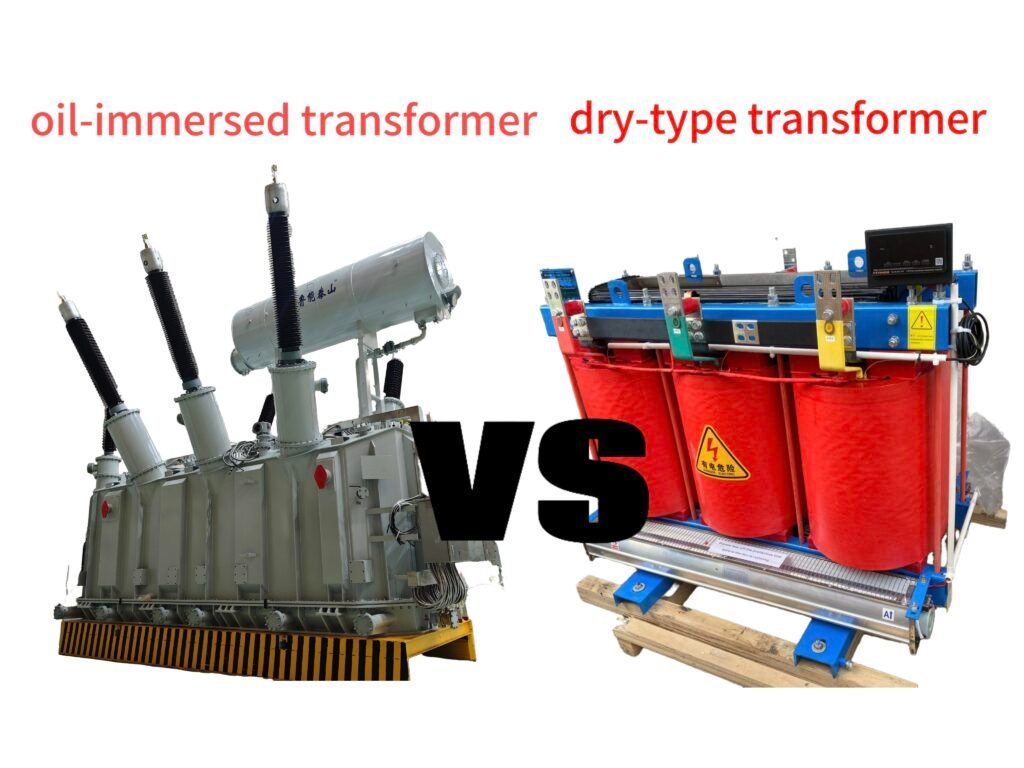
Choosing between oil-immersed and dry-type transformers can significantly affect installation safety, maintenance requirements, efficiency, operating costs, and long-term reliability. Selecting the wrong design may create unnecessary fire-protection requirements, space limitations, maintenance burdens, or higher lifecycle costs. Because each transformer type has distinct electrical, thermal, and environmental characteristics, buyers should compare them according to the actual application rather than relying on purchase price alone.
Oil-immersed transformers use insulating liquid for insulation and cooling and generally offer strong thermal performance, high capacity, and suitability for many utility and outdoor applications, but they require consideration of oil leakage, fire protection, and fluid maintenance. Dry-type transformers use solid insulation and air-based cooling, offering advantages such as reduced liquid-related fire and environmental risks and suitability for many indoor applications, but they may have different limitations regarding capacity, cooling, space, noise, and cost. The best choice depends on voltage, capacity, installation environment, safety requirements, load profile, maintenance strategy, and lifecycle cost.
Both technologies are well established, but their advantages are optimized for different operating conditions. A structured comparison of technical performance, safety, installation, maintenance, and total ownership costs helps buyers select the appropriate transformer for their project.
What Are the Pros and Cons of Oil-Immersed vs. Dry-Type Transformers?
Choosing between an oil-immersed transformer and a dry-type transformer affects safety, installation, maintenance, efficiency, cost, and long-term reliability. Selecting the wrong design can create unnecessary fire-protection measures, maintenance work, space requirements, or lifecycle expense. Oil-immersed transformers generally offer strong thermal performance, high efficiency, and good suitability for outdoor and high-capacity applications, while dry-type transformers eliminate insulating liquid and can provide advantages for indoor installations, fire-sensitive locations, and applications where oil containment is undesirable. The right choice depends on voltage, capacity, environment, fire requirements, load profile, installation space, maintenance strategy, and total lifecycle cost.

Dry-type transformers are always safer and more reliable than oil-immersed transformers.False
Dry-type transformers eliminate insulating liquid and can reduce certain fire and leakage concerns, but safety and reliability depend on design, installation, cooling, insulation, loading, maintenance and environmental conditions.
What Is the Main Difference?
The fundamental distinction is the insulation and cooling medium.
An oil-immersed transformer uses insulating liquid around the core and windings. The liquid provides electrical insulation and transfers heat from the active parts to the cooling system.
A dry-type transformer uses solid insulation and air as the primary cooling medium. Common designs include cast-resin and other ventilated dry-type constructions.
| Factor | Oil-Immersed Transformer | Dry-Type Transformer |
|---|---|---|
| Insulating medium | Transformer oil or other insulating liquid | Solid insulation + air |
| Liquid leakage | Possible | None |
| Fire concern | Requires liquid/fire-risk assessment | Generally lower liquid-related fire risk |
| Typical installation | Outdoor, substations, utility systems | Indoor, commercial, industrial |
| Cooling capability | Strong | More dependent on ventilation |
| Large-capacity suitability | Excellent | More application-dependent |
| Maintenance | Oil and accessories require attention | No oil maintenance |
| Environmental considerations | Liquid management required | No insulating-liquid handling |
| Installation footprint | Often efficient for high ratings | Can require suitable ventilation/clearance |
| Initial cost | Often competitive at larger ratings | Can be competitive for suitable indoor applications |
What Are the Advantages of Oil-Immersed Transformers?
1. Strong Thermal Performance
Insulating liquid provides an efficient path for transferring heat away from windings and the core.
This is particularly useful for:
- Large transformers
- High-voltage systems
- Utility substations
- Outdoor installations
- Heavily loaded transformers
The thermal design can incorporate radiators, fans, pumps, or other cooling arrangements depending on the transformer rating.
Although transformer thermal behavior is more complex than a simple energy model, the fundamental principle is that electrical losses become heat that must be transferred to the surrounding environment.
2. Good Suitability for High Capacity
Oil-immersed construction is widely suited to large power-transformer applications because liquid cooling can efficiently manage heat from substantial active-part losses.
As capacity and voltage increase, thermal management becomes increasingly important.
3. Efficient Use of Space
For many large outdoor applications, oil-immersed transformers provide a practical combination of:
- High capacity
- Effective cooling
- High-voltage insulation
- Compact active-part design
The complete installation still requires appropriate clearances and safety infrastructure, but the transformer itself can be highly space-efficient for its rating.
4. Strong Outdoor Suitability
Oil-immersed transformers are commonly selected for outdoor substations because the enclosure and cooling arrangement can be designed for demanding environmental conditions.
They can be engineered for:
- Rain
- Dust
- Temperature variation
- Outdoor UV exposure
- High humidity
- High-altitude conditions
The specific environmental design must still be defined in the purchase specification.
What Are the Disadvantages of Oil-Immersed Transformers?
1. Insulating-Liquid Management
Oil introduces additional requirements for:
- Oil quality control
- Sampling
- Leak inspection
- Moisture management
- Oil processing
- Disposal or recycling
- Fire protection
For large installations, containment and environmental protection can also become significant project considerations.
2. Fire Risk Must Be Addressed
Mineral insulating oil is combustible.
This does not mean that every oil-filled transformer installation is inherently unsafe. Proper engineering can manage the risk through suitable:
- Transformer location
- Fire separation
- Oil containment
- Protection systems
- Fire detection
- Emergency procedures
However, these requirements can increase installation complexity and cost.
3. Leakage Risk
Although properly designed tanks and seals provide reliable containment, liquid leakage remains a potential maintenance and environmental issue.
Buyers should therefore consider:
- Tank construction
- Gaskets
- Valves
- Bushings
- Conservator system
- Pressure-relief equipment
- Leak detection
What Are the Advantages of Dry-Type Transformers?
1. No Insulating-Liquid Leakage
Dry-type transformers eliminate oil leakage because there is no insulating liquid.
This can simplify installations where liquid containment is undesirable.
Potentially useful locations include:
- Commercial buildings
- Hospitals
- High-rise buildings
- Underground facilities
- Data centers
- Industrial buildings
- Transportation facilities
2. Lower Liquid-Related Fire Risk
Because there is no transformer oil, dry-type transformers remove the specific fire and spill risks associated with oil-filled construction.
This can be particularly valuable where equipment is installed close to occupied spaces.
However, dry-type does not mean zero fire risk. Electrical faults, overheating, cables and surrounding materials can still create hazards.
3. Simplified Routine Maintenance
There is no insulating oil to sample, filter, regenerate or replace.
Maintenance can instead focus on:
- Visual inspection
- Cleaning
- Electrical connections
- Ventilation
- Temperature monitoring
- Insulation condition
- Fans where installed
This can reduce certain recurring maintenance activities.
4. Attractive for Indoor Applications
Dry-type transformers can be installed inside electrical rooms without the oil-containment infrastructure required by many oil-filled installations.
This can simplify building integration.
What Are the Disadvantages of Dry-Type Transformers?
1. Cooling Is More Dependent on Air Movement
Air has lower heat-transfer capability than transformer liquid.
Therefore, dry-type transformers require careful attention to:
- Ventilation
- Room temperature
- Airflow
- Installation clearances
- Dust accumulation
- Cooling fans where applicable
An inadequately ventilated electrical room can reduce transformer performance or accelerate insulation aging.
2. Large Ratings Can Become More Challenging
Dry-type transformers can certainly be manufactured for substantial capacities, but the economics, physical dimensions and cooling requirements become increasingly important as ratings increase.
For large utility-scale power applications, oil-immersed designs are often more practical.
3. Environmental Contamination Can Matter
Dry-type transformers eliminate oil contamination but are not immune to environmental problems.
Dust, moisture, corrosive atmospheres and conductive contamination can affect solid insulation and cooling surfaces.
Regular cleaning and appropriate enclosure or environmental protection may therefore be necessary.
How Do the Two Designs Compare for Fire Safety?
| Fire/Safety Factor | Oil-Immersed | Dry-Type |
|---|---|---|
| Combustible insulating liquid | Present depending on liquid type | None |
| Oil leakage | Possible | None |
| Oil containment | May be required | Not applicable |
| Liquid-related fire protection | Must be evaluated | Reduced |
| Electrical fault risk | Still present | Still present |
| Ventilation requirement | Cooling-dependent | Often especially important |
| Indoor occupied areas | Requires careful fire engineering | Often advantageous |
The buyer should evaluate actual site conditions rather than assuming one design is automatically acceptable.
Which Transformer Is Easier to Maintain?
There is no universal winner.
Dry-type transformers eliminate liquid-related maintenance, but they may require careful cleaning and ventilation management.
Oil-immersed transformers require additional attention to:
- Oil condition
- Moisture
- Leaks
- Cooling equipment
- Tap changers
- Bushings
- Protective devices
For critical oil-filled transformers, dissolved-gas analysis and other condition-monitoring methods can provide valuable diagnostic information.
Thus, maintenance should be evaluated based on the complete transformer system, not only the main tank.
Which Transformer Has the Lower Lifecycle Cost?
The answer depends on the application.
Oil-immersed transformers may have an advantage when:
- Capacity is high
- Loading is substantial
- Outdoor installation is available
- Efficient thermal management is important
- Oil-related infrastructure is already available
Dry-type transformers may be economically attractive when:
- The transformer is indoors
- Fire protection is highly restrictive
- Oil containment would be expensive
- Liquid maintenance is undesirable
- Building integration is important
Buyers should compare:
Purchase price + installation + fire protection + ventilation + maintenance + losses + monitoring + expected service life
rather than comparing transformer prices alone.
How Should Buyers Select Between Them?
A practical decision matrix can help.
| Application Requirement | Preferred Direction |
|---|---|
| Large outdoor substation | Oil-immersed often advantageous |
| Indoor commercial building | Dry-type often attractive |
| Very high capacity | Oil-immersed often practical |
| Strict liquid-spill restrictions | Dry-type |
| Limited ventilation capability | Oil-immersed may be easier |
| Occupied indoor area | Dry-type often attractive |
| Existing oil infrastructure | Oil-immersed |
| Minimal oil maintenance | Dry-type |
| High thermal loading | Oil-immersed often advantageous |
| Highly fire-sensitive location | Dry-type often worth considering |
These are starting points, not universal rules.
What Should Buyers Check Before Making the Final Decision?
Before requesting final quotations, define:
- Rated MVA
- Primary and secondary voltage
- Frequency
- Vector group
- Impedance
- Load profile
- Ambient temperature
- Altitude
- Indoor/outdoor location
- Fire requirements
- Ventilation conditions
- Noise limits
- Maintenance strategy
- Monitoring requirements
- Applicable standards
- Expected service life
- Total lifecycle cost
The transformer type should then be selected based on the complete application.
Oil-immersed transformers are generally well suited to large outdoor and heavily loaded power applications, while dry-type transformers are often attractive for indoor and fire-sensitive installations.True
Liquid cooling can provide strong thermal performance for large power applications, while dry construction eliminates insulating-liquid leakage and reduces liquid-related fire concerns.
Buyer Takeaway
Oil-immersed transformers generally provide strong thermal performance, high-capacity capability and practical outdoor operation, but require insulating-liquid management and appropriate fire and environmental controls. Dry-type transformers eliminate insulating-liquid leakage, can simplify indoor installation and reduce liquid-related fire concerns, but require careful ventilation, thermal management and environmental cleanliness.
The best selection process is:
Application requirements → capacity and load profile → site environment → fire and safety requirements → cooling → maintenance → lifecycle cost → transformer type
Neither technology is universally superior. The right choice is the one that provides the required electrical performance, safety, reliability and lifecycle economics for the specific installation.
How Do Oil-Immersed and Dry-Type Transformers Compare in Electrical and Thermal Performance?
Choosing between oil-immersed and dry-type transformers based only on fire safety or purchase price can overlook the characteristics that directly determine transformer performance. The insulation system, cooling medium, winding temperature, losses, voltage regulation, overload behavior, and installation environment all influence how efficiently and reliably a transformer operates. Oil-immersed and dry-type transformers can both provide excellent electrical performance when properly designed, but oil-immersed transformers generally have greater thermal-transfer capability and are often advantageous for high-capacity, heavily loaded applications, while dry-type transformers can deliver strong electrical performance with simpler liquid-free construction but require more careful attention to airflow, ambient temperature, and insulation temperature.

Oil-immersed transformers always have better electrical performance than dry-type transformers.False
Both transformer types can provide excellent electrical performance when appropriately designed; the application, insulation system, winding design, voltage level, impedance, losses and operating conditions determine actual performance.
What Determines Transformer Electrical Performance?
The transformer type itself does not determine all electrical characteristics. Buyers should compare the actual guaranteed parameters.
Important parameters include:
- Rated capacity
- Voltage ratio
- Frequency
- Impedance
- No-load current
- No-load loss
- Load loss
- Voltage regulation
- Insulation level
- Partial-discharge performance where applicable
- Short-circuit withstand capability
- Temperature rise
For quotation evaluation, these values should be compared at identical operating conditions.
| Performance Factor | Oil-Immersed | Dry-Type |
|---|---|---|
| Voltage transformation | Excellent | Excellent |
| Typical efficiency | Very high | Very high |
| Insulation medium | Liquid + solid | Solid + air |
| Heat transfer | Strong | Air-dependent |
| High-capacity suitability | Excellent | Application-dependent |
| Overload thermal margin | Often strong | More temperature-sensitive |
| Indoor installation | Possible with proper design | Often advantageous |
| Outdoor installation | Very common | Possible with suitable enclosure |
| Oil-related maintenance | Required | None |
| Ventilation sensitivity | Moderate to high depending on design | Often high |
How Does the Insulation System Affect Electrical Performance?
Oil-immersed transformers use a combined liquid-solid insulation system.
The liquid surrounds the active parts and contributes both dielectric insulation and heat transfer.
Dry-type transformers rely primarily on solid insulation, commonly using cast-resin or other solid insulation arrangements.
The electrical design must withstand:
- Normal operating voltage
- Temporary overvoltage
- Switching events
- Lightning impulses
- Internal electrical stress
- Thermal stress
- Mechanical forces during faults
A properly engineered dry-type transformer can therefore provide strong dielectric performance without using insulating liquid.
How Does Impedance Affect Both Types?
Transformer impedance affects voltage regulation and fault current.
A higher impedance generally produces greater voltage drop under load but can limit short-circuit current.
A lower impedance can improve voltage regulation but may increase fault-current contribution.
For this reason, buyers should not compare transformer quotations merely by efficiency. The specified impedance must also be compatible with the electrical system.
Which Type Generally Has Better Thermal Performance?
Oil-immersed transformers generally have an advantage in heat transfer.
The insulating liquid can circulate naturally or through forced circulation, transferring heat from the core and windings to radiators or heat exchangers.
Dry-type transformers transfer heat through air.
Air cooling can be highly effective when the installation provides adequate:
- Ventilation
- Airflow
- Room volume
- Clearance
- Temperature control
However, the thermal path is generally less efficient than liquid cooling for very high heat loads.
In both designs, electrical losses ultimately become heat. The practical difference is how efficiently that heat moves from the active components to the surrounding environment.
Why Is Temperature Rise Important?
Temperature rise is one of the most important indicators of transformer thermal design.
The buyer should compare:
- Winding temperature rise
- Top-liquid temperature rise for liquid-filled designs
- Hot-spot temperature
- Ambient-temperature assumptions
- Cooling-stage assumptions
A transformer operating at excessive temperature can experience accelerated insulation aging.
Therefore, thermal performance directly affects expected service life.
How Do Oil and Air Transfer Heat Differently?
Oil can contact a large portion of the active insulation and winding structure, allowing heat to move away from internal components.
The basic heat-transfer path can be represented as:
Winding/core → insulating medium → cooling surface → surrounding environment
For oil-immersed transformers, the insulating liquid participates directly in this process.
For dry-type transformers, heat must ultimately move through solid insulation and surrounding air, making room ventilation and airflow especially important.
This distinction becomes more significant as transformer capacity and losses increase.
How Do the Two Types Handle High Loading?
Oil-immersed designs are often advantageous for high continuous loading because their cooling systems can be engineered to remove substantial heat.
Dry-type transformers can also operate reliably at high loading, but the installation must provide appropriate thermal conditions.
Buyers should therefore compare:
- Continuous loading
- Peak loading
- Load duration
- Ambient temperature
- Overload requirements
- Cooling-stage capacity
A dry-type transformer installed in a poorly ventilated room can experience a very different thermal condition from the same transformer installed in a properly designed electrical room.
How Does Ambient Temperature Affect Performance?
Ambient temperature directly affects available thermal margin.
For both transformer types, buyers should provide:
- Maximum ambient temperature
- Minimum ambient temperature
- Daily temperature variation
- Installation altitude
- Indoor/outdoor conditions
- Ventilation conditions
For dry-type transformers, room temperature and ventilation are especially important.
For oil-immersed transformers, external temperature also affects cooling-system performance, but liquid circulation and radiators can provide an effective thermal path.
What About Transformer Efficiency?
Both designs can achieve high efficiency.
Efficiency should not be generalized simply as:
Oil = efficient
or
Dry = inefficient
Instead, compare guaranteed losses.
The buyer should request:
- No-load loss
- Load loss
- Total loss at defined load
- Loss tolerances
- Test conditions
For an application with many operating hours at low load, no-load loss can be particularly important.
For a heavily loaded transformer, load loss can become a much larger component of energy consumption.
How Do Cooling Systems Differ?
Oil-immersed transformers can use several cooling arrangements depending on their design and rating.
These may involve:
- Natural oil circulation
- Forced air
- Forced oil circulation
- Radiators
- Fans
- Pumps
- Heat exchangers
Dry-type transformers generally rely on:
- Natural air circulation
- Forced-air cooling
- Fans
- Ventilated enclosures
The buyer should compare the rated capacity at each cooling stage, rather than simply comparing the names of cooling systems.
How Does Cooling Failure Affect Each Type?
Cooling-system redundancy can be important for critical transformers.
For example, buyers should ask:
- How many fans are installed?
- Is there standby capacity?
- What happens if a fan fails?
- Is there an alarm?
- Does the transformer automatically reduce allowable loading?
- Can the transformer continue operating safely under partial cooling failure?
This is especially important where transformer availability is critical.
How Do Overloads Affect Thermal Stress?
Transformer overload is fundamentally a thermal problem.
As load current increases, winding losses increase significantly.
Higher winding temperature can accelerate insulation aging.
Therefore, buyers should distinguish between:
- Short-duration emergency overload
- Regular peak loading
- Continuous overload
An application with frequent overloads may favor a transformer design with stronger thermal margins.
How Does Dry-Type Insulation Handle Heat?
Dry-type transformers depend heavily on solid insulation materials.
Common systems may include cast-resin insulation and other engineered solid insulation arrangements.
These systems must withstand:
- Electrical stress
- Thermal cycling
- Moisture
- Mechanical vibration
- Partial-discharge stress
A properly manufactured dry-type transformer can provide excellent reliability, but manufacturing quality is particularly important because defects in solid insulation can be difficult to repair after manufacture.
How Does Oil Help With Insulation and Cooling at the Same Time?
One important advantage of oil-immersed construction is that the insulating liquid performs two functions simultaneously:
- Electrical insulation
- Heat transfer
This integrated function is particularly valuable in high-voltage and high-capacity transformers.
The liquid also allows the transformer to use sophisticated monitoring techniques, such as dissolved-gas analysis, to identify certain developing internal faults.
Does Dry-Type Mean Lower Electrical Reliability?
No.
Dry-type transformers can be highly reliable when:
- Properly designed
- Correctly sized
- Properly ventilated
- Protected from contamination
- Operated within temperature limits
- Maintained correctly
Reliability problems can arise if buyers ignore environmental conditions or overload requirements.
For example, dust accumulation can reduce heat dissipation, while moisture and contamination can affect insulation performance.
How Should Buyers Compare Thermal Performance in Quotations?
Ask each supplier to provide the same information.
| Thermal Parameter | Supplier A | Supplier B | Supplier C |
|---|---|---|---|
| Rated MVA | — | — | — |
| Ambient reference | — | — | — |
| Winding rise | — | — | — |
| Hot-spot data | — | — | — |
| Cooling arrangement | — | — | — |
| Cooling-stage rating | — | — | — |
| Overload capability | — | — | — |
| Fan redundancy | — | — | — |
| Room ventilation requirement | — | — | — |
| Altitude correction | — | — | — |
This creates a much more useful comparison than comparing cooling labels alone.
How Should Buyers Evaluate Electrical Performance?
Use a similar technical matrix.
| Electrical Parameter | What to Verify |
|---|---|
| Voltage ratio | Rated and system voltage |
| MVA | Continuous rating |
| Impedance | Guaranteed value and tolerance |
| No-load loss | Guaranteed maximum |
| Load loss | Guaranteed maximum |
| No-load current | Guaranteed value |
| Insulation level | Required withstand |
| Vector group | System compatibility |
| Short-circuit withstand | Mechanical capability |
| Partial discharge | Applicable requirement |
| Tap range | Voltage regulation |
Buyers should compare guaranteed electrical and thermal parameters under identical conditions when evaluating oil-immersed and dry-type transformers.True
Different test conditions, ambient temperatures, cooling stages or loading assumptions can make nominal performance figures misleading when quotations are compared directly.
Which Transformer Should Buyers Choose?
There is no universal answer.
Oil-immersed transformers are often preferable when:
- Capacity is high
- Continuous loading is substantial
- Strong thermal performance is required
- Outdoor installation is available
- High-voltage utility service is involved
- Oil-based condition monitoring is valuable
Dry-type transformers are often preferable when:
- Indoor installation is required
- Liquid-free construction is desirable
- Fire-sensitive environments are involved
- Oil containment is undesirable
- Maintenance access favors a liquid-free design
- Proper ventilation can be provided
The final decision should consider the entire electrical and thermal operating environment.
Buyer Takeaway
Oil-immersed transformers generally offer strong thermal-transfer capability and are particularly practical for high-capacity, heavily loaded and outdoor applications. Dry-type transformers can provide excellent electrical performance and reliable operation while eliminating insulating liquid, but their thermal performance depends more strongly on ventilation, ambient temperature and installation conditions.
When comparing quotations, buyers should focus on:
Guaranteed losses → impedance → insulation → temperature rise → hot-spot performance → cooling capacity → overload capability → ambient conditions → lifecycle cost
The best transformer is not simply the one with the better cooling label. It is the design that maintains acceptable electrical performance, temperature, efficiency and insulation life under the actual operating conditions of the project.
How Do Oil-Immersed and Dry-Type Transformers Compare in Fire Safety and Environmental Risk?
Transformer selection becomes more complicated when equipment is installed near occupied buildings, production areas, tunnels, data centers, hospitals, or environmentally sensitive locations. An oil-immersed transformer can provide excellent electrical and thermal performance, but its insulating liquid introduces additional fire, leakage, containment, and fluid-management considerations. A dry-type transformer eliminates insulating liquid, which can simplify some safety and environmental requirements, but it does not eliminate electrical fire hazards or environmental risks altogether. Oil-immersed and dry-type transformers should therefore be compared according to the actual insulating medium, fire characteristics, installation environment, spill consequences, ventilation, protection systems, and applicable project requirements rather than assuming that one technology is universally safer.

Dry-type transformers cannot catch fire because they contain no insulating oil.False
Dry-type transformers eliminate liquid-related fire hazards, but electrical faults, overheating, insulation failure and surrounding combustible materials can still create fire risks.
What Creates the Main Fire-Safety Difference?
The fundamental difference is the presence or absence of insulating liquid.
Oil-immersed transformers use insulating liquid for both dielectric insulation and heat transfer. Depending on the liquid type and installation, the fluid can contribute to the fire load and may require additional containment and protection measures.
Dry-type transformers use solid insulation and air cooling. There is no transformer oil that can leak or contribute liquid fuel to a fire.
| Risk Factor | Oil-Immersed Transformer | Dry-Type Transformer |
|---|---|---|
| Insulating liquid | Present | None |
| Liquid leakage | Possible | None |
| Liquid-related fire load | Must be assessed | Eliminated |
| Oil containment | May be required | Not required for transformer liquid |
| Electrical fault fire risk | Present | Present |
| Overheating risk | Present | Present |
| Fire detection | Application-dependent | Application-dependent |
| Ventilation | Cooling-dependent | Often particularly important |
| Spill management | Required where applicable | Not applicable |
| Indoor occupied areas | Requires careful assessment | Often advantageous |
The absence of oil provides a clear advantage for certain installations, but it does not make a dry-type transformer inherently immune to fire.
What Are the Fire-Safety Advantages of Oil-Immersed Transformers?
Oil-filled construction is not automatically unsafe. It is widely used because the transformer can be engineered with comprehensive protection.
Depending on the project, protection may include:
- Appropriate transformer separation
- Fire-resistant barriers
- Oil containment
- Drainage systems
- Fire detection
- Pressure-relief protection
- Electrical protection
- Emergency procedures
The design should account for the transformer's liquid quantity, location, building arrangement, surrounding equipment and applicable safety requirements.
For outdoor substations, these measures can often be integrated into the overall site design.
Why Does Transformer Oil Matter?
Transformer oil can create two separate concerns:
Fire risk
The insulating liquid can contribute to the fire load depending on its composition and operating conditions.
Environmental risk
A leak can contaminate soil, drainage systems or water if containment is inadequate.
Therefore, oil-filled transformers require more attention to:
- Tank integrity
- Seals and gaskets
- Valves
- Oil-level monitoring
- Pressure equipment
- Containment
- Spill response
- Oil sampling
- Fluid disposal or recycling
What Are the Fire-Safety Advantages of Dry-Type Transformers?
The largest advantage is straightforward:
There is no transformer oil to leak or burn.
This can make dry-type transformers attractive for:
- Hospitals
- Commercial buildings
- High-rise buildings
- Underground facilities
- Data centers
- Transportation infrastructure
- Industrial buildings
- Areas with strict fire-control requirements
Removing liquid can simplify some aspects of site planning.
However, the electrical system still requires appropriate protection.
Can Dry-Type Transformers Overheat?
Yes.
A dry-type transformer can experience excessive temperature if:
- Room ventilation is inadequate
- Airflow is restricted
- Ambient temperature is too high
- Cooling fans fail
- Dust blocks cooling surfaces
- The transformer is overloaded
Thermal protection therefore remains important.
Removing transformer oil eliminates the need for all transformer fire protection.False
Dry-type transformers remove liquid-related fire and spill hazards, but electrical faults, overheating, insulation failure and nearby combustible materials still require appropriate protection.
How Does Ventilation Affect Fire and Environmental Risk?
Ventilation is particularly important for dry-type transformers because heat must be transferred through air.
The installation should consider:
- Room size
- Air inlet and outlet
- Natural ventilation
- Forced ventilation
- Fan redundancy
- Ambient temperature
- Dust
- Humidity
- Emergency ventilation requirements
Poor ventilation can cause overheating, which increases insulation stress and potentially contributes to equipment failure.
Thus, dry-type construction transfers some design emphasis from liquid containment toward thermal and ventilation management.
What Environmental Risks Are Associated With Oil-Immersed Transformers?
The principal additional environmental concern is insulating-liquid release.
Possible causes include:
- Tank damage
- Seal deterioration
- Valve leakage
- Bushing failure
- Transportation damage
- Mechanical impact
- Overpressure events
- Maintenance errors
The consequences depend strongly on site conditions.
A transformer located above an impermeable containment system presents a different environmental risk from one installed directly above sensitive soil or near surface water.
How Does Oil Containment Reduce Environmental Risk?
Containment creates a controlled pathway for leaked liquid.
A site may use measures such as:
- Bunded areas
- Containment pits
- Drainage controls
- Oil-water separation
- Emergency collection systems
- Spill-response equipment
The appropriate arrangement depends on local requirements and project design.
The buyer should clarify whether these costs are included in the transformer project budget or belong to the civil and electrical installation scope.
Are All Insulating Liquids Equally Risky?
No.
"Oil-filled" is not sufficiently precise for a complete safety comparison.
The buyer should identify the actual insulating liquid and obtain its relevant safety and environmental characteristics.
Depending on the fluid, important properties can include:
- Fire point
- Flash point
- Biodegradability
- Toxicity profile
- Environmental persistence
- Spill behavior
- Disposal requirements
Therefore, the insulating-fluid specification should be reviewed as part of the transformer quotation.
How Should Buyers Compare Fire Safety Costs?
The transformer price alone does not capture site fire-protection costs.
A practical comparison should include:
| Cost/Risk Item | Oil-Immersed | Dry-Type |
|---|---|---|
| Transformer liquid | Included | None |
| Oil containment | Potential additional cost | None |
| Spill protection | Potential | Minimal liquid-related requirement |
| Fire barriers | Application-dependent | Application-dependent |
| Fire detection | Application-dependent | Application-dependent |
| Ventilation | Cooling requirement | Often significant |
| Oil maintenance | Required | None |
| Spill response | Required where applicable | No liquid spill response |
| Cooling maintenance | Required | Required |
| Electrical protection | Required | Required |
The total installation cost should therefore be compared rather than the equipment price alone.
How Do Environmental Risks Affect Indoor Installation?
Indoor installations can make the distinction particularly important.
For an oil-immersed transformer, buyers should evaluate:
- Fire separation
- Oil containment
- Building drainage
- Emergency access
- Smoke/fire detection
- Ventilation
- Transformer room location
For a dry-type transformer, attention may shift toward:
- Room temperature
- Ventilation
- Dust control
- Humidity
- Clearance
- Fire-resistant enclosure where required
Dry-type construction can therefore simplify certain building-integrated applications.
What About Outdoor Substations?
Outdoor substations often provide more flexibility for oil-immersed transformers because the site can accommodate:
- Transformer separation
- Radiators
- Containment
- Fire barriers
- Drainage
- Access for maintenance
Oil-immersed designs are therefore frequently practical for utility and industrial outdoor applications.
However, environmental sensitivity must still be assessed.
How Should Buyers Evaluate Transformer Fire Protection?
Buyers should request a project-specific fire-safety review covering:
- Transformer location.
- Transformer liquid type and quantity.
- Separation distance.
- Fire barriers.
- Containment.
- Detection.
- Electrical protection.
- Emergency access.
- Ventilation.
- Applicable project requirements.
The manufacturer should clearly identify the transformer-related requirements while the site engineer should define the wider installation requirements.
How Do Environmental Risks Affect Maintenance?
Oil-immersed transformers require fluid-related maintenance.
This can include:
- Oil sampling
- Dissolved-gas analysis
- Moisture measurement
- Oil-quality testing
- Leak inspection
- Oil treatment where required
Dry-type transformers remove these tasks but introduce greater importance for:
- Cleaning
- Ventilation
- Temperature monitoring
- Fan inspection
- Solid-insulation condition
Neither technology is maintenance-free.
How Does Condition Monitoring Differ?
Oil-immersed transformers offer diagnostic information from the insulating liquid.
For example, dissolved-gas analysis can help identify certain developing internal faults.
Dry-type transformers do not provide an oil sample for this type of analysis. Instead, monitoring may focus on:
- Winding temperature
- Thermal behavior
- Partial discharge where applicable
- Insulation condition
- Fan operation
- Electrical parameters
The monitoring system should therefore match the transformer technology.
How Should Buyers Compare Overall Risk?
A useful risk matrix can combine probability and consequence.
| Risk | Oil-Immersed | Dry-Type |
|---|---|---|
| Electrical fault | Medium/High | Medium/High |
| Liquid leakage | Present | None |
| Liquid-related fire | Present depending on fluid | None |
| Overheating | Present | Present |
| Ventilation dependency | Moderate | Often higher |
| Environmental spill | Possible | None from transformer liquid |
| Insulation contamination | Oil/solid system | Solid/air system |
| Liquid maintenance | Required | None |
The actual ratings must be determined from the specific transformer design and site.
Which Type Is Better for Fire-Sensitive Locations?
Dry-type transformers are often attractive where the consequences of a liquid-related fire or spill are difficult to manage.
Examples include:
- Buildings with high occupancy
- Critical indoor infrastructure
- Underground electrical rooms
- Facilities with strict spill-control requirements
However, the buyer should still verify the applicable fire-performance requirements for the complete transformer assembly and installation.
Which Type Is Better for Environmentally Sensitive Sites?
Again, dry-type construction can provide an advantage because there is no transformer insulating liquid to release.
This may be particularly valuable near:
- Waterways
- Groundwater-sensitive locations
- Protected environmental areas
- Facilities with strict spill-control requirements
For oil-immersed designs, appropriate containment and fluid selection can significantly reduce environmental risk.
What Should Buyers Include in Their Quotation Evaluation?
A complete quotation comparison should include:
Transformer price + insulating fluid + fire protection + containment + ventilation + installation + monitoring + maintenance + environmental controls
Do not compare an oil-filled transformer and a dry-type transformer using only the factory equipment price.
The environmental and fire-safety comparison between oil-immersed and dry-type transformers should include site infrastructure as well as transformer construction.True
Containment, fire protection, ventilation, drainage, monitoring and maintenance can materially affect the overall safety and project cost of either transformer type.
Buyer Takeaway
Dry-type transformers have a clear advantage in eliminating transformer-liquid leakage and liquid-related fire hazards, making them attractive for many indoor and environmentally sensitive applications. Oil-immersed transformers, however, remain highly practical for many outdoor and high-capacity installations because their liquid insulation and cooling systems provide strong performance when supported by appropriate containment and fire protection.
The best selection process is:
Identify fluid characteristics → assess fire exposure → assess environmental sensitivity → evaluate containment → evaluate ventilation → compare protection systems → calculate total project cost → assess lifecycle risk.
The correct choice depends on the complete installation, not simply on whether a transformer contains oil.
How Do Oil-Immersed and Dry-Type Transformers Compare in Installation and Maintenance Requirements?
Transformer installation and maintenance requirements can significantly affect project cost, commissioning time, safety procedures, and long-term reliability. Choosing a transformer without considering site access, oil handling, ventilation, lifting, inspection, cooling equipment, and maintenance resources can create avoidable problems after delivery. Oil-immersed transformers generally require more installation and maintenance attention to insulating liquid, containment, oil processing, and liquid-related components, while dry-type transformers usually simplify liquid handling but place greater emphasis on ventilation, cleanliness, thermal management, and solid-insulation inspection. Buyers should compare the complete installation and maintenance workload rather than assuming that one transformer type is automatically easier or cheaper to own.

Dry-type transformers require almost no maintenance because they contain no insulating oil.False
Dry-type transformers eliminate oil-related maintenance but still require inspection, cleaning, ventilation management, connection checks, temperature monitoring and inspection of insulation and cooling equipment.
What Is the Main Installation Difference?
The biggest difference is the installation infrastructure associated with the insulating and cooling systems.
Oil-immersed transformers may require:
- Oil containment
- Oil filling or processing
- Leak inspection
- Fire-protection provisions
- Larger outdoor working areas
- Conservator or pressure equipment
- Radiators and cooling accessories
Dry-type transformers eliminate oil handling but require careful attention to:
- Room ventilation
- Airflow
- Clearance
- Ambient temperature
- Dust control
- Indoor lifting and positioning
| Installation Factor | Oil-Immersed | Dry-Type |
|---|---|---|
| Oil filling/processing | May be required | Not required |
| Oil containment | Potentially required | Not required |
| Ventilation | Cooling-dependent | Often important |
| Fire infrastructure | Requires site assessment | Generally simpler regarding liquid fire risk |
| Outdoor installation | Very common | Possible |
| Indoor installation | Possible | Very common |
| Lifting/access | Important | Important |
| Cooling accessories | Radiators/fans/pumps as applicable | Fans/ventilation as applicable |
| Cleaning before operation | General inspection | Particularly important |
| Moisture control | Critical for insulation system | Important for solid insulation |
How Should Oil-Immersed Transformers Be Installed?
Installation begins well before the transformer reaches its final position.
The buyer should confirm:
- Transport route.
- Site access.
- Foundation dimensions.
- Lifting points.
- Transformer weight.
- Center of gravity.
- Required clearances.
- Radiator installation.
- Bushing installation.
- Tap-changer connections.
- Control wiring.
- Grounding.
- Oil containment.
- Oil processing requirements.
- Commissioning tests.
Large transformers may arrive with some accessories removed for transportation.
Correct assembly procedures are therefore important.
Why Is Oil Handling Important?
If an oil-immersed transformer requires oil filling, topping-up or processing, the work should be performed under controlled conditions.
The objective is to prevent:
- Moisture entering the insulation system
- Particulate contamination
- Air entrapment
- Incorrect oil quality
- Leakage
- Improper oil level
Oil quality can directly affect insulation performance and long-term reliability.
Depending on transformer design and project requirements, oil may need filtration, vacuum treatment, sampling and testing before the transformer is energized.
How Should Dry-Type Transformers Be Installed?
Dry-type transformers generally avoid liquid-handling procedures, which can simplify installation.
However, the electrical room must be suitable.
Important considerations include:
- Adequate ventilation
- Sufficient room volume
- Correct clearances
- Accessible terminals
- Cable routing
- Cooling-air paths
- Protection against dust and moisture
- Suitable lifting equipment
The transformer should not be installed so that walls, cables or other equipment obstruct required airflow.
Why Is Ventilation So Important for Dry-Type Transformers?
Dry-type transformers reject heat primarily through air.
If ventilation is inadequate, room temperature can rise and reduce the available thermal margin.
The installation design should therefore verify:
- Air inlet area
- Air outlet area
- Natural airflow
- Forced ventilation
- Fan capacity
- Fan redundancy
- Room temperature
- Heat generated by other equipment
A transformer with excellent factory thermal performance can still experience excessive temperature if the installation environment is poorly designed.
How Does Foundation and Positioning Affect Installation?
Both transformer types require appropriate mechanical support.
The foundation should accommodate:
- Transformer weight
- Dynamic loading
- Transportation and installation loads
- Anchoring requirements
- Cable entry
- Maintenance access
- Drainage where applicable
Oil-immersed transformers may require additional consideration for oil containment and drainage.
Dry-type transformers may require particularly careful positioning to preserve ventilation clearances.
What Maintenance Is Required for Oil-Immersed Transformers?
Maintenance typically includes both electrical and fluid-related activities.
Important tasks include:
- Visual inspection
- Oil-level inspection
- Oil-quality testing
- Dissolved-gas analysis where appropriate
- Moisture testing
- Leak inspection
- Bushing inspection
- Cooling-system inspection
- Tap-changer inspection
- Protective-device testing
- Grounding checks
- Temperature monitoring
The maintenance interval should be determined by transformer design, operating conditions, criticality and manufacturer recommendations.
What Maintenance Is Required for Dry-Type Transformers?
Dry-type transformers generally eliminate oil maintenance, but they still require systematic inspection.
Typical activities include:
- Visual inspection
- Cleaning
- Terminal inspection
- Connection torque verification
- Temperature monitoring
- Insulation inspection
- Fan inspection
- Ventilation inspection
- Partial-discharge monitoring where applicable
- Grounding checks
Dust is particularly important because accumulated contamination can reduce heat dissipation and potentially affect insulation surfaces.
How Does Maintenance Frequency Differ?
There is no universal maintenance interval for either technology.
A transformer operating in a clean, stable environment with moderate loading may require less intensive intervention than one operating in:
- Heavy industrial environments
- High-dust locations
- High-humidity areas
- High ambient temperatures
- Frequently overloaded systems
- Highly critical applications
Therefore, buyers should compare maintenance workload, not simply the number of scheduled maintenance visits.
How Do Cooling Systems Affect Maintenance?
Oil-immersed transformers may use:
- Radiators
- Fans
- Oil pumps
- Heat exchangers
- Temperature controls
Each additional active cooling component can introduce maintenance requirements.
Dry-type transformers may use:
- Natural ventilation
- Cooling fans
- Temperature controllers
Fans and ventilation systems also require inspection and replacement planning.
The buyer should evaluate the entire cooling chain.
How Does Condition Monitoring Change Maintenance?
Condition monitoring can reduce dependence on purely calendar-based maintenance.
For oil-immersed transformers, monitoring can include:
- Oil temperature
- Winding temperature
- Dissolved gases
- Moisture
- Oil level
- Pressure
- Bushing condition
- Tap-changer condition
For dry-type transformers, monitoring can include:
- Winding temperature
- Ambient temperature
- Partial discharge
- Fan operation
- Insulation condition
- Electrical parameters
The objective is to detect developing problems before they become major failures.
How Should Buyers Compare Installation Cost?
A realistic comparison should include more than the transformer manufacturer's price.
| Installation Cost | Oil-Immersed | Dry-Type |
|---|---|---|
| Transformer delivery | Required | Required |
| Crane/lifting | Often significant | Often significant |
| Foundation | Required | Required |
| Oil processing | Potentially significant | None |
| Oil containment | Potentially significant | None |
| Fire protection | Site-dependent | Often simpler |
| Ventilation | Site-dependent | Often significant |
| Access/clearance | Important | Important |
| Accessory assembly | Potentially extensive | Generally simpler |
| Commissioning | Extensive | Extensive |
For large transformers, logistics and civil works can become substantial components of total project cost.
How Should Buyers Compare Maintenance Cost?
A useful lifecycle model is:
Annual maintenance cost = routine inspection + consumables + testing + labor + cooling maintenance + condition monitoring + expected corrective work
For oil-immersed transformers, add:
- Oil sampling
- Oil treatment
- Fluid replacement where necessary
- Leak management
For dry-type transformers, emphasize:
- Cleaning
- Ventilation maintenance
- Fan maintenance
- Insulation inspection
The actual cost depends strongly on the operating environment.
Which Type Is Easier to Repair?
This depends on the failure.
Oil-immersed transformers can benefit from established field-service procedures for many external components, including certain:
- Bushings
- Cooling components
- Valves
- Monitoring devices
- Tap-changer components
Internal winding or core faults can require major repair facilities.
Dry-type transformers eliminate oil-related repair work but damage to solid insulation or windings can be more difficult to restore on site.
Therefore, buyers should evaluate local service capability before selecting the technology.
Dry-type transformers are always cheaper to maintain than oil-immersed transformers.False
Dry-type designs eliminate oil-related maintenance, but cleaning, ventilation, cooling and solid-insulation inspection can create significant maintenance costs depending on the installation environment.
How Does Site Environment Affect Maintenance?
Site conditions can change the preferred transformer type.
| Site Condition | Potentially Important Consideration |
|---|---|
| High dust | Dry-type cleaning and airflow |
| High humidity | Insulation and moisture control |
| High ambient temperature | Cooling capacity |
| Outdoor exposure | Enclosure and environmental protection |
| Occupied building | Fire and indoor safety |
| Water-sensitive area | Oil containment |
| Limited ventilation | Dry-type thermal limitation |
| High loading | Thermal margin |
| Critical load | Monitoring and service response |
This is why transformer selection should occur together with site engineering.
How Should Buyers Prepare a Maintenance Plan?
Before purchasing, define:
Inspection → Testing → Monitoring → Preventive maintenance → Corrective maintenance → Emergency response
The plan should identify:
- Responsible personnel
- Inspection frequency
- Required instruments
- Test procedures
- Spare parts
- Emergency contacts
- Manufacturer support
- Documentation requirements
This reduces the risk of discovering after commissioning that the facility lacks the equipment or expertise required for routine maintenance.
What Spare Parts Should Be Considered?
For oil-immersed transformers, possible critical spares include:
- Gaskets
- Valves
- Cooling fans
- Temperature devices
- Relays
- Bushings
- Tap-changer components
For dry-type transformers, consider:
- Cooling fans
- Temperature controllers
- Sensors
- Terminal components
- Protective devices
The exact spare-parts list should be based on transformer configuration and criticality.
How Should Buyers Evaluate Commissioning?
Commissioning is important for both technologies.
Depending on the transformer and project, commissioning may include:
- Insulation resistance
- Winding resistance
- Transformer ratio
- Vector-group verification
- Protective-device testing
- Grounding verification
- Functional testing
- Temperature-system checks
- Oil tests for liquid-filled transformers
- Other specified electrical tests
The buyer should define the commissioning scope before comparing quotations.
Buyer Takeaway
Oil-immersed transformers generally require more installation and maintenance work related to insulating liquid, containment, cooling accessories and liquid condition. Dry-type transformers simplify installation by eliminating oil handling, but require careful ventilation, cleanliness, temperature control and solid-insulation maintenance.
The most reliable comparison is:
Installation infrastructure → commissioning requirements → routine maintenance → cooling maintenance → condition monitoring → spare parts → service capability → lifecycle cost
Neither technology should be selected simply because it appears easier to install or maintain. The correct choice depends on capacity, environment, loading, fire requirements, available maintenance resources and the consequences of transformer failure.
How Do Oil-Immersed and Dry-Type Transformers Compare in Cost, Efficiency, and Service Life?
The lowest-priced transformer is not necessarily the lowest-cost transformer to own. A buyer may save on the initial quotation but spend more over decades through higher energy losses, ventilation requirements, maintenance, spare parts, or premature replacement. Conversely, a dry-type transformer may reduce oil-related costs while requiring a higher initial investment or more demanding thermal management. Oil-immersed transformers often provide strong cost and efficiency advantages for high-capacity and heavily loaded applications, while dry-type transformers can offer attractive lifecycle value where indoor installation, fire safety, and oil-free operation are priorities. Service life for either type depends primarily on insulation temperature, loading, moisture, manufacturing quality, maintenance, and operating environment rather than transformer type alone.
Oil-immersed transformers always have lower lifecycle costs than dry-type transformers.False
Lifecycle cost depends on capacity, loading, electricity losses, installation requirements, fire protection, maintenance, environment, monitoring, service life and site-specific operating conditions.
What Is the Basic Cost Difference?
Cost comparison should begin with the complete installed system, not only the factory quotation.
Oil-immersed transformers can be economically attractive because liquid cooling and insulation are well suited to high-capacity designs. However, the project may also require oil containment, fire protection, oil processing and fluid maintenance.
Dry-type transformers eliminate insulating-liquid handling and can simplify some indoor installations, but the transformer itself and associated ventilation or enclosure requirements may increase project cost.
| Cost Factor | Oil-Immersed | Dry-Type |
|---|---|---|
| Initial equipment cost | Often competitive at larger ratings | Often competitive for indoor applications |
| Oil | Required | None |
| Oil processing | Potential | None |
| Oil containment | May be required | None |
| Fire protection | Site-dependent | Often simpler |
| Ventilation | Cooling-dependent | Important |
| Routine maintenance | Liquid + electrical | Electrical + cleaning/cooling |
| Monitoring | Extensive options | Extensive options |
| High-capacity economics | Often favorable | More application-dependent |
| Lifecycle cost | Application-specific | Application-specific |
The actual quotation should therefore be normalized before comparison.
How Does Capacity Affect Cost?
Transformer capacity has a major influence on the economic balance.
For large utility and industrial transformers, oil-immersed designs often provide practical advantages in:
- Thermal management
- High-voltage insulation
- Physical design
- Cooling capacity
- Manufacturing maturity
Dry-type transformers can also cover substantial ratings, but physical size, thermal performance, ventilation and installation cost become increasingly important as capacity rises.
For smaller indoor transformers, the absence of oil can make dry-type designs commercially attractive.
How Should Buyers Compare Efficiency?
Both transformer technologies can achieve high efficiency.
The buyer should compare guaranteed losses, not general efficiency claims.
The most important values are:
- No-load loss
- Load loss
- Total loss at representative loading
- Loss tolerances
Transformer efficiency is influenced by electrical losses that ultimately become heat. The transformer that produces less heat for the same useful power output can have an economic advantage over its service life.
Why Is No-Load Loss Important?
No-load loss occurs while the transformer is energized even when the connected load is low.
This is particularly important for transformers that:
- Remain energized continuously
- Operate at low average loading
- Have large differences between peak and average load
- Provide standby or intermittent service
For these applications, a transformer with a slightly higher purchase price but lower no-load loss may provide better lifecycle economics.
Why Is Load Loss Important?
Load loss becomes increasingly important as transformer loading increases.
A simplified relationship is:
$$
P_{\text{load}} \propto I^2
$$
Therefore, high-utilization applications should pay close attention to guaranteed load loss.
A transformer operating near rated capacity for many hours can accumulate substantial energy-loss costs over its operating life.
Which Type Is More Efficient?
There is no universal answer.
A well-designed oil-immersed transformer can achieve excellent efficiency because its electrical and thermal systems are optimized for high-capacity operation.
A well-designed dry-type transformer can also achieve excellent efficiency, particularly when appropriately sized and operated under suitable thermal conditions.
The correct comparison is:
Supplier A guaranteed losses vs. Supplier B guaranteed losses under the same test conditions.
The insulating medium alone should not determine the efficiency ranking.
How Does Cooling Affect Efficiency?
Cooling affects transformer thermal performance and therefore operating conditions.
Oil-immersed transformers use liquid to transfer heat from the active parts toward radiators, fans or other cooling equipment.
Dry-type transformers transfer heat through solid insulation and air.
For dry-type transformers, inadequate ventilation can increase operating temperature and reduce thermal margin.
For oil-immersed transformers, cooling equipment must also be properly sized and maintained.
Thus, buyers should compare not only transformer losses but also the energy consumption of auxiliary cooling equipment, particularly for forced cooling.
What About Service Life?
Service life is strongly influenced by insulation aging.
The key factors include:
- Hot-spot temperature
- Average winding temperature
- Loading
- Moisture
- Thermal cycling
- Electrical stress
- Manufacturing quality
- Maintenance
- Environmental contamination
A transformer that operates within its designed thermal limits can have a long useful service life regardless of whether it is oil-immersed or dry-type.
Transformer service life is determined primarily by transformer type.False
Insulation temperature, loading, moisture, thermal cycling, electrical stress, manufacturing quality and maintenance can have a major influence on service life for both oil-immersed and dry-type transformers.
How Does Oil Affect Service Life?
Oil-immersed transformers use a liquid-solid insulation system.
The liquid contributes to:
- Dielectric insulation
- Heat transfer
- Internal cooling
- Diagnostic monitoring
Oil condition can change over time because of:
- Moisture
- Oxidation
- Contamination
- Thermal stress
- Electrical stress
Proper oil testing and maintenance can help preserve insulation performance.
How Does Dry-Type Insulation Affect Service Life?
Dry-type transformers rely primarily on solid insulation.
Depending on the design, insulation may use cast-resin or other solid insulation systems.
Important service-life factors include:
- Temperature
- Moisture
- Dust
- Thermal cycling
- Partial discharge
- Mechanical vibration
- Overloading
A clean and well-ventilated installation can therefore be very important for dry-type transformer longevity.
Which Type Requires More Maintenance?
Oil-immersed transformers generally have a broader maintenance scope because the buyer must manage both electrical components and insulating liquid.
Typical tasks can include:
- Oil sampling
- Oil-quality testing
- Dissolved-gas analysis
- Moisture measurement
- Leak inspection
- Cooling-system maintenance
- Bushing inspection
- Tap-changer maintenance
Dry-type transformers eliminate oil-related maintenance but still require:
- Cleaning
- Connection inspection
- Cooling-fan inspection
- Temperature monitoring
- Ventilation maintenance
- Insulation inspection
Therefore, dry-type does not mean maintenance-free.
How Does Maintenance Affect Lifecycle Cost?
A practical lifecycle model should include recurring maintenance.
For example:
Lifecycle maintenance cost = labor + inspection + testing + consumables + cooling equipment + monitoring + corrective maintenance
Oil-filled transformers can incur additional fluid-related costs.
Dry-type transformers may incur greater cleaning and ventilation-related costs in dusty or poorly ventilated environments.
The actual result depends on the site.
How Does Installation Cost Affect the Comparison?
Installation requirements can materially change the economic ranking.
Oil-immersed transformers may require:
- Oil containment
- Fire-protection measures
- Oil filling or treatment
- Larger working areas
Dry-type transformers may require:
- Adequate ventilation
- Cooling-air pathways
- Indoor lifting and positioning
- Environmental cleanliness
A buyer should calculate installed cost, not merely equipment cost.
Which Type Is Better for Long-Term Reliability?
Both can be highly reliable.
Oil-immersed transformers offer strong thermal capability and extensive condition-monitoring options.
Dry-type transformers eliminate oil leakage and liquid-related risks.
The more important question is whether the design matches the application.
For example:
High load + outdoor + large capacity → oil-immersed may offer strong value
Indoor + fire-sensitive + moderate capacity → dry-type may offer strong value
These are general tendencies, not universal rules.
How Should Buyers Compare Service-Life Risk?
A useful risk matrix is:
| Factor | Oil-Immersed | Dry-Type |
|---|---|---|
| Thermal capability | Strong | Strong when adequately ventilated |
| Moisture sensitivity | Important | Important |
| Oil degradation | Applicable | Not applicable |
| Dust contamination | Moderate concern | Often important |
| Cooling failure | Important | Important |
| Liquid leakage | Possible | None |
| Insulation aging | Important | Important |
| Condition monitoring | Extensive | Extensive |
| Major internal repair | Specialized | Specialized |
| Service-life predictability | High with good maintenance | High with good thermal control |
How Should Buyers Calculate Lifecycle Cost?
A useful comparison is:
$$
LCC=C0+C{\text{install}}+PV(C{\text{loss}}+C{\text{maint}}+C{\text{risk}}+C{\text{repair}})-C_{\text{residual}}
$$
Where:
- (C_0) = initial transformer cost
- (C_{\text{install}}) = installation cost
- (C_{\text{loss}}) = energy-loss cost
- (C_{\text{maint}}) = maintenance cost
- (C_{\text{risk}}) = expected failure/downtime cost
- (C_{\text{repair}}) = future repair cost
- (C_{\text{residual}}) = residual value
The model should use the actual project load profile and expected operating period.
What Cost Information Should Suppliers Provide?
Buyers should request a standardized schedule containing:
| Data | Why It Matters |
|---|---|
| No-load loss | Determines energized operating cost |
| Load loss | Determines loaded operating cost |
| Auxiliary power | Captures cooling-system energy |
| Maintenance requirements | Estimates recurring cost |
| Cooling arrangement | Determines thermal and maintenance needs |
| Expected service conditions | Supports life assessment |
| Warranty | Reduces certain financial risks |
| Spare parts | Supports long-term service |
| Monitoring | Supports condition-based maintenance |
| Installation requirements | Determines total project cost |
This makes quotations substantially easier to compare.
How Should Buyers Choose Between the Two?
A practical decision process is:
1. Determine capacity and load profile.
2. Define indoor/outdoor and fire requirements.
3. Compare guaranteed losses.
4. Calculate installation costs.
5. Estimate maintenance costs.
6. Assess thermal and insulation life.
7. Evaluate downtime and failure consequences.
8. Calculate lifecycle cost.
9. Compare supplier service capability.
10. Select the design with the best total value.
The most economical transformer is the one with the lowest justified total lifecycle cost, not necessarily the lowest initial purchase price.True
Energy losses, installation, maintenance, downtime risk, monitoring, repairs and service life can materially outweigh differences in initial equipment price.
Buyer Takeaway
Oil-immersed transformers often provide strong lifecycle economics for high-capacity, heavily loaded and outdoor applications because liquid insulation and cooling support efficient thermal management. Dry-type transformers can provide strong lifecycle value for indoor, fire-sensitive or oil-free applications because they eliminate insulating-liquid management and leakage risks. Both can achieve high efficiency and long service life when correctly designed, installed and maintained.
When comparing quotations, buyers should evaluate:
Initial price → installed cost → guaranteed losses → auxiliary cooling energy → maintenance → monitoring → downtime risk → expected service life → replacement cost
The final decision should be based on the actual application, not a general assumption that oil-immersed or dry-type technology is inherently cheaper, more efficient, or longer-lasting.
How Can Buyers Choose Between Oil-Immersed and Dry-Type Transformers for Different Applications?
Selecting the wrong transformer type can create problems that only become visible after installation: inadequate cooling, excessive room temperature, unnecessary fire-protection costs, difficult maintenance, poor space utilization, or higher lifecycle expenses. The decision is therefore not simply about whether a transformer contains oil. Buyers should choose between oil-immersed and dry-type transformers by matching capacity, voltage, load profile, installation environment, fire and environmental requirements, cooling conditions, maintenance capability, reliability needs, and lifecycle cost to the actual application. Oil-immersed transformers are often strong choices for high-capacity outdoor and utility applications, while dry-type transformers are frequently attractive for indoor, occupied, fire-sensitive, and oil-free installations.

Oil-immersed transformers are always the best choice for large applications, while dry-type transformers are only suitable for small applications.False
Both technologies cover a range of ratings and applications; selection depends on capacity, voltage, loading, cooling, installation conditions, fire requirements, economics and project-specific design criteria.
What Is the First Question Buyers Should Ask?
Start with the application, not the transformer type.
Define:
- Required capacity
- Primary voltage
- Secondary voltage
- Frequency
- Load profile
- Continuous and peak loading
- Indoor or outdoor location
- Ambient temperature
- Altitude
- Fire requirements
- Environmental sensitivity
- Space limitations
- Maintenance resources
- Required monitoring
- Expected service life
Only after these parameters are defined should the buyer compare oil-immersed and dry-type designs.
How Do Applications Typically Map to Transformer Types?
| Application | Often Favorable Choice | Main Reason |
|---|---|---|
| Utility substation | Oil-immersed | High capacity and strong thermal capability |
| Outdoor industrial substation | Oil-immersed | Outdoor suitability and cooling |
| Large power distribution | Oil-immersed | Thermal and capacity advantages |
| Commercial building | Dry-type | Indoor and liquid-free installation |
| Hospital | Dry-type | Fire-sensitive occupied environment |
| Data center | Dry-type or application-specific | Indoor safety and maintenance considerations |
| High-rise building | Dry-type | No insulating-liquid containment |
| Underground facility | Dry-type often attractive | Liquid-free design and fire considerations |
| Solar/wind substation | Application-dependent | Depends on voltage, capacity and site |
| Compact indoor plant | Dry-type often attractive | Building integration |
| Remote outdoor site | Oil-immersed often attractive | Robust outdoor configuration |
| Highly contaminated indoor environment | Application-dependent | Ventilation and enclosure become critical |
These are practical tendencies, not universal rules.
When Should Buyers Prefer Oil-Immersed Transformers?
Oil-immersed construction is often a strong candidate when the application requires:
- High capacity
- High voltage
- Heavy continuous loading
- Outdoor installation
- Strong thermal performance
- Long-distance power distribution
- Utility substation operation
The insulating liquid provides both electrical insulation and heat transfer.
This makes the technology particularly practical where thermal management is a major design concern.
When Is Dry-Type Construction More Attractive?
Dry-type transformers are often considered when:
- Installation is indoors
- The transformer is near occupied spaces
- Oil containment is undesirable
- Fire requirements are restrictive
- Environmental spill risk must be minimized
- Liquid handling should be avoided
- The electrical room can provide adequate ventilation
Typical examples include commercial buildings, hospitals, high-rise facilities, transportation infrastructure and many industrial electrical rooms.
How Does Capacity Influence the Decision?
Capacity is one of the first technical screening parameters.
As capacity increases, transformer losses and heat generation increase, making thermal management increasingly important.
Oil-immersed construction can provide an effective cooling path for large transformers.
Dry-type transformers can also be manufactured for significant capacities, but the buyer must verify:
- Transformer dimensions
- Heat dissipation
- Room ventilation
- Cooling-fan requirements
- Ambient temperature
- Noise
- Installation clearances
Therefore, capacity should be treated as a screening factor, not an automatic selection rule.
How Does the Load Profile Affect the Choice?
Two transformers with the same MVA rating can have very different operating conditions.
Consider:
Transformer A: 24-hour operation at relatively high load.
Transformer B: Mostly standby operation with occasional peaks.
The economic priorities are different.
For high-utilization applications, buyers should emphasize:
- Load loss
- Temperature rise
- Cooling capability
- Hot-spot temperature
- Overload performance
For lightly loaded but continuously energized transformers, no-load loss can become particularly important.
How Does the Installation Environment Affect Selection?
Site conditions can strongly favor one technology.
| Site Condition | Key Question |
|---|---|
| Indoor | Is ventilation adequate? |
| Outdoor | Can the transformer withstand environmental exposure? |
| High humidity | How will insulation be protected? |
| High dust | How will cooling surfaces be maintained? |
| High ambient temperature | Is sufficient thermal margin available? |
| Limited space | Which design provides acceptable dimensions and clearances? |
| Occupied building | What fire protection is required? |
| Near waterways | How will liquid-spill risk be managed? |
| High altitude | Are insulation and cooling ratings corrected? |
A transformer should be evaluated together with its installation environment.
How Important Is Fire Safety?
Fire requirements can significantly influence transformer selection.
Oil-immersed transformers contain insulating liquid, so buyers may need to evaluate:
- Liquid characteristics
- Fire separation
- Containment
- Drainage
- Fire detection
- Site protection
Dry-type transformers eliminate transformer-liquid fire and spill concerns.
However, dry-type does not mean zero fire risk. Electrical faults and overheating can still occur.
Dry-type transformers can be particularly attractive for occupied buildings where eliminating insulating liquid simplifies fire and spill risk management.True
The absence of transformer oil removes liquid-related fire and leakage concerns, although the complete electrical installation still requires appropriate protection.
How Does Environmental Risk Affect the Choice?
If a transformer is installed near environmentally sensitive areas, liquid leakage becomes an important consideration.
Oil-immersed designs can address this through appropriate:
- Containment
- Drainage
- Spill-response procedures
- Insulating-fluid selection
- Leak monitoring
Dry-type transformers eliminate transformer-liquid leakage entirely.
This can simplify certain environmentally sensitive installations.
How Does Cooling Affect the Decision?
Oil-immersed transformers generally have strong thermal-transfer capability.
Dry-type transformers rely primarily on air cooling.
For a dry-type transformer, verify:
- Room ventilation
- Airflow
- Heat extraction
- Fan capacity
- Fan redundancy
- Ambient temperature
For an oil-immersed transformer, verify:
- Radiator capacity
- Natural or forced cooling
- Fan operation
- Pump operation where applicable
- Cooling-stage ratings
The buyer should compare actual guaranteed temperature performance rather than simply comparing cooling terminology.
How Does Maintenance Affect the Selection?
Oil-immersed transformers require maintenance of both electrical components and insulating liquid.
Typical tasks include:
- Oil sampling
- Oil-quality testing
- Dissolved-gas analysis
- Moisture testing
- Leak inspection
- Cooling-system maintenance
- Bushing inspection
- Tap-changer maintenance
Dry-type transformers eliminate oil maintenance but still require:
- Cleaning
- Connection inspection
- Fan maintenance
- Temperature monitoring
- Ventilation inspection
- Insulation inspection
Therefore, the buyer should ask:
Which maintenance activities can our local maintenance team perform reliably?
A technically suitable transformer can still be a poor choice if the site lacks the necessary service capability.
How Does Reliability Influence the Decision?
Reliability should be evaluated against the consequences of failure.
For a critical facility, consider:
- Failure probability
- Expected repair time
- Spare-parts availability
- Manufacturer service network
- Condition monitoring
- Emergency response
- Redundancy
- Replacement lead time
A transformer for a critical data center, hospital or industrial process may require a different selection strategy from a non-critical auxiliary transformer.
How Should Buyers Compare Efficiency?
Both transformer types can be highly efficient.
The correct comparison uses guaranteed:
- No-load loss
- Load loss
- Total loss
- Auxiliary cooling consumption
For a transformer expected to operate continuously, even a relatively small difference in losses can accumulate into a significant lifecycle cost.
How Should Buyers Compare Total Cost?
A practical model is:
Total lifecycle cost = purchase + installation + protection + cooling + energy losses + maintenance + monitoring + expected failure cost
This is more useful than comparing factory prices alone.
For oil-immersed transformers, include potential costs for:
- Oil
- Oil processing
- Containment
- Fire protection
- Oil maintenance
For dry-type transformers, include:
- Ventilation
- Cooling fans
- Cleaning
- Indoor installation requirements
How Can Buyers Use a Decision Matrix?
A weighted matrix can make the decision more transparent.
| Category | Suggested Weight |
|---|---|
| Technical compliance | 20% |
| Electrical performance | 15% |
| Thermal performance | 15% |
| Fire/environmental suitability | 15% |
| Installation requirements | 10% |
| Maintenance | 10% |
| Lifecycle cost | 10% |
| Supplier/service capability | 5% |
The weights should be adjusted according to project priorities.
For example, a hospital may assign greater importance to fire safety and indoor installation.
A utility substation may assign greater importance to capacity, thermal performance, losses and serviceability.
What Should Buyers Ask Transformer Suppliers?
Before final selection, request clear answers to:
- What is the guaranteed efficiency?
- What are the no-load and load losses?
- What is the temperature-rise limit?
- What cooling system is required?
- What ambient temperature is assumed?
- What ventilation is required?
- What maintenance is recommended?
- What condition-monitoring options are available?
- What fire-protection measures are required?
- What environmental controls are required?
- What are the dimensions and installation clearances?
- What is the expected service life?
- What spare parts are recommended?
- What local service support is available?
- What is the expected delivery time for replacement equipment?
These questions help turn a general technology comparison into a project-specific purchasing decision.
How Should Buyers Match Transformer Types to Applications?
A practical selection logic is:
Large outdoor utility transformer
→ Start with oil-immersed options.
Large industrial outdoor transformer
→ Compare oil-immersed designs first, then evaluate dry-type alternatives if site requirements justify them.
Indoor commercial transformer
→ Start with dry-type options and compare lifecycle cost against oil-immersed alternatives where permitted.
Hospital or high-rise building
→ Give strong consideration to dry-type construction because of fire and liquid-management considerations.
Environmentally sensitive site
→ Compare dry-type first, or evaluate low-risk insulating-liquid solutions with robust containment.
High-load industrial process
→ Prioritize thermal capability, overload performance and efficiency before selecting the transformer type.
Remote outdoor installation
→ Evaluate oil-immersed designs together with transport, environmental protection and maintenance accessibility.
What Is the Most Reliable Selection Strategy?
Do not make the decision from a single parameter.
Use this sequence:
Application → capacity → voltage → load profile → site environment → fire requirements → cooling → maintenance → efficiency → lifecycle cost → supplier capability
This approach prevents an attractive feature from dominating the entire decision.
Transformer type should be selected according to the complete application and operating environment rather than by capacity or purchase price alone.True
Electrical rating, load profile, thermal conditions, fire safety, environmental exposure, maintenance capability, efficiency and lifecycle cost all influence whether oil-immersed or dry-type construction is appropriate.
Buyer Takeaway
Choose oil-immersed transformers when high capacity, strong thermal performance, heavy loading and outdoor utility or industrial operation are dominant requirements. Choose dry-type transformers when indoor installation, liquid-free operation, fire-sensitive environments and simplified oil management are more important. For applications that fall between these categories, compare both technologies using guaranteed electrical performance, thermal performance, installation requirements, maintenance workload and lifecycle cost.
The most useful purchasing rule is simple:
Do not ask which transformer type is universally better. Ask which transformer type is better for the actual site, load and operating strategy.
Conclusion
Oil-immersed and dry-type transformers can both provide reliable voltage transformation when correctly specified, but they offer different advantages. Oil-immersed designs are often attractive for high-capacity and demanding applications because of their effective heat transfer and established technology, while dry-type designs can be advantageous where indoor installation, fire safety, and avoidance of insulating-fluid leakage are priorities. Buyers should compare the two based on electrical requirements, environmental conditions, safety, installation constraints, maintenance, efficiency, and total lifecycle cost. The right choice is ultimately the transformer design that best matches the project's operating conditions and long-term reliability objectives.
FAQ
Q1: What is the difference between oil-immersed and dry-type transformers?
The main difference is the insulation and cooling medium used around the transformer's active components.
An oil-immersed transformer uses an insulating liquid, traditionally mineral oil, to provide electrical insulation and transfer heat away from the core and windings. Depending on the design, natural or forced circulation of the liquid and air can be used to dissipate heat.
A dry-type transformer does not use liquid dielectric insulation. Instead, it uses solid insulation materials such as epoxy resin, fiberglass, insulating paper, or other engineered materials, with air providing the primary cooling medium.
This fundamental difference affects installation, maintenance, fire considerations, environmental risk, and thermal performance.
Oil-immersed transformers are widely used in outdoor substations, utility networks, industrial facilities, and higher-capacity applications. Liquid cooling provides effective heat transfer, making this technology suitable for a broad range of power ratings.
Dry-type transformers are commonly used inside commercial buildings, hospitals, data centers, industrial facilities, and other locations where eliminating liquid insulation can simplify fire and environmental management.
The comparison is not simply about which technology is "better." Each has advantages depending on the project.
Factor Oil-Immersed Dry-Type
Insulation Liquid + solid insulation Solid insulation + air
Cooling Liquid-based Air-based
Oil leakage Possible Not applicable
Indoor applications Application-dependent Often attractive
Fire considerations Requires assessment No mineral oil
Oil maintenance Required Not required
Large-capacity applications Widely used Application-dependent
Ventilation Important depending on installation Particularly important
Spill containment May be required No transformer liquid to contain
Selection Strong for many outdoor/high-capacity applications Strong where oil-free installation is preferred
Both types can provide reliable service when properly designed, manufactured, installed, and maintained.
Q2: What are the advantages of oil-immersed transformers?
Oil-immersed transformers offer strong thermal performance, extensive field experience, and broad applicability across power-generation, transmission, distribution, and industrial systems.
One of their main advantages is efficient heat transfer. The insulating liquid transfers heat from the core and windings to radiators or other cooling surfaces. This makes liquid-immersed designs particularly suitable for many high-capacity applications.
Other advantages include:
Broad range of available ratings
Mature and well-established technology
Effective dielectric insulation
Efficient heat dissipation
Extensive utility operating experience
Availability of standardized accessories and maintenance practices
Suitability for many outdoor substations
Good overload and thermal-management capabilities when properly designed
Oil-immersed transformers can also be designed with different cooling arrangements. Natural circulation systems can provide simple and reliable operation, while forced oil or air circulation can support higher thermal performance where required.
Another advantage is the established maintenance infrastructure surrounding oil-filled equipment. Utilities and industrial operators have decades of experience with oil testing, dissolved-gas analysis, insulation diagnostics, and transformer refurbishment.
However, these advantages come with responsibilities.
The insulating liquid must be managed throughout the transformer's service life. Operators may need to monitor oil condition, moisture, dissolved gases, oil level, and leakage.
Installation may also require appropriate spill containment and fire-protection measures depending on transformer size and local requirements.
Therefore, oil-immersed transformers are often a strong choice when thermal performance, large capacity, established technology, and outdoor installation are important.
Their disadvantages should be evaluated alongside their technical strengths rather than treating the presence of oil as an automatic drawback.
Q3: What are the advantages of dry-type transformers?
Dry-type transformers offer several advantages where oil-free construction, indoor installation, fire considerations, and reduced fluid management are priorities.
The most obvious advantage is that they do not contain transformer oil. Consequently, there is no insulating-liquid leakage from the transformer itself and no oil-related maintenance such as fluid sampling or filtration.
Dry-type transformers can therefore be attractive for:
Commercial buildings
Hospitals
Data centers
Schools and universities
High-rise buildings
Indoor industrial facilities
Underground installations
Other locations close to occupied areas
Fire considerations are another important advantage. Because a dry-type transformer does not contain mineral insulating oil, the installation does not have the same liquid-fuel considerations associated with an oil-filled transformer.
Dry-type designs can also reduce environmental concerns associated with transformer-oil spills.
Cast-resin transformers provide additional protection for the windings against moisture and certain contaminants, depending on the design.
Maintenance can also be simpler in some respects because there is no insulating liquid to test or manage.
However, dry-type transformers are not maintenance-free. They still require inspection of connections, insulation surfaces, ventilation, cooling equipment, and protection systems.
Their air-based cooling also means that ventilation and ambient temperature can have a significant effect on operating performance.
For this reason, dry-type transformers are particularly attractive when oil-free construction and installation flexibility are more important than the thermal and capacity advantages that liquid cooling can provide.
Q4: Which is more efficient: oil-immersed or dry-type transformers?
Neither technology is automatically more efficient in every application. Efficiency depends on the transformer design, capacity, loading profile, core material, winding design, cooling system, and specified losses.
Transformer efficiency is primarily influenced by no-load losses and load losses.
No-load losses occur whenever the transformer is energized and are mainly associated with the magnetic core. Load losses increase as transformer current increases and are primarily associated with the windings and other load-dependent effects.
Both oil-immersed and dry-type transformers can be designed with low losses.
Oil provides highly effective heat transfer, which can be advantageous for thermal management in larger transformers. Dry-type transformers can also achieve excellent efficiency when designed with appropriate magnetic cores, winding systems, and cooling arrangements.
The more important question for buyers is therefore:
Which quoted transformer has the lower total losses under the project's actual operating conditions?
For a transformer that remains energized continuously but experiences relatively low loading, no-load losses can be particularly important.
For a transformer operating at high load for many hours, load losses may have a greater effect on lifetime energy consumption.
Buyers should request guaranteed values for both no-load and load losses and compare suppliers using the same test conditions.
Lifecycle cost should then consider:
Purchase price + energy losses + maintenance + installation + expected service life.
A transformer with a higher initial purchase price can sometimes provide a lower overall cost if its guaranteed losses are substantially lower.
Consequently, buyers should avoid assuming that either oil-immersed or dry-type technology is inherently more energy-efficient. The specific transformer design and operating profile determine the result.
Q5: Which transformer type requires less maintenance?
Dry-type transformers can have simpler maintenance requirements because they do not contain insulating liquid. However, both dry-type and oil-immersed transformers require appropriate inspection and maintenance to remain reliable.
Oil-immersed transformers may require monitoring and testing of:
Insulating-fluid condition
Dissolved gases
Moisture
Oil level
Leakage
Bushings
Cooling systems
Tap changers
Connections
Oil condition can provide valuable information about transformer health, but maintaining the liquid system adds additional maintenance activities.
Dry-type transformers eliminate oil-related tasks. Nevertheless, maintenance may include:
Visual inspection
Cleaning
Connection checks
Temperature monitoring
Ventilation inspection
Cooling-fan checks
Insulation assessment
Partial-discharge testing where appropriate
Dust and contamination can be particularly important for dry-type transformers because accumulated material can interfere with cooling or affect insulation surfaces.
The actual maintenance burden therefore depends on the transformer design and installation environment.
A dry-type transformer in a dusty industrial facility may require more frequent cleaning than a sealed transformer in a clean electrical room.
Likewise, an oil-immersed transformer equipped with advanced monitoring can reduce the need for some routine physical inspections by providing continuous condition information.
The better comparison is therefore not simply "oil versus no oil."
Buyers should evaluate:
Maintenance frequency + monitoring requirements + accessibility + environmental conditions + spare parts + service availability + expected lifecycle cost.
For installations where eliminating oil handling is a major priority, dry-type technology may offer a significant practical advantage.
For large utility transformers, the extensive diagnostic and maintenance infrastructure available for oil-immersed equipment can make the additional maintenance requirements manageable.
References
IEC 60076 – Power Transformers
https://webstore.iec.ch/en/publication/602
IEC 60076-1 – Power Transformers: General
https://webstore.iec.ch/en/publication/603
IEC 60076-11 – Power Transformers: Dry-Type Transformers
https://webstore.iec.ch/en/publication/604
IEC 60076-3 – Power Transformers: Insulation Levels, Dielectric Tests and External Clearances
https://webstore.iec.ch/en/publication/605
IEEE Standards Association – Transformer Standards
https://standards.ieee.org
U.S. Department of Energy – Electricity Delivery and Grid Systems
https://www.energy.gov/oe