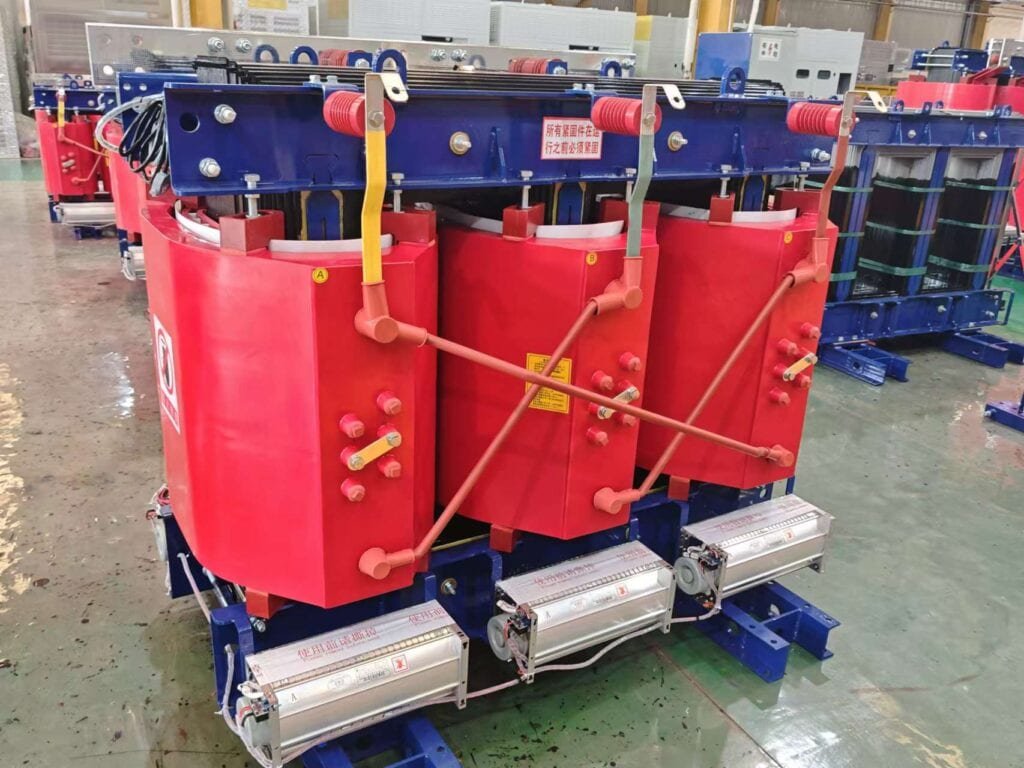
Traditional oil-immersed transformers provide effective insulation and cooling, but they also require considerations related to flammable liquids, oil containment, leakage, and environmental protection. These concerns can become particularly important in indoor installations, commercial buildings, high-density facilities, and locations where fire and environmental risks must be minimized. Choosing an inappropriate transformer design may increase installation complexity, maintenance requirements, and safety costs. Dry-type transformers provide an oil-free alternative that can address many of these challenges while maintaining reliable voltage transformation.
A dry-type transformer is a transformer that uses solid insulation and air rather than liquid insulating oil for insulation and cooling. Its oil-free design eliminates the risks of oil leakage and reduces liquid-related fire and environmental concerns, while offering advantages such as suitability for indoor installations, simplified maintenance, and easier integration into locations with strict fire-safety requirements. Common dry-type designs include cast-resin and ventilated dry-type transformers.
The absence of insulating oil does not mean that dry-type transformers are maintenance-free or suitable for every application. Capacity, voltage level, cooling conditions, ambient environment, installation space, efficiency, noise, and applicable standards should all be considered when determining whether an oil-free design is appropriate.
What Is a Dry-Type Transformer and What Are the Advantages of an Oil-Free Design?
When transformers are installed inside commercial buildings, hospitals, factories, data centers, tunnels, or other sensitive locations, conventional oil-filled designs can introduce additional requirements for liquid containment, fire protection, ventilation, and spill management. A dry-type transformer eliminates conventional insulating oil and uses solid insulation with air-based cooling, providing an oil-free solution with reduced spill risk, simpler indoor installation, and favorable fire-safety characteristics. However, dry-type does not automatically mean maintenance-free or more efficient. Buyers should still evaluate insulation, temperature rise, cooling, noise, harmonics, loading, enclosure, environmental conditions, reliability, and lifecycle cost.

Dry-type transformers contain no insulating oil, so they completely eliminate transformer fire risk.False
Dry-type transformers eliminate conventional oil-related fire and spill risks, but electrical faults, overheating and arcing can still occur and require appropriate protection.
What Is a Dry-Type Transformer?
A dry-type transformer is a transformer that does not use liquid insulating oil as its primary insulation and cooling medium. Its windings use solid insulation systems, while heat is transferred through air or forced-air cooling.
Common constructions include:
- Cast-resin transformers
- VPI transformers
- Air-insulated transformers
- Resin-encapsulated designs
The electromagnetic principle remains the same as an oil-filled transformer. The main difference is the insulation and heat-removal system.
| Feature | Dry-Type | Oil-Filled |
|---|---|---|
| Insulating medium | Solid insulation/air/resin | Insulating liquid |
| Oil spill risk | Very low | Present |
| Indoor suitability | Often excellent | Application dependent |
| Oil maintenance | None | Required |
| Cooling | Air-based | Oil-based |
| Fire considerations | Favorable for many indoor applications | Requires liquid-fire assessment |
| Environmental spill concern | Low | Higher |
| Large utility applications | Project dependent | Widely used |
What Are the Main Advantages of an Oil-Free Design?
The biggest advantage is eliminating conventional transformer oil.
This can reduce concerns related to:
- Oil leakage
- Liquid containment
- Oil spill cleanup
- Oil-related fire
- Oil sampling and treatment
- Environmental contamination
This makes dry-type transformers particularly attractive where the transformer must be installed close to people, buildings, sensitive equipment, or environmentally protected areas.
Why Are Dry-Type Transformers Popular Indoors?
Dry-type transformers are often suitable for:
- Commercial buildings
- Hospitals
- Data centers
- Industrial plants
- Shopping centers
- High-rise buildings
- Underground facilities
- Transportation systems
Without an oil-filled tank, the installation may require fewer liquid-management measures. However, the transformer still needs adequate ventilation, electrical clearances, protection and maintenance access.
Are Dry-Type Transformers Maintenance-Free?
No.
They eliminate oil-related maintenance, but buyers still need to plan inspections for:
- Dust accumulation
- Cooling ducts
- Windings
- Electrical connections
- Terminals
- Temperature sensors
- Enclosures
- Signs of overheating
- Insulation deterioration
In dusty or humid environments, cleaning and environmental control can become particularly important.
How Do Cast-Resin Transformers Protect the Windings?
In cast-resin construction, resin provides electrical insulation and mechanical protection around the windings.
The quality of the resin system and manufacturing process is therefore critical.
Buyers should consider:
- Insulation thermal class
- Resin quality
- Curing process
- Void control
- Crack resistance
- Moisture resistance
- Partial-discharge performance
A poorly manufactured cast-resin winding can suffer from defects that become more serious during thermal and electrical cycling.
How Does Cooling Affect Dry-Type Transformer Performance?
Dry-type transformers generally rely on air for heat removal.
Cooling may be:
- Naturally ventilated
- Forced-air cooled
Temperature rise depends on transformer loading, ambient temperature, cooling design and installation conditions.
For this reason, buyers should specify the expected:
- Ambient temperature
- Loading profile
- Overload requirement
- Altitude
- Ventilation conditions
A dry-type transformer should never be selected without checking whether the electrical room can remove the generated heat.
Are Dry-Type Transformers More Efficient Than Oil-Filled Transformers?
Not necessarily.
Efficiency depends mainly on transformer design, including:
- Core material
- Core construction
- Winding resistance
- Flux density
- Load losses
- No-load losses
- Cooling requirements
Both dry-type and oil-filled transformers can achieve high efficiency.
Buyers should compare guaranteed no-load and load losses instead of assuming that oil-free construction automatically means lower energy consumption.
How Do Harmonics Affect Dry-Type Transformers?
Modern facilities may contain many nonlinear loads, including:
- Solar inverters
- Battery converters
- EV chargers
- UPS systems
- Variable-frequency drives
- Data-center equipment
Harmonic currents can increase transformer heating and certain losses.
Buyers should therefore provide the supplier with relevant load and harmonic information when significant power-electronic equipment is connected.
When Should Buyers Choose Dry-Type Instead of Oil-Filled?
A dry-type transformer is often attractive when:
- Indoor installation is required
- Liquid spill risk must be minimized
- Fire-safety requirements are restrictive
- Environmental contamination must be minimized
- Oil maintenance should be avoided
- The transformer is close to occupied areas
Oil-filled transformers may be preferable for:
- Large MVA ratings
- High-voltage utility substations
- Outdoor transmission applications
- Applications with demanding thermal requirements
- Large-scale generation and transmission projects
Neither technology is universally superior.
What Should Buyers Check Before Purchasing?
A practical specification should include:
| Item | What to Evaluate |
|---|---|
| MVA | Present and future loading |
| Voltage | Primary/secondary ratings |
| Impedance | Voltage regulation and fault current |
| Temperature rise | Thermal performance |
| Cooling | Natural or forced air |
| Insulation | Thermal and dielectric capability |
| Environment | Temperature, humidity, dust and altitude |
| Noise | Indoor sound requirements |
| Harmonics | Converter and nonlinear loads |
| Enclosure | Required protection level |
| Monitoring | Temperature, alarms and condition data |
| Testing | Factory electrical and insulation tests |
| Lifecycle cost | Losses, maintenance and installation |
Dry-type transformers are always the best choice for indoor power systems.False
Dry-type construction is often advantageous indoors, but transformer rating, thermal requirements, harmonics, noise, space, environment and lifecycle economics must still be evaluated.
How Does an Oil-Free Design Work in Dry-Type Transformers?
Conventional oil-filled transformers use insulating liquid to provide both electrical insulation and heat transfer, but this approach can create additional concerns for indoor installations, including oil leakage, liquid containment, fire protection, and environmental management. Dry-type transformers solve this problem by removing conventional insulating oil from the active transformer system and using solid insulation together with air-based heat dissipation. The transformer still relies on the same electromagnetic induction principle, but insulation, cooling, mechanical support, and environmental protection are achieved through materials and construction methods such as cast resin, VPI insulation, air ducts, and ventilated enclosures.

An oil-free transformer replaces the electromagnetic transformer principle with a completely different operating principle.False
Dry-type transformers still operate through electromagnetic induction; the oil-free design changes the insulation and cooling system rather than the fundamental electrical principle.
What Does "Oil-Free" Mean in a Transformer?
Oil-free means that the transformer does not use conventional insulating oil around its active windings and core.
Instead, the transformer uses a combination of:
- Solid electrical insulation
- Resin or impregnating materials
- Air
- Cooling ducts
- Ventilation
- Protective enclosure
The basic energy-transfer path remains:
Electrical current → Magnetic flux → Induced voltage
The main engineering change is:
Oil-filled: insulation and heat transfer are strongly dependent on insulating liquid.
Dry-type: insulation is primarily solid, while heat is transferred through air and the surrounding structure.
How Does the Insulation System Work Without Oil?
The windings must remain electrically separated even though they operate at different potentials.
Dry-type transformers achieve this through carefully designed solid insulation.
Depending on the transformer construction, insulation can include:
- Epoxy resin
- Glass-fiber reinforced materials
- Insulating paper
- Polymer films
- VPI impregnation systems
- Other solid dielectric materials
For cast-resin transformers, resin surrounds or encapsulates the windings and provides both electrical insulation and mechanical support.
The insulation must withstand:
- Normal operating voltage
- Temporary overvoltage
- Thermal cycling
- Mechanical forces
- Moisture
- Environmental contamination
- Short-circuit forces
How Does a Dry-Type Transformer Remove Heat?
Every transformer produces heat because of core and winding losses.
Without oil, heat must move through a different thermal path:
Core and windings → solid insulation → surrounding air → ventilation system → room or outdoor environment
Natural-air cooling can be sufficient for some designs.
For higher thermal requirements, forced-air cooling can increase heat removal.
The cooling system therefore becomes an important part of transformer performance.
Why Is Resin Important in Cast-Resin Transformers?
Resin serves several functions simultaneously.
It can:
- Provide dielectric insulation.
- Mechanically stabilize the winding.
- Protect the winding against certain environmental contaminants.
- Help transfer heat toward the surrounding cooling path.
- Reduce exposure of the conductor to direct environmental conditions.
However, resin quality is critical.
Poor manufacturing control can lead to:
- Voids
- Cracks
- Incomplete curing
- Uneven insulation
- Local electrical stress
These defects may become more significant as the transformer experiences repeated heating and cooling.
How Does Air Cooling Replace Oil Cooling?
Oil is an effective heat-transfer medium, but dry-type transformers use air instead.
A typical cooling path is:
Hot winding → cooling surface/duct → air → ventilation opening
Natural convection allows heated air to rise and cooler air to enter.
Forced-air designs use fans to increase airflow.
Therefore, the electrical-room ventilation system can become an important part of transformer thermal performance.
Does Oil-Free Mean No Cooling System Is Needed?
No.
Oil-free does not mean heat-free.
A transformer still produces:
- Core losses
- Copper losses
- Stray losses
- Additional losses associated with certain harmonic loads
All of these ultimately become heat.
If heat cannot be removed effectively, winding temperature rises and insulation aging accelerates.
Therefore, buyers should verify:
- Temperature rise
- Cooling class
- Ambient temperature
- Ventilation requirements
- Installation clearance
- Overload capability
How Does the Oil-Free Design Improve Fire and Spill Safety?
Removing conventional insulating oil eliminates a major source of liquid-related risk.
There is no transformer oil that can:
- Leak from the tank
- Spill onto the floor
- Contaminate soil
- Require oil drainage
- Require routine oil sampling
This can make dry-type transformers particularly attractive for indoor installations and environmentally sensitive locations.
However, an oil-free transformer can still experience electrical faults and overheating.
Appropriate protection remains necessary.
How Does the Design Handle Moisture?
A common misconception is that dry-type means completely insensitive to moisture.
In reality, moisture can affect solid insulation and electrical surfaces.
Depending on the environment, buyers may need to consider:
- Anti-condensation heating
- Proper enclosure design
- Controlled ventilation
- Humidity management
- Adequate electrical clearances
- Periodic inspection
Cast-resin construction can provide strong environmental protection, but it does not eliminate the need for proper installation conditions.
How Does the Oil-Free Design Affect Maintenance?
The main maintenance advantage is the elimination of liquid-related work.
There is no need for routine:
- Oil sampling
- Oil filtration
- Oil purification
- Oil-level inspection
- Oil replacement
However, dry-type transformers still require inspection.
Maintenance may include:
- Removing dust
- Checking ventilation ducts
- Inspecting connections
- Checking terminals
- Monitoring temperature
- Examining insulation
- Checking fans
- Inspecting enclosures
The maintenance profile is therefore simpler in some areas, but not maintenance-free.
What Happens When the Transformer Is Heavily Loaded?
Higher current increases winding losses and therefore heat generation.
A simplified relationship is:
[P_{\text{loss}} \propto I^2R]
This means that increasing current can cause winding losses to rise rapidly.
The dry-type cooling system must therefore be capable of removing the additional heat.
This is especially important for transformers supplying:
- EV charging
- Data centers
- Industrial drives
- Battery systems
- Solar inverters
- Other variable or nonlinear loads
How Does the Oil-Free Design Affect Transformer Efficiency?
Oil-free construction itself does not guarantee higher efficiency.
Efficiency depends primarily on:
- Core design
- Magnetic material
- Winding resistance
- Flux density
- Load losses
- No-load losses
- Cooling requirements
Therefore, buyers should compare guaranteed loss values rather than selecting a transformer simply because it is dry-type.
How Does Manufacturing Quality Affect Oil-Free Reliability?
Because there is no insulating liquid to fill small spaces around the windings, the solid insulation system must be carefully manufactured.
Important processes include:
- Winding
- Insulation placement
- Resin mixing
- Vacuum casting or impregnation
- Curing
- Temperature control
- Mechanical assembly
Quality control should focus on achieving consistent insulation thickness, controlled resin processing and low defect levels.
What Fire Safety Advantages Do Oil-Free Dry-Type Transformers Offer?
When a transformer is installed inside a building, hospital, data center, factory, tunnel, or other occupied facility, fire safety can become as important as electrical performance. Oil-filled transformers contain insulating liquid that can leak or contribute to a fire under severe fault conditions, creating additional requirements for containment and fire protection. Oil-free dry-type transformers remove conventional insulating oil from the transformer, eliminating oil leakage and oil-spill hazards and reducing the amount of combustible liquid associated with a transformer installation. This can simplify fire-safety planning, particularly indoors, although dry-type transformers can still experience electrical faults and overheating and therefore still require suitable protection, ventilation, clearances, and monitoring.

Oil-free dry-type transformers cannot catch fire.False
Removing transformer oil eliminates liquid-related fire hazards, but dry-type transformers still contain energized conductors, insulation and other electrical components that can overheat or arc during faults.
How Does an Oil-Free Design Improve Fire Safety?
The main advantage is straightforward: there is no conventional transformer oil to leak, spill, or sustain an oil-related fire.
In an oil-filled transformer, a severe internal fault can potentially cause:
- Rapid heating
- Arcing
- Pressure generation
- Oil decomposition
- Oil leakage
- Fire involving insulating liquid
A dry-type transformer removes the liquid-insulation component.
The basic comparison is:
Oil-filled:
Electrical fault → possible oil involvement → additional fire and containment concerns
Dry-type:
Electrical fault → electrical/thermal protection remains necessary, but no transformer oil is present
This distinction is especially valuable where transformers are installed near occupied spaces.
Why Is This Important for Indoor Installations?
Dry-type transformers are commonly considered for:
- Hospitals
- Commercial buildings
- High-rise buildings
- Schools
- Data centers
- Airports
- Transportation systems
- Underground facilities
- Industrial buildings
In these environments, a transformer fire can affect not only electrical equipment but also people, building structures and critical operations.
Removing oil can reduce certain fire-management requirements and may simplify the integration of the transformer into an indoor electrical room.
However, the actual installation still needs to comply with the project's applicable fire and electrical requirements.
Does Dry-Type Construction Eliminate Oil-Containment Requirements?
For conventional transformer oil, yes—the transformer has no oil to contain.
This can eliminate or reduce concerns related to:
- Oil collection systems
- Spill containment
- Oil drainage
- Oil leakage detection
- Liquid cleanup
- Oil storage and handling
This is one of the clearest practical advantages of an oil-free design.
How Does Cast Resin Contribute to Fire Safety?
Many dry-type transformers use cast-resin insulation.
The resin surrounds or encapsulates the windings and provides electrical and mechanical protection.
Depending on the specific resin system and tested construction, it can provide favorable fire characteristics compared with a transformer containing a large volume of insulating oil.
Buyers should not assume that every resin system has identical fire performance.
Instead, request the manufacturer's documented fire-performance characteristics and applicable test information.
Can a Dry-Type Transformer Still Overheat?
Yes.
All transformers generate heat.
The main sources include:
- Core losses
- Winding losses
- Stray losses
- Harmonic-related losses
If cooling is inadequate, temperature can rise beyond acceptable limits.
Potential causes include:
- Excessive loading
- Blocked ventilation
- Failed cooling fans
- High ambient temperature
- Dust accumulation
- Poor installation clearance
Therefore, fire safety still requires effective thermal management.
What Protection Should Be Used With Dry-Type Transformers?
An oil-free transformer should still be protected against electrical and thermal abnormalities.
Depending on the application, protection may include:
- Overcurrent protection
- Short-circuit protection
- Ground-fault protection
- Temperature monitoring
- Overtemperature alarms
- Cooling-system alarms
- Appropriate fire detection
- Emergency shutdown functions where required
The transformer should be considered part of the complete electrical protection system.
How Does Ventilation Affect Fire Safety?
Ventilation has two important functions.
First, it removes transformer heat.
Second, it helps prevent excessive temperature buildup within the electrical room.
A dry-type transformer may therefore require adequate:
- Airflow
- Room ventilation
- Cooling clearance
- Fan capacity
- Air inlet and outlet area
A poorly ventilated room can undermine the thermal advantages of a well-designed transformer.
Is Dry-Type Safer Than Oil-Filled in Every Application?
Not necessarily.
Dry-type has a strong advantage where oil-related fire and spill concerns are important.
Oil-filled transformers, however, remain widely used in outdoor substations and large utility applications because liquid insulation and cooling can provide significant electrical and thermal advantages.
The comparison should therefore consider:
| Requirement | Dry-Type Advantage |
|---|---|
| Indoor installation | Strong |
| Oil spill prevention | Strong |
| Liquid containment | Strong |
| Fire-conscious building | Often strong |
| Environmental spill control | Strong |
| Very large MVA | Application dependent |
| High-voltage utility substation | Application dependent |
| Heavy thermal loading | Requires detailed comparison |
| Outdoor utility network | Oil-filled often remains common |
What Should Buyers Verify Before Purchasing?
Do not accept "oil-free" as the only fire-safety specification.
Ask suppliers for:
- Transformer construction type
- Insulation system
- Resin specifications where applicable
- Fire-performance information
- Temperature-rise data
- Cooling requirements
- Overtemperature protection
- Short-circuit withstand capability
- Enclosure requirements
- Installation clearances
- Factory-test records
- Applicable compliance documentation
The buyer should also confirm that the transformer room's ventilation and protection design are compatible with the selected transformer.
How Do Oil-Free Dry-Type Transformers Reduce Environmental and Maintenance Risks?
Oil-filled transformers rely on insulating liquid for electrical insulation and cooling, which can introduce risks related to leakage, spills, oil handling, fire protection, and environmental cleanup. These issues become especially important in hospitals, commercial buildings, factories, data centers, underground facilities, and environmentally sensitive sites. Oil-free dry-type transformers reduce these risks by eliminating conventional transformer oil, thereby removing oil-spill and oil-treatment requirements while simplifying many inspection and maintenance activities. However, dry-type transformers are not maintenance-free: dust, moisture, overheating, electrical connections, insulation condition, ventilation, and cooling systems still require appropriate attention.
Oil-free dry-type transformers eliminate all environmental and maintenance risks associated with transformers.False
They eliminate conventional transformer-oil leakage, sampling, filtration and spill-management risks, but dry-type transformers still require inspection, cleaning, thermal management and electrical maintenance.
How Does Eliminating Transformer Oil Reduce Environmental Risk?
The most direct environmental advantage is the absence of conventional insulating oil.
An oil-filled transformer may require measures for:
- Oil containment
- Leak detection
- Spill response
- Oil sampling
- Oil treatment
- Oil disposal
- End-of-life liquid management
A dry-type transformer removes these liquid-related requirements from the transformer system.
This is particularly valuable where a transformer is installed near:
- Water sources
- Occupied buildings
- Sensitive production areas
- Underground spaces
- Urban facilities
- Environmentally protected locations
The environmental benefit is therefore not simply "no oil." It is the reduction of the liquid-handling chain associated with transformer operation and maintenance.
How Does an Oil-Free Design Reduce Spill Risk?
An oil-filled transformer can potentially release insulating liquid because of:
- Tank damage
- Gasket deterioration
- Valve leakage
- Bushing problems
- Mechanical damage
- Installation errors
Dry-type transformers do not have conventional insulating oil that can leak onto floors or into surrounding soil.
This can simplify facility planning and reduce the consequences of mechanical damage.
A dry-type transformer cannot leak insulating oil.True
A conventional dry-type transformer does not use insulating oil as its insulation and cooling medium, so there is no transformer oil to leak.
How Does Dry-Type Construction Reduce Maintenance Work?
One of the clearest maintenance benefits is eliminating oil-related service.
Depending on the transformer design and maintenance program, buyers no longer need routine activities such as:
- Oil sampling
- Oil filtration
- Oil purification
- Oil-level management
- Oil replacement
- Oil leak inspection
Instead, maintenance focuses more directly on the electrical and thermal condition of the transformer.
Typical inspections include:
| Maintenance Area | What to Check |
|---|---|
| Windings | Dust, contamination and insulation condition |
| Connections | Loose or overheated joints |
| Ventilation | Blockage and airflow |
| Cooling fans | Operation and abnormal noise |
| Temperature sensors | Correct readings and alarms |
| Enclosure | Damage, corrosion and cleanliness |
| Terminals | Heating, looseness and insulation |
| Environment | Humidity, dust and condensation |
Why Is Dust an Important Dry-Type Transformer Risk?
Dry-type transformers normally transfer heat through air, so ventilation is essential.
Dust can accumulate on:
- Windings
- Cooling ducts
- Insulating surfaces
- Ventilation openings
- Enclosures
Heavy contamination can reduce heat dissipation and may adversely affect insulation performance.
Therefore, an oil-free transformer installed in a clean electrical room may have relatively simple maintenance, while one installed in a dusty industrial environment may require considerably more frequent cleaning.
Does Dry-Type Mean Maintenance-Free?
No.
This is an important distinction for buyers.
Oil-free ≠ maintenance-free.
Dry-type transformers still need appropriate inspection because they contain:
- Energized windings
- Solid insulation
- Terminals
- Connections
- Temperature-sensitive components
- Cooling systems
Forced-air designs also introduce fans and control components that require inspection.
A realistic maintenance strategy is therefore:
Monitor → Inspect → Clean → Test → Correct abnormal conditions
rather than simply installing the transformer and leaving it unattended.
How Does Moisture Affect Environmental and Maintenance Risk?
Dry-type transformers do not contain oil, but they remain sensitive to unfavorable environmental conditions.
High humidity and condensation can contribute to:
- Surface contamination
- Tracking
- Corrosion
- Reduced insulation performance
- Connection deterioration
For humid environments, buyers should consider:
- Proper enclosure design
- Ventilation
- Anti-condensation heating where appropriate
- Humidity control
- Adequate electrical clearances
The installation environment should be specified before the transformer is manufactured.
How Does Dry-Type Design Reduce Fire-Related Environmental Damage?
Eliminating conventional transformer oil also eliminates the possibility of an oil spill accompanying an electrical fault.
This can reduce secondary consequences such as:
- Burning liquid
- Oil-contaminated water
- Oil-contaminated building surfaces
- Spill cleanup
- Liquid-fire response
However, dry-type transformers can still experience electrical faults and overheating.
Appropriate protection remains necessary.
How Does Transformer Monitoring Reduce Maintenance Risk?
Modern dry-type transformers can incorporate monitoring for:
- Winding temperature
- Ambient temperature
- Load current
- Voltage
- Cooling status
- Alarm conditions
Monitoring helps identify abnormal conditions before they become serious failures.
For example:
High loading → rising temperature → alarm → load assessment → corrective action
This approach can reduce unexpected failures and support condition-based maintenance.
How Does Lifecycle Cost Compare?
Dry-type transformers may have a higher initial purchase price in some applications, but the total cost should include more than equipment price.
Consider:
Purchase + installation + ventilation + energy losses + inspection + cleaning + spare parts + downtime risk
The absence of oil can reduce certain maintenance and environmental-management costs.
However, dry-type transformers may require careful ventilation and can have different dimensions, losses and cooling requirements.
Therefore, buyers should compare total lifecycle cost, not simply the purchase quotation.
How Should Buyers Evaluate Environmental and Maintenance Performance?
A practical purchasing checklist includes:
- Is conventional insulating oil eliminated?
- What solid insulation system is used?
- What cleaning interval is recommended?
- What environmental conditions are permitted?
- What humidity limits apply?
- What ventilation is required?
- Is forced cooling used?
- What temperature monitoring is included?
- What factory tests are performed?
- What maintenance tools are required?
- Are spare parts readily available?
- What are the guaranteed losses?
- What are the expected lifecycle costs?
A supplier should provide clear technical documentation rather than relying only on the term "oil-free."
Where Are Oil-Free Dry-Type Transformers Commonly Used?
When a transformer must be installed close to people, sensitive equipment, valuable buildings, or environmentally restricted areas, conventional oil-filled construction can create additional concerns involving liquid containment, fire protection, ventilation, and maintenance. These concerns can make transformer selection more complicated and increase project cost. Oil-free dry-type transformers are commonly used in commercial buildings, hospitals, data centers, industrial facilities, transportation infrastructure, renewable-energy systems, underground electrical rooms, and other locations where eliminating insulating oil provides safety, environmental, installation, or maintenance advantages. The best application depends on voltage, capacity, load profile, environment, cooling requirements, available space, noise limits, and the project's protection strategy.

Oil-free dry-type transformers are used only for small indoor electrical systems.False
Dry-type transformers are used across commercial, industrial, transportation, renewable-energy and other applications, with selection depending on voltage, capacity, environment and project requirements.
What Types of Facilities Commonly Use Dry-Type Transformers?
The most common applications are locations where the absence of insulating oil provides a practical advantage.
| Application | Why Dry-Type Is Attractive |
|---|---|
| Commercial buildings | Indoor installation and reduced liquid risk |
| Hospitals | Fire-conscious and occupied environments |
| Data centers | Indoor reliability and monitoring requirements |
| Industrial plants | Suitable for many indoor industrial systems |
| High-rise buildings | Reduced oil-management requirements |
| Transportation facilities | Suitable for stations and constrained spaces |
| Underground facilities | No conventional oil-spill concern |
| Renewable-energy projects | Useful where environmental requirements favor oil-free equipment |
| Schools and public buildings | Favorable for occupied facilities |
| Special industrial areas | Can reduce liquid-related environmental concerns |
Where Are Dry-Type Transformers Used in Commercial Buildings?
Commercial buildings are one of the most recognizable applications.
Examples include:
- Office buildings
- Shopping centers
- Hotels
- Apartment complexes
- Convention centers
- Large retail facilities
Transformers may be installed inside electrical rooms or close to building loads.
The oil-free design can be attractive because building owners generally want to minimize:
- Fire hazards
- Liquid leakage
- Maintenance complexity
- Environmental cleanup
- Space required for oil containment
For these projects, the transformer should be selected together with the building's ventilation, electrical protection and fire-safety design.
Why Are Dry-Type Transformers Used in Hospitals?
Hospitals require reliable electricity while also having strict requirements concerning patient safety and building operation.
Dry-type transformers can be suitable for:
- Main building distribution
- Medical equipment supply systems
- Auxiliary electrical rooms
- Critical facility distribution
Their oil-free construction can reduce concerns about liquid leakage and oil-related fire.
However, hospitals also require careful consideration of:
- Reliability
- Redundancy
- Temperature
- Noise
- Monitoring
- Maintenance access
- Emergency power systems
The transformer technology is only one part of the overall electrical system.
Why Are Dry-Type Transformers Popular in Data Centers?
Data centers are highly sensitive to electrical interruptions and thermal problems.
Dry-type transformers may be used in:
- Medium-voltage distribution
- UPS-related electrical systems
- Building distribution
- Data-hall electrical infrastructure
Important selection factors include:
- Efficiency
- No-load losses
- Load losses
- Harmonic currents
- Temperature rise
- Monitoring
- Noise
- Short-circuit withstand capability
Because data centers can have high concentrations of nonlinear loads, transformer heating caused by harmonics should not be overlooked.
Where Are Dry-Type Transformers Used in Industrial Facilities?
Industrial applications can include:
- Manufacturing plants
- Processing facilities
- Warehouses
- Automotive factories
- Machinery plants
- Chemical facilities
- Production lines
Dry-type transformers may be installed near production equipment when the environment is appropriate.
However, industrial environments can contain:
- Dust
- Moisture
- Chemical contaminants
- High ambient temperatures
- Mechanical vibration
Therefore, enclosure design and environmental protection are particularly important.
A dry-type transformer is not automatically suitable for every industrial environment.
Are Dry-Type Transformers Used in High-Rise Buildings?
Yes.
High-rise buildings often benefit from equipment that can be installed within the building without conventional transformer oil.
Potential applications include:
- Building substations
- Floor-level distribution
- Mechanical systems
- Emergency systems
- Commercial load centers
Space and transportation must be considered carefully because dry-type transformers can have different dimensions and ventilation requirements compared with oil-filled equipment.
Are Dry-Type Transformers Used in Transportation Systems?
They can be used in:
- Metro stations
- Railway facilities
- Airports
- Tunnels
- Transit buildings
- Transportation power systems
These locations may have limited space and strict fire-safety requirements.
Oil-free construction can therefore provide a practical advantage.
For transportation projects, buyers should also evaluate:
- Vibration
- Ambient conditions
- Ventilation
- Noise
- Enclosure protection
- Maintenance accessibility
Where Are Dry-Type Transformers Used in Renewable Energy?
Dry-type transformers can be integrated into renewable-energy systems such as:
- Solar photovoltaic plants
- Battery energy-storage systems
- Wind-power facilities
- Commercial renewable-energy installations
They may be used between power-conversion equipment and distribution systems.
The main technical consideration is often the interaction between the transformer and power electronics.
Inverter-based systems can produce harmonic currents and rapidly changing loads, so buyers should evaluate:
- Harmonic heating
- Load cycles
- Temperature rise
- Insulation stress
- Cooling
- Transformer impedance
Are Dry-Type Transformers Suitable for Underground Installations?
They can be particularly attractive in underground electrical rooms, tunnels and similar spaces because there is no conventional insulating oil to spill.
Potential benefits include:
- Reduced liquid-management requirements
- Simplified spill control
- Favorable fire-safety characteristics
- Indoor installation suitability
Nevertheless, underground spaces can have difficult ventilation and humidity conditions.
Therefore, the transformer and ventilation system must be designed together.
Are Dry-Type Transformers Used in Environmentally Sensitive Locations?
Yes.
They can be advantageous where liquid leakage could create significant consequences.
Examples may include facilities near:
- Water-treatment systems
- Protected water sources
- Environmentally sensitive industrial areas
- Urban infrastructure
- Certain public facilities
The absence of conventional transformer oil reduces the risk associated with liquid spills.
Dry-type transformers eliminate all environmental risks because they contain no oil.False
They significantly reduce conventional oil-spill risks, but manufacturing materials, electrical losses, noise, waste and end-of-life management still need environmental consideration.
When Is Oil-Filled Construction Still Preferable?
Dry-type transformers are not universally better.
Oil-filled transformers may be advantageous for:
- Very large power ratings
- Large outdoor substations
- High-voltage transmission systems
- Certain generation applications
- Projects requiring strong liquid-based cooling
- Utility applications with established oil-filled infrastructure
The decision should be based on the complete electrical and physical requirements.
How Can Buyers Match Dry-Type Transformers to Applications?
Use this practical selection approach:
1. Identify the location.
Indoor, outdoor, underground or environmentally sensitive?
2. Determine electrical requirements.
Voltage, MVA, frequency, impedance and load profile.
3. Evaluate the environment.
Temperature, humidity, dust, altitude and contamination.
4. Evaluate power quality.
Check harmonics and nonlinear loads.
5. Evaluate thermal performance.
Confirm temperature rise and ventilation requirements.
6. Evaluate safety.
Consider fire strategy, electrical protection and clearances.
7. Compare lifecycle cost.
Include purchase, installation, energy losses, maintenance and downtime.
| Application | Key Selection Priority |
|---|---|
| Office building | Fire safety, noise, footprint |
| Hospital | Reliability, safety, monitoring |
| Data center | Efficiency, harmonics, redundancy |
| Factory | Environment, cooling, overload |
| High-rise | Space, ventilation, fire safety |
| Metro/tunnel | Fire safety, ventilation, vibration |
| Solar plant | Harmonics, loading cycles, efficiency |
| Battery storage | Power electronics, thermal management |
| Underground facility | Ventilation, humidity, fire safety |
How Can Buyers Determine Whether an Oil-Free Dry-Type Transformer Is Suitable for Their Applications?
Choosing a dry-type transformer simply because a project requires an oil-free design can create problems later. The transformer may fit the building but have insufficient cooling, unsuitable insulation, excessive noise, inadequate short-circuit strength, or poor compatibility with nonlinear and renewable-energy loads. Buyers should determine suitability by checking five areas together: electrical requirements, thermal performance, installation environment, safety requirements, and lifecycle economics. If the dry-type transformer can meet the required voltage, MVA, impedance, temperature rise, insulation, environmental conditions, power quality, protection and maintenance requirements with acceptable lifecycle cost, it is usually a strong candidate for the application.

If the transformer has the correct voltage and MVA rating, a dry-type transformer is suitable for the application.False
Voltage and MVA are only the starting points; cooling, insulation, impedance, harmonics, environment, noise, installation conditions, protection and lifecycle requirements must also be verified.
What Should Buyers Check First?
Start with the basic electrical specification:
- Primary voltage
- Secondary voltage
- Rated MVA
- Frequency
- Phase
- Vector group
- Impedance
- Insulation level
- Required tap range
The transformer must satisfy the actual network conditions, not merely the nominal voltage.
Capacity should also reflect future demand where appropriate. A transformer supplying a growing facility, EV charging system, solar installation or battery system may require additional capacity compared with today's measured load.
How Does the Load Determine Suitability?
The load profile is more important than a single maximum-current value.
Buyers should examine:
| Condition | What to Evaluate |
|---|---|
| Normal load | Continuous thermal performance |
| Peak load | Temperature rise and capacity |
| Minimum load | Efficiency and voltage behavior |
| Variable load | Thermal cycling |
| Emergency overload | Permitted duration |
| EV charging | Demand peaks |
| Solar generation | Possible reverse flow |
| Battery storage | Bidirectional operation |
| Nonlinear loads | Harmonic heating |
A transformer should be selected according to the complete expected operating profile.
Is the Transformer Suitable for Renewable or Battery Applications?
If the transformer connects to solar, wind or battery systems, buyers should specifically investigate bidirectional power flow and power-electronic effects.
Consider:
- Maximum import power
- Maximum export power
- Charging/discharging cycles
- Reactive-power range
- Power factor
- Harmonic current
- Converter characteristics
- Voltage variation
A dry-type transformer can automatically handle reverse power flow because transformers are inherently bidirectional devices.False
The electromagnetic transformer can transfer power in either direction, but the complete installation must be designed for reverse-flow voltage, thermal, protection and control conditions.
How Important Is Cooling?
Cooling is one of the most important checks for dry-type transformers because they depend on air-based heat removal.
Verify:
- Cooling class
- Temperature rise
- Ambient temperature
- Room ventilation
- Air inlet and outlet requirements
- Cooling-fan requirements
- Overload capability
- Installation clearances
A transformer can have adequate MVA capacity but still be unsuitable if the electrical room cannot remove its heat.
What Environmental Conditions Must Be Considered?
Evaluate the actual installation environment:
- Temperature
- Humidity
- Dust
- Chemical contamination
- Altitude
- Salt exposure
- Vibration
- Indoor/outdoor location
For dusty or humid facilities, buyers should pay particular attention to enclosure protection, ventilation and cleaning requirements.
Dry-type does not mean moisture-proof or contamination-proof.
How Should Buyers Evaluate Fire Safety?
The absence of conventional transformer oil is a major advantage where liquid-spill and oil-fire concerns are important.
Dry-type construction can reduce requirements related to:
- Oil containment
- Oil leakage
- Spill cleanup
- Liquid-fire management
However, dry-type transformers can still experience electrical faults and overheating.
Buyers should therefore verify:
- Overcurrent protection
- Short-circuit protection
- Temperature protection
- Fire detection where required
- Ventilation
- Electrical clearances
- Enclosure requirements
How Should Insulation Be Evaluated?
The insulation system is central to dry-type reliability.
Ask the manufacturer about:
- Insulation thermal class
- Resin system
- Moisture resistance
- Partial-discharge performance
- Thermal cycling capability
- Manufacturing process
- Factory testing
For cast-resin transformers, resin quality and controlled manufacturing are particularly important.
What About Noise?
Noise can become a significant issue in:
- Hospitals
- Hotels
- Offices
- Residential buildings
- Schools
- Data centers
Buyers should request the manufacturer's guaranteed sound level where noise is restricted.
Do not assume that a dry-type transformer is automatically quieter than an oil-filled transformer.
How Should Buyers Evaluate Efficiency?
Compare actual guaranteed losses.
Important data include:
- No-load loss
- Load loss
- Efficiency at typical loading
- Expected annual operating hours
A transformer with a higher purchase price may provide lower lifecycle cost if its losses are significantly lower.
The correct comparison is:
Purchase cost + installation + energy losses + maintenance + downtime risk
rather than purchase price alone.
When Is Dry-Type Usually a Strong Candidate?
Dry-type transformers are often attractive when several of these conditions apply:
- Indoor installation
- Limited liquid-spill tolerance
- Strict fire-safety requirements
- Environmentally sensitive location
- Close proximity to occupied areas
- Desire to eliminate oil maintenance
- Moderate or application-appropriate capacity
- Adequate ventilation
Typical applications include commercial buildings, hospitals, data centers, industrial plants, transportation facilities and some renewable-energy installations.
When Should Buyers Consider Oil-Filled Transformers Instead?
Oil-filled construction may be more appropriate when the project requires:
- Very large MVA capacity
- High-voltage utility applications
- Large outdoor substations
- Highly demanding thermal performance
- Established oil-filled utility infrastructure
The final decision should come from the technical and economic comparison rather than the transformer label.
A Simple Buyer Decision Matrix
| Requirement | Dry-Type Suitability |
|---|---|
| Indoor installation | High potential |
| Oil spill must be avoided | High |
| Strict fire considerations | High potential |
| Environmentally sensitive site | High potential |
| Very dusty environment | Requires careful evaluation |
| High humidity | Requires careful evaluation |
| Significant harmonics | Requires thermal analysis |
| Bidirectional renewable flow | Requires system study |
| Very large utility transformer | Compare carefully with oil-filled |
| High-voltage transmission | Application dependent |
| Limited ventilation | Potential concern |
| Strict noise limit | Verify guaranteed sound level |
What Documents Should Buyers Request?
Before placing an order, request:
- Technical datasheet
- Guaranteed losses
- Impedance data
- Temperature-rise information
- Cooling requirements
- Insulation specifications
- Environmental limitations
- Noise data
- Short-circuit withstand information
- Monitoring and protection details
- Factory-test program
- Installation and maintenance instructions
These documents allow buyers to compare suppliers on technical performance rather than marketing descriptions.
Conclusion
Dry-type transformers provide an effective oil-free solution for applications where fire safety, environmental protection, indoor installation, and reduced liquid-related maintenance are important. By using solid insulation and air-based cooling instead of insulating oil, they eliminate oil leakage risks and simplify certain installation requirements. However, buyers should evaluate capacity, voltage, cooling, ambient conditions, efficiency, noise, space, and lifecycle costs before selecting a dry-type transformer. When properly matched to the application, an oil-free transformer can provide safe, reliable, and practical long-term electrical performance.
FAQ
Q1: What is a dry-type transformer?
A dry-type transformer is an electrical transformer that uses solid insulation and air rather than liquid insulating oil as its primary insulation and cooling medium. It performs the same fundamental voltage-conversion function as other transformers but uses an oil-free construction.
Dry-type transformers commonly use materials such as epoxy resin, fiberglass, insulating paper, pressboard, enamel, or other solid insulation systems. Depending on the design, the windings may be resin-encapsulated, vacuum-pressure impregnated, or constructed using other dry insulation technologies.
The basic operating principle remains the same. Alternating current in the primary winding creates a changing magnetic field in the transformer core, which induces voltage in the secondary winding. The voltage ratio is determined primarily by the winding turns ratio.
The main difference is the insulation and cooling arrangement.
An oil-immersed transformer uses insulating liquid to provide both electrical insulation and heat transfer. A dry-type transformer transfers heat primarily through air circulation, either naturally or with forced ventilation.
Common dry-type configurations include:
Cast-resin transformers
Vacuum-pressure-impregnated transformers
Air-insulated transformers
Dry-type transformers are frequently used in buildings, commercial facilities, industrial plants, hospitals, data centers, renewable-energy installations, and other locations where liquid insulation may be undesirable.
Their oil-free construction can simplify certain environmental and fire-safety considerations. There is no transformer oil that can leak from the active unit, and there is no requirement for an oil containment system specifically for the transformer itself.
However, "oil-free" does not mean maintenance-free or risk-free. Dry-type transformers still generate heat and require adequate ventilation, electrical protection, inspection, and appropriate environmental protection.
Their suitability depends on voltage, capacity, load profile, ambient conditions, installation space, noise requirements, fire considerations, and lifecycle economics.
The most important advantage is therefore not simply the absence of oil. It is the ability to provide reliable transformer operation while avoiding many of the fluid-management requirements associated with liquid-immersed designs.
Q2: What are the main advantages of an oil-free dry-type transformer?
Oil-free dry-type transformers offer several advantages, particularly where fire safety, environmental protection, indoor installation, and simplified fluid management are important.
The first major advantage is the absence of insulating liquid. Because there is no transformer oil, there is no oil leak from the transformer itself and no need to manage oil as part of normal operation.
This can simplify installation in locations where liquid containment would be difficult or undesirable.
Other advantages include:
Reduced liquid-fire concerns
Conventional mineral oil is combustible. Dry-type transformers eliminate the need to manage mineral transformer oil as a fire fuel source. This can be particularly attractive inside buildings and near occupied areas, although the transformer and surrounding installation still require appropriate fire and electrical protection.Environmental benefits
An oil-free transformer eliminates the risk of a transformer-oil spill from the unit. This can be advantageous in environmentally sensitive locations.Indoor installation flexibility
Dry-type transformers are commonly used inside commercial buildings, industrial facilities, hospitals, data centers, and other structures.Simplified fluid maintenance
There is no insulating-oil sampling, filtration, dehydration, or oil-level management for the transformer itself.Reduced spill-management requirements
Because there is no liquid dielectric to collect, oil containment arrangements associated with liquid-filled transformers may not be required.Convenient placement near loads
Dry-type transformers can often be installed closer to electrical loads, subject to applicable clearances, ventilation, noise, and fire requirements.Good environmental compatibility
Appropriately designed dry-type units can operate in many indoor and industrial environments.
Nevertheless, these benefits should be evaluated alongside limitations. Dry-type transformers rely on air-based heat dissipation, so ventilation and ambient temperature can be important. Their physical size and cost may also become less favorable at some higher ratings.
The best application is therefore one where the benefits of an oil-free design outweigh its installation, cooling, and capital-cost considerations.
Q3: Where are dry-type transformers commonly used?
Dry-type transformers are commonly selected for applications where eliminating liquid insulation provides practical, environmental, or safety benefits.
Commercial buildings are a major application. Office buildings, shopping centers, hotels, and other facilities may install transformers inside electrical rooms or other controlled spaces.
Hospitals can use dry-type transformers where electrical reliability and fire-safety considerations are particularly important. Transformers may supply critical building loads and can be integrated into redundant electrical systems.
Data centers may use dry-type transformers because indoor installation, monitoring, reliability, and reduced liquid-spill concerns can be valuable in facilities containing sensitive electronic equipment.
Industrial facilities can also use dry-type units for plant distribution, machinery, process equipment, and other electrical loads. The appropriate design depends on the industrial environment and load characteristics.
Other applications include:
Airports
Universities
High-rise buildings
Underground facilities
Renewable-energy installations
Transportation infrastructure
Marine or specialized facilities
Indoor substations
Dry-type transformers are particularly attractive when a transformer must be installed close to people or valuable equipment.
However, application suitability still depends on the electrical rating. Oil-immersed transformers remain widely used for many large utility and outdoor substation applications because liquid cooling can efficiently manage high power ratings.
Environmental conditions also matter. Dust, humidity, chemical contamination, and inadequate ventilation can affect dry-type transformer performance.
For example, an industrial plant with conductive dust or corrosive chemicals may require an appropriate enclosure and protection level rather than simply selecting a standard open dry-type transformer.
Therefore, application selection should consider:
Voltage + capacity + load characteristics + environment + fire requirements + ventilation + installation space + maintenance strategy.
Dry-type technology is best viewed as one option within the broader transformer technology selection process.
Q4: Are dry-type transformers safer than oil-immersed transformers?
Dry-type transformers can provide important fire-safety and environmental advantages compared with mineral-oil-immersed transformers, but it is more accurate to say that they have different risk characteristics rather than being universally safer.
A major difference is that a dry-type transformer does not contain mineral insulating oil. Therefore, it does not present the same quantity of combustible transformer liquid that must be contained and managed.
This can be especially valuable in:
Indoor electrical rooms
High-rise buildings
Hospitals
Data centers
Underground facilities
Areas near occupied spaces
An oil-immersed transformer may require fire barriers, oil containment, drainage systems, fire detection, or other site-specific measures depending on its size and installation.
Dry-type transformers eliminate many of the hazards associated specifically with liquid leakage and oil fires.
However, dry-type transformers can still experience electrical faults, overheating, insulation failure, arcing, and other hazards. Their insulation materials can also be damaged by excessive temperature or contamination.
Adequate ventilation is particularly important because dry-type transformers transfer heat through air. A poorly ventilated transformer room can lead to excessive winding temperatures.
Therefore, safety still depends on:
Correct transformer sizing
Proper installation
Adequate ventilation
Electrical protection
Appropriate clearances
Temperature monitoring
Regular inspection
Proper grounding
Compliance with applicable standards
Cast-resin transformers can provide additional protection for windings against moisture and certain environmental contaminants, but their suitability depends on the specific construction and operating environment.
For project design, the comparison should therefore consider both electrical safety and site-specific hazards.
A dry-type transformer may be the preferred solution when fire and liquid-spill risks are major concerns, while an oil-immersed transformer may provide advantages in other applications, especially at larger ratings and outdoor substations.
References
IEC 60076-11 – Power Transformers: Dry-Type Transformers
https://webstore.iec.ch/en/publication/604
IEC 60076-1 – Power Transformers: General
https://webstore.iec.ch/en/publication/603
IEC 60076-3 – Power Transformers: Insulation Levels, Dielectric Tests and External Clearances
https://webstore.iec.ch/en/publication/605
IEEE Standards Association – Transformer Standards
https://standards.ieee.org
U.S. Department of Energy – Electricity Delivery and Grid Systems
https://www.energy.gov/oe