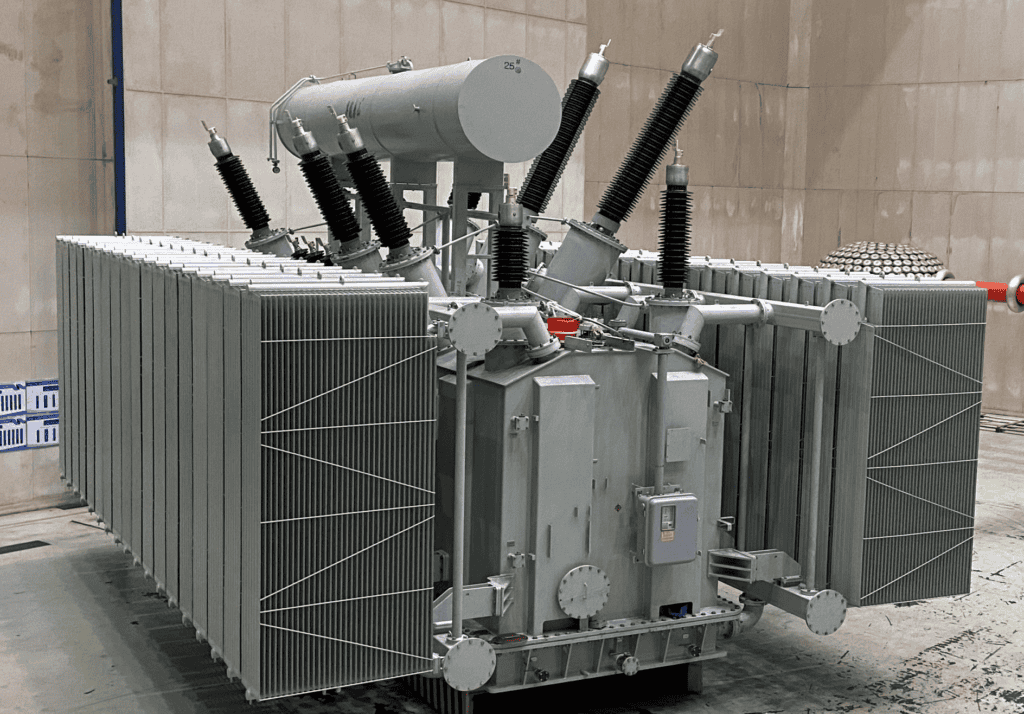
Choosing between oil-immersed and dry-type transformers is an important engineering and procurement decision because the transformer type affects installation safety, cooling performance, maintenance, space requirements, environmental risk, and lifecycle cost. Selecting a design based only on initial price or general preference can result in unsuitable equipment, higher operating expenses, or additional installation requirements. Buyers need to understand the fundamental differences between the two technologies and match them to the actual project conditions.
The main difference between oil-immersed and dry-type transformers is their insulation and cooling method: oil-immersed transformers use insulating liquid for heat transfer and dielectric insulation, while dry-type transformers use solid insulation and air for cooling. Oil-immersed transformers are often preferred for high-capacity, outdoor, and utility applications because of their effective cooling and high power-density capability, while dry-type transformers are often suitable for indoor, commercial, industrial, and fire-sensitive locations where avoiding insulating liquid is advantageous. The choice should consider capacity, voltage, installation environment, fire safety, cooling, maintenance, efficiency, space, and total lifecycle cost.
Neither transformer type is universally better. The appropriate choice depends on the electrical and environmental requirements of the specific installation, as well as applicable standards and project constraints.
What Is the Difference Between Oil-Immersed and Dry-Type Transformers and How Do You Choose?
Choosing between an oil-immersed transformer and a dry-type transformer affects far more than the initial purchase price. The wrong choice can create problems with installation space, fire protection, environmental management, cooling, maintenance, noise, efficiency, or future expansion. Oil-immersed transformers can offer excellent thermal performance and strong suitability for high-capacity outdoor power systems, while dry-type transformers eliminate insulating liquid and can be attractive where fire safety, indoor installation, cleanliness, and reduced liquid-related maintenance are priorities. The right choice depends on voltage and capacity, installation location, fire and environmental requirements, efficiency and losses, cooling conditions, available space, maintenance philosophy, acoustic requirements, lifecycle cost, and applicable standards—not simply on whether one transformer type is generally “better.” In practice, buyers should first define the application and site constraints, then compare both transformer technologies against the same technical and lifecycle criteria.

Dry-type transformers are always safer and more efficient than oil-immersed transformers.False
Both technologies can provide reliable and safe service when properly designed and installed. Their relative advantages depend on capacity, site conditions, insulation system, cooling, fire requirements, losses and application.
Oil-immersed transformers can provide effective heat transfer because the insulating liquid acts as both an electrical insulation medium and a cooling medium.True
Transformer liquid transfers heat from windings and core toward radiators or other cooling surfaces, supporting thermal management in many power-transformer designs.
What Is the Basic Difference Between the Two Transformer Types?
The fundamental difference is the insulation and cooling medium surrounding the active parts.
An oil-immersed transformer places the core and windings inside a tank containing insulating liquid, commonly mineral oil or another approved transformer fluid. The liquid provides electrical insulation and transfers heat away from the active components.
A dry-type transformer does not use an insulating liquid for its main insulation system. Its windings are insulated using solid materials, with designs commonly including cast-resin or other solid-insulation systems. Heat is normally transferred to surrounding air through natural or forced ventilation.
This difference creates a chain of practical consequences:
Insulation medium → thermal behavior → fire characteristics → installation requirements → maintenance → lifecycle cost.
The comparison should therefore start with the actual operating environment.
| Factor | Oil-Immersed Transformer | Dry-Type Transformer |
|---|---|---|
| Main insulation | Insulating liquid + solid insulation | Solid insulation + air |
| Typical installation | Outdoor substations and utility networks | Indoor, commercial and industrial facilities |
| Cooling | Liquid-assisted heat transfer + radiators | Air cooling |
| Liquid management | Required | Not applicable to main insulation |
| Liquid leakage risk | Present | Eliminated |
| Fire considerations | Requires assessment of transformer fluid and installation | Generally favorable because no main insulating liquid is present |
| Environmental considerations | Fluid selection and containment matter | No transformer-fluid containment for the main insulation |
| Typical footprint | Often favorable at larger power ratings | Can require more space for cooling |
| Inspection | Includes tank, liquid, bushings and accessories | Focuses on windings, insulation, ventilation and connections |
| Maintenance | Includes liquid diagnostics where applicable | No transformer-oil maintenance |
| High-capacity applications | Very common | More application-dependent |
These are general engineering tendencies, not universal rules.
How Do Electrical and Thermal Performance Compare?
Both technologies can be engineered for strong electrical performance.
The more important question is whether the selected design satisfies the required:
- Voltage class
- Insulation level
- Impedance
- Short-circuit withstand
- Temperature-rise limits
- Loss requirements
- Cooling capability
- Environmental conditions
Oil-immersed transformers have an important thermal advantage in many large power applications because the liquid circulates or transfers heat from the windings and core to external cooling surfaces.
Dry-type transformers rely primarily on air as the cooling medium. This can be highly effective for appropriately designed units, but the installation must provide adequate ventilation and heat dissipation.
A transformer room that is physically small but poorly ventilated can therefore create thermal problems even when the dry-type transformer itself is correctly designed.
Why Does Transformer Loading Matter?
Both transformer types generate losses.
These include:
- Core loss
- Winding load loss
- Additional stray losses
- Auxiliary losses where applicable
Load loss generally increases strongly with current, so operating a transformer above its intended loading conditions can produce substantially greater heat generation.
Therefore, buyers should evaluate the expected:
- Average load
- Peak load
- Load duration
- Load growth
- Harmonic content
- Ambient temperature
A transformer that appears appropriately rated based only on today's average load may not be the best choice if significant future loading is expected.
How Does Fire Safety Affect the Choice?
Fire safety is often one of the strongest reasons buyers consider dry-type transformers.
An oil-immersed transformer contains a significant quantity of insulating liquid. If a severe internal fault occurs, the fluid can contribute to the fire load depending on the fluid type and installation conditions.
This does not mean every oil-filled transformer installation is unsafe. Utility substations routinely use oil-immersed transformers with appropriate:
- Fire separation
- Containment
- Drainage
- Protection
- Fault interruption
- Site layout
Dry-type transformers eliminate the main insulating-liquid fire and spill considerations associated with oil-filled designs.
For buildings where liquid containment or fire separation is difficult, this can be a major advantage.
Is Dry-Type Always the Best Choice for Fire Safety?
Not necessarily.
Dry-type transformers still contain combustible solid insulation and other electrical components, and a serious electrical fault can generate heat, smoke, or fire.
The correct conclusion is:
Oil-free does not mean fire-proof.
Fire risk should be evaluated as part of the complete electrical installation.
How Do Environmental Risks Differ?
Oil-immersed transformers require consideration of the insulating liquid throughout their lifecycle.
Potential concerns include:
- Leakage
- Spill containment
- Fluid degradation
- Disposal
- Sampling
- Environmental release
Dry-type transformers eliminate the main liquid-related spill pathway.
This can simplify installations where environmental protection is particularly important.
However, buyers should still consider:
- Manufacturing impacts
- Insulation materials
- End-of-life disposal
- Energy losses
- Component recycling
Environmental performance is therefore broader than simply asking whether the transformer contains oil.
How Does Maintenance Differ?
Oil-immersed transformer maintenance can include:
- Oil sampling
- Dissolved gas analysis
- Moisture testing
- Dielectric-fluid testing
- Tank inspection
- Bushing inspection
- Cooling-system inspection
- Leak inspection
Dry-type transformer maintenance generally focuses on:
- Winding cleanliness
- Insulation condition
- Ventilation
- Cooling passages
- Connections
- Terminals
- Temperature monitoring
- Partial-discharge assessment where applicable
This creates a useful distinction:
Oil-immersed: more liquid-related diagnostic work.
Dry-type: less liquid-related maintenance, but greater attention may be required for ventilation, contamination and solid insulation condition.
How Does Installation Location Affect the Decision?
Location can quickly narrow the options.
Outdoor utility substation: oil-immersed technology is often highly practical.
Indoor commercial building: dry-type may be attractive.
Industrial plant: either may be appropriate depending on fire, capacity, environment and reliability requirements.
Renewable-energy site: either may work depending on transformer voltage, capacity, inverter characteristics, harmonics and environmental exposure.
Underground or enclosed location: fire, ventilation, access and liquid containment become especially important.
How Does Space Affect the Choice?
Dry-type transformers can require significant ventilation because air must remove heat from the transformer.
The buyer should therefore evaluate:
- Transformer dimensions
- Clearance
- Ventilation area
- Room temperature
- Airflow
- Access space
- Maintenance space
Oil-immersed designs can have different space requirements because radiators and liquid-cooling arrangements affect their geometry.
The correct comparison should use the complete installation footprint, not just the transformer nameplate dimensions.
How Does Humidity Affect Dry-Type Transformers?
Dry-type does not mean completely insensitive to moisture.
High humidity, condensation and contamination can affect solid insulation surfaces and electrical performance.
Appropriate design may therefore require consideration of:
- Enclosure
- Ventilation
- Condensation control
- Heating
- Pollution level
- Installation environment
This is particularly important in damp industrial or poorly controlled rooms.
How Does Pollution Affect Both Technologies?
Dust and industrial contamination can accumulate on exposed insulation and cooling surfaces.
For dry-type transformers, contamination can affect:
- Insulation surfaces
- Heat dissipation
- Creepage behavior
- Partial-discharge performance
Oil-immersed transformers also have exposed bushings and other external insulation that can become contaminated.
Therefore, neither transformer type eliminates the need for environmental maintenance.
How Do Noise Levels Compare?
Transformer noise originates primarily from:
- Core magnetostriction
- Electromagnetic forces
- Cooling fans
- Pumps
- Structural vibration
Neither technology should automatically be assumed to be silent.
For noise-sensitive projects, buyers should specify the required acoustic performance and request supplier data.
This is especially important for:
- Hospitals
- Residential developments
- Commercial buildings
- Data centers
- Urban substations
How Do Efficiency and Lifecycle Costs Compare?
Purchase price alone can produce a misleading comparison.
A more useful lifecycle calculation considers:
Purchase cost + installation cost + losses + maintenance + auxiliary energy + environmental management + downtime risk + end-of-life cost.
For example, a transformer with a slightly higher purchase price may be preferable if its losses are substantially lower over a long operating period.
Conversely, a lower-maintenance dry-type transformer may have an attractive lifecycle profile in an indoor facility even if its initial purchase price differs from an oil-immersed alternative.
What Costs Should Buyers Include?
| Cost Category | Oil-Immersed | Dry-Type |
|---|---|---|
| Transformer purchase | Compare actual specification | Compare actual specification |
| Installation | Tank/radiator/site requirements | Room/ventilation requirements |
| Civil works | Containment may be relevant | Room and ventilation may dominate |
| Fire protection | Site-specific liquid/fire measures | Generally simpler liquid-related requirements |
| Cooling auxiliaries | Fans/pumps depending on design | Fans may be required depending on design |
| Fluid testing | Applicable | Not applicable to main insulation |
| Oil replacement | Applicable to relevant designs | Not applicable |
| Leak management | Applicable | No transformer-fluid leakage |
| Energy losses | Must be evaluated | Must be evaluated |
| Maintenance labor | Liquid + electrical | Electrical + ventilation/cleaning |
| Downtime risk | Application-dependent | Application-dependent |
| End-of-life | Fluid and equipment handling | Solid materials and equipment handling |
How Should Buyers Compare Service Life?
Service life depends heavily on:
- Thermal stress
- Insulation aging
- Loading
- Moisture
- Maintenance
- Manufacturing quality
- Environmental conditions
It is therefore misleading to state that one technology automatically lasts longer.
A properly selected and maintained transformer of either type can provide long service.
The buyer should instead ask suppliers to explain:
- Insulation aging assumptions
- Temperature-rise design
- Expected loading profile
- Maintenance requirements
- Environmental limitations
- Monitoring provisions
How Does Short-Circuit Withstand Affect the Choice?
A transformer must withstand the mechanical and thermal effects of short-circuit events for the required duration.
This is especially important for high-capacity systems.
Buyers should verify:
- Transformer impedance
- Prospective fault current
- Short-circuit withstand
- Winding mechanical design
- Applicable test evidence
This requirement applies to both oil-immersed and dry-type transformers.
How Do Harmonics Affect the Decision?
Modern loads can generate significant harmonic currents, particularly:
- Variable-frequency drives
- Rectifiers
- UPS systems
- Data centers
- Solar inverters
- Battery systems
Harmonic currents can increase transformer heating and losses.
Therefore, buyers should provide the expected harmonic environment and ask suppliers whether:
- Derating is required
- A K-factor or equivalent design consideration is needed
- Additional thermal margin is appropriate
- Special winding arrangements are recommended
The transformer type should be selected after considering the actual load waveform.
What About Renewable-Energy Applications?
Both technologies can support renewable-energy systems.
For example:
- Solar farms
- Wind projects
- Battery energy storage
- Microgrids
The selection depends on:
- Voltage
- Capacity
- Inverter behavior
- Harmonics
- Outdoor exposure
- Fire requirements
- Cooling
- Maintenance access
Large outdoor renewable-energy collector systems frequently favor oil-immersed designs, while certain indoor or compact power-conversion applications may favor dry-type designs.
How Does Fire Risk Affect Indoor Installation?
For indoor applications, buyers should examine:
- Building fire strategy
- Transformer room location
- Fire separation
- Ventilation
- Emergency access
- Spill requirements
- Local electrical/fire codes
If installing an oil-immersed transformer inside a building, the liquid volume and fire-protection requirements can materially affect the project.
A dry-type transformer can simplify some of these requirements, but the complete installation still requires appropriate electrical and fire protection.
How Should Buyers Compare Reliability?
Reliability should be evaluated using the complete system rather than transformer type alone.
Consider:
- Manufacturer quality
- Insulation design
- Cooling
- Protection
- Monitoring
- Environmental exposure
- Maintenance access
- Spare parts
- Factory testing
- Installation quality
A premium transformer installed incorrectly can be less reliable than a simpler transformer installed correctly.
What Monitoring Options Should Buyers Consider?
For critical transformers, buyers may consider:
Oil-immersed
- Oil temperature
- Winding temperature
- Moisture
- Dissolved gases
- Bushing condition
- Pressure
- Load
- Cooling status
Dry-type
- Winding temperature
- Partial discharge where applicable
- Insulation condition
- Cooling/ventilation status
- Load
- Hot-spot temperature
Monitoring is particularly useful where transformer failure would cause major operational or financial consequences.
How Should Buyers Evaluate Standards and Compliance?
Do not ask simply:
“Is this transformer compliant?”
Instead, identify the standards and project requirements applicable to the installation and ask the supplier to map the offered design to them.
Review:
- Transformer design standard
- Installation requirements
- Insulation requirements
- Testing requirements
- Fire requirements
- Environmental requirements
- Noise limits
- Local electrical regulations
The exact standards depend on the country, voltage level, application and installation.
What Questions Should Buyers Ask Suppliers?
A useful supplier comparison should include:
- What transformer technology is being offered?
- Why is it suitable for the application?
- What are the guaranteed no-load and load losses?
- What are the temperature-rise limits?
- What cooling system is required?
- What clearances and ventilation are required?
- What fire-protection measures are required?
- What maintenance is recommended?
- What monitoring is included?
- What factory tests are performed?
- What type-test evidence is available?
- What warranty conditions apply?
- What spare parts are recommended?
- What is the expected delivery time?
- What are the end-of-life handling requirements?
These questions make quotations much easier to compare objectively.
A Practical Decision Matrix
Buyers can use a weighted evaluation like this:
| Criterion | Oil-Immersed Advantage | Dry-Type Advantage | Importance |
|---|---|---|---|
| Large outdoor capacity | High | Application-dependent | High |
| Indoor installation | Application-dependent | High | High |
| Fire-sensitive building | Requires additional assessment | Often favorable | High |
| Liquid spill avoidance | Lower | High | High |
| Large-capacity thermal management | Often strong | Application-dependent | High |
| Minimal liquid maintenance | Lower | High | Medium |
| Severe outdoor exposure | Often practical | Application-dependent | High |
| Limited ventilation | Can be advantageous depending on design | Potential limitation | High |
| Environmental liquid restrictions | Requires fluid/containment strategy | Favorable | High |
| Very low noise | Design-dependent | Design-dependent | Medium |
| Lifecycle efficiency | Depends on losses | Depends on losses | High |
| Initial price | Project-dependent | Project-dependent | Medium |
| Future maintenance | Liquid diagnostics required | Cleaning/electrical focus | Medium |
The weighting should reflect the actual project rather than using a universal scoring system.
When Is an Oil-Immersed Transformer Usually the Better Choice?
Oil-immersed technology is often worth serious consideration when the application involves:
- Large power ratings
- Outdoor substations
- Utility transmission/distribution systems
- High-capacity renewable-energy collection
- Strong thermal-management requirements
- Adequate space for radiators and associated equipment
- Appropriate fire and environmental controls
Its mature technology and strong thermal characteristics make it a common choice for large power-system applications.
When Is a Dry-Type Transformer Usually the Better Choice?
Dry-type technology is often attractive when the project prioritizes:
- Indoor installation
- Reduced liquid-related fire concerns
- No transformer-fluid spill risk
- Clean electrical rooms
- Commercial buildings
- Industrial facilities
- Buildings where liquid containment is difficult
- Reduced liquid-maintenance requirements
However, ventilation, temperature, contamination and physical space must be carefully evaluated.
When Should Buyers Consider Both Before Deciding?
If the application is not obviously suited to one technology, buyers should request comparable quotations for both.
Use the same:
- Capacity
- Voltage
- Impedance
- Insulation level
- Loss guarantees
- Temperature-rise requirements
- Noise requirements
- Protection
- Monitoring
- Warranty
- Testing
Then compare the complete installed and lifecycle cost.
This prevents an apparently cheaper transformer from winning simply because important accessories or installation requirements have been excluded.
What Is the Simplest Way to Choose?
A practical decision sequence is:
Step 1 — Define the electrical duty.
Determine voltage, capacity, impedance, fault level and load profile.
Step 2 — Define the environment.
Determine indoor/outdoor conditions, altitude, humidity, pollution, ambient temperature and ventilation.
Step 3 — Define safety constraints.
Establish fire, spill, access and environmental requirements.
Step 4 — Define lifecycle priorities.
Evaluate losses, maintenance, monitoring, spare parts and expected operating life.
Step 5 — Compare complete quotations.
Include transformer, accessories, installation, testing, protection, cooling, fire measures and commissioning.
Step 6 — Verify compliance.
Review drawings, test reports, certificates and applicable standards.
Step 7 — Select based on total value.
Choose the technology that best satisfies the technical and lifecycle requirements—not simply the lowest purchase price.
Buyer Takeaway
Oil-immersed and dry-type transformers are not competing technologies with one universal winner. Oil-immersed transformers are often highly suitable for large outdoor power systems because insulating liquid provides effective heat transfer and mature high-capacity designs are widely available. Dry-type transformers are often attractive for indoor, commercial and industrial applications because they eliminate the main insulating-liquid spill pathway and can simplify some fire and environmental considerations. However, dry-type units still require careful attention to ventilation, temperature, contamination and insulation condition.
For procurement, compare both technologies using the same technical baseline:
Electrical performance → thermal performance → fire safety → environmental risk → installation → maintenance → efficiency → reliability → lifecycle cost.
The most important principle is to evaluate the complete installation, not the transformer alone. An oil-immersed transformer may be the better value for a large outdoor substation, while a dry-type transformer may be the better solution inside a fire-sensitive commercial or industrial building. The final choice should follow the actual duty, site conditions, applicable regulations and lifecycle economics.
How Do Oil-Immersed and Dry-Type Transformers Differ in Insulation and Cooling?
Transformer insulation and cooling directly determine electrical reliability, temperature rise, insulation aging, overload capability, and service life. Choosing a transformer without understanding these two systems can lead to excessive temperature, accelerated insulation deterioration, poor installation performance, or unexpected maintenance requirements. The key difference is that an oil-immersed transformer uses insulating liquid together with solid insulation, while a dry-type transformer relies primarily on solid insulation and air for insulation and heat removal. Oil-immersed transformers use transformer liquid to provide both dielectric insulation and efficient heat transfer from the core and windings to cooling surfaces, whereas dry-type transformers use solid insulation around the windings and transfer heat primarily through air, either naturally or with forced ventilation. Neither approach is universally superior: the appropriate choice depends on voltage, capacity, loading, ambient conditions, installation environment, ventilation, fire requirements, and the required thermal performance.

Oil in an oil-immersed transformer serves both electrical insulation and heat-transfer functions.True
Transformer liquid provides dielectric insulation around active parts while transferring heat from the core and windings toward radiators, tanks, heat exchangers or other cooling surfaces.
Dry-type transformers have no insulation system because they do not contain transformer oil.False
Dry-type transformers use engineered solid insulation systems, commonly including resin, enamel, paper, films and other insulating materials, depending on their design.
How Does Insulation Work in an Oil-Immersed Transformer?
An oil-immersed transformer normally uses a combined liquid-and-solid insulation system. The windings contain conductor insulation, while additional solid insulation separates winding sections and controls electric-field stress. The surrounding transformer liquid fills spaces between active components and contributes additional dielectric strength.
This arrangement provides several functions simultaneously:
- Electrical separation between conductors
- Electrical separation between winding sections
- Insulation between windings and grounded structures
- Electric-field control
- Heat transfer
- Protection of cellulose insulation from direct atmospheric exposure
The insulation system therefore should be considered as an integrated structure rather than simply “oil around copper.”
In a properly designed oil-immersed transformer, the liquid circulates through or around heated regions and carries thermal energy toward cooler surfaces. Depending on the transformer design, cooling may rely on natural circulation, forced liquid circulation, fans, pumps, or combinations of these methods.
How Does Insulation Work in a Dry-Type Transformer?
Dry-type transformers eliminate the main insulating-liquid system and use solid dielectric materials plus air.
Depending on the design, windings may use:
- Cast resin
- Vacuum-pressure impregnation
- Enamel insulation
- Insulating films
- Glass-fiber reinforcement
- Other solid insulation materials
A cast-resin transformer, for example, encapsulates or surrounds the winding with resin that provides mechanical support and electrical insulation.
The absence of insulating liquid changes the thermal pathway:
Winding conductor → solid insulation → surrounding air → ventilation system
Consequently, the transformer's enclosure and room ventilation can become important parts of its thermal-management system.
How Do the Two Cooling Systems Differ?
| Feature | Oil-Immersed Transformer | Dry-Type Transformer |
|---|---|---|
| Primary cooling medium | Transformer liquid | Air |
| Insulation medium | Liquid + solid insulation | Solid insulation + air |
| Heat transfer | Liquid-assisted | Air-based |
| Heat removal surfaces | Tank/radiators/heat exchangers | Winding surfaces/air ducts/enclosure |
| Natural cooling | Liquid circulation + natural air movement | Natural air circulation |
| Forced cooling | Fans and/or pumps depending on design | Fans where required |
| Liquid maintenance | Applicable | Not applicable |
| Ventilation dependence | Site-specific | Often significant |
| Moisture considerations | Important for liquid and solid insulation | Important for solid insulation and condensation |
| Large power applications | Very common | More application-dependent |
Why Is Oil an Effective Cooling Medium?
Transformer oil or another approved transformer liquid has two important characteristics: it can provide dielectric insulation while also transporting heat.
The basic thermal path is:
Core and windings → liquid → tank/radiators → surrounding environment
Because the liquid is in close contact with the heated active components, it can efficiently move thermal energy away from localized hot regions.
This is particularly valuable as transformer capacity increases.
How Does Natural Oil Cooling Work?
In a naturally cooled oil-immersed transformer, heating causes the liquid to circulate through the transformer by natural convection.
The simplified process is:
- Windings and core generate heat.
- Nearby liquid becomes warmer.
- Warmer liquid moves upward.
- Cooler liquid moves downward.
- Heat reaches the tank and radiators.
- Heat is transferred to surrounding air.
This process can provide effective cooling without continuously operating pumps.
How Does Forced Oil Cooling Work?
Higher-capacity transformers may require additional cooling.
Depending on the design, pumps can increase liquid circulation while fans increase airflow across radiators or heat exchangers.
This creates a more effective thermal path:
Active parts → circulating liquid → heat exchanger/radiator → forced airflow → ambient environment
The exact cooling designation and arrangement should be verified against the manufacturer's documentation rather than assumed from transformer size alone.
Why Does Dry-Type Cooling Depend on Airflow?
Air has a lower heat-transfer capability than transformer liquid, so the physical design of the dry-type transformer must provide effective heat dissipation.
Heat travels from the conductor and insulation toward exposed surfaces and then into surrounding air.
The installation therefore needs suitable:
- Ventilation
- Airflow
- Room volume
- Heat removal
- Clearance
- Ambient temperature control
A correctly designed dry-type transformer installed in a poorly ventilated room can experience higher temperatures than expected.
How Does Temperature Affect Transformer Insulation?
Temperature is one of the most important factors governing insulation aging.
As transformer insulation operates at elevated temperature over long periods, aging generally accelerates.
For both transformer types, buyers should therefore review:
- Temperature rise
- Hot-spot temperature
- Ambient temperature assumptions
- Loading profile
- Cooling-system capability
- Insulation thermal class where applicable
The goal is not simply to keep the average transformer temperature low. Local hot spots can be especially important because aging can be strongly influenced by the hottest regions of the insulation system.
Why Is Hot-Spot Temperature Important?
The winding hot spot is typically hotter than the average winding temperature.
This distinction matters because a transformer can show an acceptable average temperature while a localized region experiences significantly higher thermal stress.
For critical transformers, buyers should therefore ask about:
- Hot-spot assumptions
- Temperature sensors
- Thermal monitoring
- Overtemperature alarms
- Cooling-stage control
How Does Overloading Affect Oil-Immersed Transformers?
When transformer current increases, winding losses increase and additional heat is generated.
The liquid cooling system must remove this additional heat.
If the transformer remains overloaded for too long, the resulting temperature increase can accelerate insulation aging.
Therefore, buyers should compare:
Expected loading profile vs. transformer thermal capability.
This is more meaningful than simply asking whether a transformer can “handle overload.”
How Does Overloading Affect Dry-Type Transformers?
The same basic principle applies.
Higher current produces greater winding losses and therefore more heat.
In a dry-type transformer, that heat must ultimately be transferred to air.
If room ventilation cannot remove the heat, transformer temperature can rise.
This is why the transformer specification and building HVAC/ventilation design should be considered together for indoor dry-type installations.
How Do Moisture and Insulation Differ Between the Two?
Moisture is undesirable for both technologies, but it interacts with their insulation systems differently.
In oil-immersed transformers, moisture can migrate between:
- Transformer liquid
- Cellulose insulation
- Paper
- Pressboard
Moisture can reduce dielectric performance and contribute to accelerated insulation aging.
In dry-type transformers, moisture can contribute to:
- Surface contamination
- Reduced insulation performance
- Condensation
- Partial-discharge risk under unfavorable conditions
Therefore, dry-type does not mean moisture-proof.
How Does Pollution Affect Dry-Type Transformer Cooling?
Dust and industrial contamination can accumulate on winding surfaces and cooling passages.
This can:
- Restrict airflow
- Reduce heat transfer
- Increase surface contamination
- Increase tracking risk under humid conditions
Therefore, dry-type transformers installed in dusty industrial environments may require appropriate enclosures, filtration, cleaning and environmental controls.
How Does Pollution Affect Oil-Immersed Transformers?
Oil-immersed transformers also require external insulation maintenance.
Bushings and terminals can collect:
- Dust
- Salt
- Industrial deposits
- Moisture
Contaminated external insulation can increase leakage current and surface-flashover risk.
The internal insulating liquid does not eliminate the need to maintain external insulation surfaces.
Which Type Provides Better Cooling?
There is no universal answer, but oil-immersed designs generally have strong thermal-management advantages for high-capacity power applications because liquid provides efficient heat transfer from active parts.
Dry-type transformers can also provide excellent thermal performance when properly designed and installed, particularly at their intended capacity and environmental conditions.
For a buyer, the better question is:
Does the proposed transformer maintain acceptable winding and hot-spot temperatures under my actual load and ambient conditions?
Request actual temperature-rise data rather than relying on the transformer category alone.
Which Type Provides Better Insulation?
Again, neither technology is automatically superior.
Oil-immersed transformers use a sophisticated liquid-and-solid insulation system that has long been used for high-voltage power applications.
Dry-type transformers use engineered solid insulation systems that can provide excellent dielectric and mechanical performance.
The relevant evaluation should include:
- Insulation level
- Dielectric withstand
- Impulse withstand
- Partial-discharge performance where applicable
- Creepage
- Clearances
- Insulation aging
- Environmental suitability
How Should Buyers Compare Insulation and Cooling Specifications?
A practical comparison table should look like this:
| Parameter | Oil-Immersed | Dry-Type | Buyer Question |
|---|---|---|---|
| Insulation system | Liquid + solid | Solid + air | Is the system suitable for voltage class? |
| Cooling medium | Liquid | Air | Can heat be adequately removed? |
| Temperature rise | Design-specific | Design-specific | Does it meet project limits? |
| Hot spot | Important | Important | How is it controlled/monitored? |
| Ambient temperature | Important | Very important | What ambient conditions were assumed? |
| Ventilation | Usually site-specific | Often critical | Is sufficient airflow available? |
| Moisture | Liquid + solid insulation | Solid insulation | What environmental controls are needed? |
| Pollution | External insulation | Windings + external insulation | What cleaning/enclosure is required? |
| Overload | Thermal capability dependent | Thermal capability dependent | What loading profile is permitted? |
| Monitoring | Oil and temperature diagnostics possible | Temperature/PD monitoring possible | What sensors are included? |
What Should Buyers Ask About Cooling Capacity?
Before ordering, request:
- Rated cooling method.
- Maximum ambient temperature.
- Rated temperature rise.
- Winding hot-spot information.
- Cooling-stage operation.
- Fan or pump requirements.
- Auxiliary power requirements.
- Ventilation requirements.
- Overload limitations.
- Alarm and trip settings.
These details help prevent a transformer from being technically compliant but poorly matched to the installation.
What Should Buyers Ask About Insulation?
Ask the manufacturer to provide:
- Rated insulation levels
- Power-frequency withstand
- Impulse withstand
- Bushing insulation information
- Creepage and clearance data
- Partial-discharge requirements where applicable
- Insulation-temperature limits
- Environmental limitations
- Factory test results
For high-voltage applications, insulation coordination should be reviewed as part of the complete system.
How Does Cooling Influence Transformer Efficiency?
Cooling itself consumes energy when fans or pumps are used.
A transformer with forced cooling may therefore have auxiliary electrical consumption in addition to its core and load losses.
Buyers evaluating lifecycle efficiency should consider:
No-load loss + load loss + cooling auxiliary consumption
This can be particularly relevant for continuously energized transformers.
How Does Cooling Affect Installation Design?
For an oil-immersed transformer, installation planning may need to include:
- Radiator clearance
- Liquid containment where applicable
- Fire separation
- Access
- Cooling airflow
- Maintenance space
For a dry-type transformer, the installation may require:
- Ventilation openings
- Airflow paths
- Room heat removal
- Adequate clearances
- Cleaning access
Therefore, transformer selection and installation design should not be treated as completely independent decisions.
How Do Buyers Verify the Manufacturer's Claims?
Do not rely only on a datasheet statement such as “excellent cooling.”
Request measurable evidence:
- Temperature-rise test results
- Routine test reports
- Type-test evidence where relevant
- Cooling-system drawings
- Thermal calculations where required
- Ambient-temperature assumptions
- Installation instructions
The factory data should become the baseline for commissioning and future condition monitoring.
What Is the Key Procurement Principle?
The most useful procurement principle is:
Specify the operating condition first, then verify the thermal and insulation design against it.
For example:
If the transformer will operate outdoors at high ambient temperature with substantial peak loading, the buyer should provide those conditions to the manufacturer.
If it will operate indoors in a compact electrical room, the buyer should specify room temperature, ventilation and available space.
The transformer should then be evaluated against the actual conditions rather than a generic application.
Buyer Takeaway
Oil-immersed transformers use insulating liquid as part of both their dielectric and thermal systems, allowing heat generated by the core and windings to be transferred efficiently toward tanks, radiators or heat exchangers. Dry-type transformers use solid insulation and rely primarily on air to remove heat, making ventilation, room temperature, contamination and airflow particularly important. Both technologies can achieve strong insulation and cooling performance when correctly engineered, but their thermal and insulation requirements must be evaluated against the actual voltage, load, ambient and installation conditions.
For buyers, compare:
Insulation level → temperature rise → hot-spot temperature → cooling method → ambient conditions → ventilation → moisture → pollution → overload capability → monitoring → test evidence.
The right transformer is not simply the one with the preferred insulation medium. It is the transformer whose complete insulation and cooling system can reliably manage the electrical and thermal stresses of the intended application throughout its service life.
How Do Oil-Immersed and Dry-Type Transformers Compare in Fire Safety and Environmental Requirements?
Fire safety and environmental compliance can become major cost and design constraints when selecting a transformer. An oil-immersed transformer contains insulating liquid, so buyers must consider fire load, leakage, containment, drainage, fluid management, and site separation in addition to normal electrical protection. A dry-type transformer removes the main liquid-related spill and fire considerations, but it is not fire-proof and still requires appropriate ventilation, temperature control, insulation protection, and electrical fault protection. Oil-immersed transformers generally require more extensive fire and liquid-management measures because they contain insulating fluid, while dry-type transformers generally simplify spill containment and some indoor fire-safety requirements; however, the correct choice must be based on transformer fluid properties, capacity, installation location, applicable fire and environmental codes, ventilation, building layout, and lifecycle risk.

Dry-type transformers are completely fire-proof because they contain no transformer oil.False
Dry-type transformers eliminate the main insulating-liquid fire and spill pathway, but their solid insulation, conductors and other electrical components can still be involved in an electrical fault or fire.
Oil-immersed transformer installations may require measures such as liquid containment and fire separation depending on the transformer, fluid and installation.True
The quantity and characteristics of insulating liquid and the installation environment can create fire and environmental hazards that must be addressed through applicable engineering and regulatory requirements.
What Is the Main Fire-Safety Difference?
The most important difference is the presence of insulating liquid.
An oil-immersed transformer normally contains a substantial volume of insulating fluid. During a severe internal electrical fault, the transformer can experience rapid heating, gas generation, pressure rise, arcing and potentially fluid ignition.
This means the installation may need to address several separate hazards:
- Electrical fault energy
- Transformer fluid fire load
- Fluid leakage
- Pressure release
- Fire propagation
- Heat exposure to nearby equipment
- Environmental contamination
A dry-type transformer has no main insulating-liquid reservoir. Consequently, it eliminates the specific hazard of a transformer-fluid spill or pool fire.
However, electrical fault protection remains essential for both technologies.
How Do Fire Risks Compare?
| Requirement | Oil-Immersed Transformer | Dry-Type Transformer |
|---|---|---|
| Insulating liquid | Present | Normally absent |
| Liquid fire load | Must be evaluated | Eliminated for main insulation |
| Liquid spill | Possible | Not applicable |
| Oil containment | May be required | Not required for transformer liquid |
| Fire separation | Site/design dependent | Still required according to installation |
| Ventilation | Depends on installation/cooling | Often important for heat removal |
| Electrical fault protection | Essential | Essential |
| Fire detection | Project dependent | Project dependent |
| Pressure protection | Applicable to relevant designs | Different fault-management approach |
| Environmental spill control | Important | Simplified |
| Building installation | Requires additional assessment | Often easier from liquid-management perspective |
This table should be treated as a procurement starting point, not a substitute for local code review.
Does Oil-Immersed Automatically Mean Unsafe?
No.
Oil-immersed transformers are widely used in utility substations and industrial power systems because their electrical and thermal performance can be excellent.
Their safety depends heavily on the complete installation design.
Appropriate engineering can include:
- Fault protection
- Fire barriers
- Separation distances
- Liquid containment
- Drainage
- Pressure-relief arrangements
- Automatic isolation
- Fire detection
- Emergency access
Therefore, the correct question is not whether an oil-immersed transformer is inherently unsafe. It is whether its fluid, fire and electrical hazards have been appropriately managed.
Does Dry-Type Automatically Eliminate Fire Concerns?
No.
Dry-type transformers remove the main insulating-fluid hazard, but they still contain:
- Conductors
- Solid insulation
- Terminals
- Connections
- Core components
- Enclosures
- Potentially cooling fans and control equipment
An internal fault can generate substantial heat and electrical arcing.
Therefore, buyers should still verify:
- Short-circuit protection
- Overcurrent protection
- Temperature protection
- Installation clearances
- Ventilation
- Fire detection where required
- Enclosure requirements
The phrase “oil-free” should never be interpreted as “risk-free.”
How Does Transformer Fluid Affect Environmental Requirements?
For oil-immersed transformers, buyers should identify the exact insulating fluid.
Potential fluids include:
- Mineral transformer oil
- Natural ester fluids
- Synthetic ester fluids
- Other approved insulating liquids
These fluids can have different:
- Fire characteristics
- Biodegradability
- Environmental profiles
- Handling requirements
- Storage requirements
- Disposal requirements
Consequently, specifying simply “oil-filled transformer” is not sufficient for a complete environmental evaluation.
What Environmental Risks Exist With Oil-Immersed Transformers?
The main lifecycle concerns can include:
Leakage: Damaged tanks, seals, valves or connections can release fluid.
Spills: Large releases can contaminate soil or drainage systems.
Fluid disposal: Used transformer fluid must be handled according to applicable requirements.
Maintenance: Fluid sampling and testing create additional handling requirements.
Transportation: Fluid-filled equipment requires consideration of leakage and shipping damage.
End of life: The transformer fluid and contaminated components require appropriate management.
These risks can often be controlled, but they should be included in the project design and procurement specification.
What Environmental Advantages Does Dry-Type Offer?
Dry-type transformers provide an important practical advantage by eliminating the main insulating-liquid system.
This means:
- No transformer-fluid spill
- No oil containment basin for the transformer
- No routine transformer-oil sampling
- No oil leakage from the main insulation system
- No transformer-fluid disposal at end of life
This can be particularly valuable in:
- Commercial buildings
- Hospitals
- Schools
- Underground facilities
- Urban electrical rooms
- Environmentally sensitive locations
Is Dry-Type More Environmentally Friendly?
Not automatically.
Environmental performance includes more than fluid leakage.
Buyers should compare:
- Transformer losses
- Electricity consumption over service life
- Manufacturing materials
- Cooling energy
- Maintenance
- Transportation
- Insulation materials
- End-of-life treatment
A transformer that has lower operating losses can have a significant lifecycle environmental advantage because electrical losses occur throughout its operating life.
How Does Installation Location Affect Fire Requirements?
Installation location can strongly influence the choice.
For example:
Outdoor substation: An oil-immersed transformer may be highly practical when appropriate separation and containment are available.
Indoor commercial building: Dry-type can simplify liquid-related fire and spill management.
Underground facility: Avoiding large quantities of insulating liquid may be particularly attractive, subject to project-specific engineering.
Industrial plant: The decision depends on fire risk, chemicals, dust, process hazards, capacity and maintenance access.
Coastal installation: Environmental exposure affects both technologies, especially external insulation and enclosures.
Why Is Ventilation Important for Dry-Type Transformers?
Dry-type transformers transfer heat to air.
Therefore, the room must be able to remove the heat generated by:
- Core losses
- Load losses
- Harmonic-related losses
- Auxiliary equipment
Insufficient ventilation can increase transformer temperature and accelerate insulation aging.
The buyer should therefore verify:
- Room volume
- Ventilation openings
- Airflow direction
- Cooling fan requirements
- Maximum room temperature
- Heat rejection capacity
A dry-type transformer should be evaluated together with its electrical room.
Does Oil-Immersed Cooling Reduce Ventilation Requirements?
Not necessarily.
Oil-immersed transformers transfer much of their heat through the insulating liquid to radiators, but the radiators still ultimately release heat to the surrounding environment.
Indoor oil-immersed installations therefore also require appropriate thermal and ventilation planning.
The difference is that the internal heat-transfer mechanism is primarily liquid-based rather than directly air-based.
How Should Buyers Evaluate Fire Separation?
The required separation depends on:
- Transformer size
- Fluid volume
- Fluid type
- Building construction
- Transformer location
- Nearby combustible materials
- Applicable fire codes
- Fire-protection strategy
Buyers should not assume that one universal separation distance applies to every transformer.
Instead, the transformer supplier and responsible electrical/fire engineers should establish the required installation arrangement.
What Is Liquid Containment?
Liquid containment is designed to prevent insulating fluid released from an oil-immersed transformer from spreading into undesirable areas.
Possible arrangements can include:
- Bunds
- Containment pits
- Drainage systems
- Oil-water separation
- Collection systems
- Controlled drainage
The appropriate design depends on the transformer fluid quantity and local environmental requirements.
Why Is Drainage Important?
A transformer fluid release should not simply be allowed to enter:
- Stormwater systems
- Soil
- Surface water
- Building drainage
The installation should provide a controlled path for collecting or managing released fluid where required.
This is an important difference between oil-immersed and dry-type installations because the latter does not have a comparable transformer-fluid spill pathway.
How Does Fire Protection Interact With Transformer Protection?
Electrical protection is the first line of defense against many transformer fire scenarios.
Important functions can include:
- Differential protection
- Overcurrent protection
- Ground-fault protection
- Temperature protection
- Pressure protection
- Surge protection
- Appropriate breaker operation
The objective is to identify abnormal conditions and isolate the transformer before damage escalates.
How Should Buyers Evaluate Fire Protection Equipment?
Depending on the application, buyers may need to evaluate:
- Fire detection
- Automatic suppression
- Fire barriers
- Emergency shutdown
- Alarm systems
- Pressure relief
- Containment
- Remote monitoring
The transformer supplier should clearly identify which functions are included in the transformer and which must be provided by the site contractor.
This distinction is important during quotation comparison.
What Should Buyers Include in the Technical Specification?
A useful fire and environmental section should define:
Fire
- Installation location
- Transformer fluid type
- Fluid quantity
- Fire classification requirements
- Required separation
- Fire barriers
- Detection requirements
- Suppression requirements
- Emergency isolation
Environment
- Spill containment
- Drainage
- Fluid handling
- Fluid testing
- Disposal
- Environmental reporting
- End-of-life requirements
This prevents suppliers from making incompatible assumptions.
How Should Buyers Compare Fluid Types?
For oil-immersed transformers, ask suppliers to identify the proposed fluid and provide relevant technical data.
| Fluid Consideration | Why It Matters |
|---|---|
| Flash/fire characteristics | Influences fire-risk assessment |
| Biodegradability | Important for environmental planning |
| Dielectric performance | Affects insulation design |
| Thermal performance | Affects cooling |
| Oxidation stability | Influences service and maintenance |
| Moisture interaction | Affects insulation condition |
| Spill response | Influences environmental planning |
| Disposal requirements | Important at end of life |
| Availability | Affects maintenance and replacement |
| Compatibility | Important for materials and accessories |
The lowest-risk fluid is not necessarily the cheapest fluid. The complete technical and lifecycle impact should be evaluated.
What About Ester-Filled Transformers?
Ester fluids may provide favorable fire and environmental characteristics compared with conventional mineral oil in suitable applications.
However, buyers should not assume that changing the fluid requires no design changes.
The manufacturer should confirm compatibility with:
- Transformer materials
- Seals
- Insulation
- Cooling design
- Accessories
- Protection settings
- Testing requirements
Fluid selection should therefore occur during transformer design, not after procurement.
How Does Dry-Type Insulation Affect Fire Safety?
Dry-type transformer insulation systems can use resin and other solid materials with different fire characteristics.
The buyer should ask for the applicable:
- Insulation class
- Fire-performance classification
- Smoke characteristics where relevant
- Certification
- Applicable testing
Requirements vary by transformer construction and jurisdiction.
How Do Environmental Conditions Affect Both Transformer Types?
Both technologies must be designed for their actual environment.
Important conditions include:
- Ambient temperature
- Humidity
- Altitude
- Dust
- Salt
- Industrial chemicals
- UV exposure
- Water ingress
- Corrosive atmospheres
For dry-type transformers, contamination and ventilation can be especially important.
For oil-immersed transformers, external insulation, tank corrosion, seals and fluid condition also require attention.
How Should Buyers Compare Indoor Applications?
For indoor applications, buyers can use a simple screening matrix:
| Question | Oil-Immersed | Dry-Type |
|---|---|---|
| Is transformer liquid permitted? | Check | No main liquid system |
| Is liquid containment available? | May be required | Not applicable |
| Is fire separation practical? | Must be assessed | Generally simpler regarding liquid |
| Is ventilation adequate? | Required for heat rejection | Often particularly important |
| Is spill prevention important? | High priority | Lower transformer-fluid risk |
| Is electrical-room space limited? | Design dependent | Design dependent |
| Is maintenance access easy? | Important | Important |
| Are environmental restrictions strict? | Fluid must be evaluated | Generally favorable |
What Should Buyers Verify Before Purchasing?
A procurement review should ask for evidence of:
- Transformer fluid type and quantity.
- Fire-risk information.
- Installation requirements.
- Required clearances.
- Fire-separation requirements.
- Containment requirements.
- Drainage requirements.
- Ventilation requirements.
- Protection functions.
- Temperature limits.
- Applicable certifications.
- Factory test reports.
- Installation instructions.
- Maintenance requirements.
- End-of-life handling recommendations.
How Can Buyers Build a Fire and Environmental Compliance Matrix?
| Requirement | Oil-Immersed | Dry-Type | Verification |
|---|---|---|---|
| Fluid identification | Required | N/A | Datasheet |
| Fluid quantity | Required | N/A | Datasheet |
| Fire assessment | Required | Required | Engineering review |
| Liquid containment | Project-dependent | N/A | Layout |
| Drainage | Project-dependent | N/A | Civil/site drawings |
| Fire separation | Project-dependent | Project-dependent | Approved layout |
| Ventilation | Required as applicable | Required as applicable | Thermal/layout review |
| Grounding | Required | Required | Electrical drawings |
| Overcurrent protection | Required | Required | Protection design |
| Temperature protection | Required | Required | Control diagram |
| Routine testing | Required | Required | Test report |
| Environmental documentation | Fluid-specific | Material/lifecycle-specific | Supplier documentation |
| Maintenance instructions | Required | Required | O&M manual |
| End-of-life plan | Fluid + equipment | Solid insulation + equipment | Supplier documentation |
What Are the Most Important Buyer Mistakes?
Avoid:
- Assuming dry-type means fire-proof.
- Treating all transformer oils as equivalent.
- Ignoring fluid quantity.
- Failing to check local fire codes.
- Omitting spill containment from project planning.
- Forgetting drainage requirements.
- Ignoring dry-type ventilation.
- Comparing transformer price without installation costs.
- Failing to define who supplies fire-protection equipment.
- Accepting unsupported environmental claims.
- Ignoring transformer losses in environmental comparisons.
- Failing to plan end-of-life fluid/material management.
Buyer Takeaway
Oil-immersed and dry-type transformers differ most significantly because oil-immersed designs contain insulating liquid, creating additional requirements for fire-risk assessment, containment, drainage, fluid management and environmental protection. Dry-type transformers eliminate the main transformer-fluid spill pathway and can simplify some indoor fire-safety requirements, but they still require electrical fault protection, appropriate solid-insulation design, ventilation and temperature management.
For buyers, the correct comparison is:
Transformer technology → fluid/insulation system → fire risk → containment → ventilation → environmental exposure → protection → installation → lifecycle cost.
Do not select a transformer solely because it is labeled “oil-free” or “fire-safe.” Verify the actual transformer construction, fire performance, installation conditions, applicable regulations and supporting test/documentation. For oil-immersed units, evaluate the fluid itself; for dry-type units, pay particular attention to solid insulation, ventilation and thermal conditions.
How Do Oil-Immersed and Dry-Type Transformers Compare in Efficiency, Capacity, and Installation Requirements?
Selecting a transformer based only on rated capacity or purchase price can create costly problems later. A transformer that fits the electrical rating may still be poorly matched to the site's cooling, ventilation, space, fire-safety, or future-load requirements. Oil-immersed and dry-type transformers can both deliver high efficiency and reliable power conversion, but oil-immersed designs are generally favored for larger outdoor power applications, while dry-type designs are often attractive for indoor installations where eliminating insulating liquid simplifies the site. The correct choice depends on the required kVA/MVA rating, losses, loading profile, ambient conditions, available space, ventilation, fire requirements, and installation infrastructure.

Dry-type transformers are always less efficient than oil-immersed transformers.False
Efficiency depends on transformer design, rating, conductor and core materials, loss guarantees, loading profile, cooling auxiliaries and operating conditions rather than simply whether the transformer is dry-type or oil-immersed.
Oil-immersed transformers are commonly used for large-capacity outdoor power applications.True
Liquid-insulated transformer technology is widely used in utility and industrial substations because liquid cooling supports effective thermal management at high power ratings.
How Do Efficiency Levels Compare?
The first important point is that transformer type alone does not determine efficiency.
Transformer efficiency is primarily influenced by:
- Core material and core loss
- Winding resistance
- Conductor material and geometry
- Load loss
- Stray loss
- Transformer rating
- Loading level
- Cooling-system auxiliary consumption
A transformer has losses even when lightly loaded because the energized core produces no-load losses. As load increases, winding-related losses become increasingly important.
For procurement, buyers should therefore compare the supplier's guaranteed no-load loss and load loss, rather than accepting a generic statement such as “high efficiency.”
The relationship between losses and operating conditions is particularly important when comparing transformers with different ratings. A larger transformer does not automatically consume more energy under every operating condition, and a transformer operating far below its optimum loading point can have a different efficiency profile from one operating closer to its design load.
Does Oil Cooling Make an Oil-Immersed Transformer More Efficient?
Not necessarily.
The insulating liquid provides an effective thermal pathway from the core and windings to the tank, radiators or heat exchangers. This allows high-capacity transformers to manage substantial heat generation.
However, efficiency is determined mainly by electrical losses. The cooling system primarily allows the transformer to operate within its thermal limits.
If fans or pumps are used, they also consume auxiliary power. Consequently, lifecycle efficiency should consider:
No-load losses + load losses + cooling auxiliary consumption.
Dry-type transformers similarly need effective thermal management. Depending on the design, natural-air or forced-air cooling can be used.
How Does Capacity Influence the Choice?
Capacity is one of the strongest practical differentiators.
Oil-immersed technology is particularly common as transformer ratings increase because liquid cooling can efficiently transfer heat from high-loss active parts.
Dry-type transformers are also available across a broad range of capacities, but the economic and physical practicality of dry-type construction can become increasingly application-dependent as capacity rises.
| Application Characteristic | Oil-Immersed | Dry-Type |
|---|---|---|
| Small/medium commercial loads | Possible | Often attractive |
| Industrial distribution | Very common | Very common |
| Large outdoor substation | Often preferred | More application-dependent |
| High MVA power transformer | Common | Specialized/application-dependent |
| Indoor building transformer | Possible with additional assessment | Often attractive |
| Renewable-energy collector systems | Very common | Possible |
| Fire-sensitive indoor location | Requires fluid/fire assessment | Often favorable |
| Liquid containment unavailable | Potential limitation | Advantage |
| High-capacity thermal management | Strong | Requires careful design |
There is no universal kVA threshold at which one technology suddenly becomes inappropriate. The decision depends on voltage, installation, thermal design and project economics.
Why Is Capacity Related to Cooling?
As transformer capacity increases, the amount of heat generated by losses also increases.
The transformer must remove this heat while keeping:
- Winding temperature
- Hot-spot temperature
- Insulation temperature
- Core temperature
within acceptable limits.
Oil-immersed transformers use liquid to move heat away from the active components.
Dry-type transformers rely on air and exposed or ventilated winding structures.
This difference becomes increasingly important as thermal loading rises.
How Does Installation Space Compare?
A transformer quotation should never be evaluated using only the transformer's nameplate dimensions.
Buyers should consider the complete installation envelope, including:
- Transformer body
- Radiators
- Cable connections
- Bushings
- Ventilation
- Maintenance clearance
- Fire separation
- Access routes
- Lifting requirements
Oil-immersed transformers may require space around radiators and potentially containment infrastructure.
Dry-type transformers may require additional room for airflow and heat removal.
Therefore, the smallest transformer footprint is not necessarily the smallest installation footprint.
What Are the Installation Requirements for Oil-Immersed Transformers?
An oil-immersed installation may require consideration of:
- Transformer foundation
- Tank and radiator clearance
- Cable/busbar connections
- Fire separation
- Liquid containment
- Drainage
- Access for maintenance
- Lifting equipment
- Cooling-system requirements
- Environmental protection
Outdoor substations often have the infrastructure needed to accommodate these requirements.
For indoor installations, the project team must determine whether the transformer fluid and fire-management requirements are compatible with the building.
What Are the Installation Requirements for Dry-Type Transformers?
Dry-type transformers are often attractive indoors because there is no main transformer-fluid containment requirement.
However, buyers must pay close attention to:
- Room ventilation
- Airflow
- Ambient temperature
- Clearance
- Dust
- Humidity
- Condensation
- Cable termination
- Maintenance access
The electrical room effectively becomes part of the transformer's cooling environment.
If the room cannot dissipate the transformer's losses, the transformer can operate at elevated temperature even when its electrical rating is correct.
How Does Ventilation Affect Dry-Type Transformer Selection?
This is one of the most frequently overlooked issues.
A dry-type transformer transfers heat to air. If natural ventilation is insufficient, mechanical ventilation or forced cooling may be required.
A simplified heat-removal relationship is:
Heat generated ≈ core loss + load loss + auxiliary losses
The room's heat-removal capability must be sufficient for the expected transformer losses.
Therefore, buyers should provide the manufacturer with:
- Maximum room temperature
- Room dimensions
- Ventilation method
- Airflow information
- Installation altitude
- Expected loading
How Does Outdoor Installation Affect Dry-Type Transformers?
Dry-type transformers can be designed for outdoor use, but the enclosure and environmental protection requirements become more important.
The buyer may need to consider:
- Rain
- Humidity
- Dust
- Salt
- UV exposure
- Condensation
- Corrosive chemicals
- Enclosure protection
A dry-type transformer designed for a clean indoor electrical room should not simply be installed outdoors without confirming its environmental suitability.
How Does Ambient Temperature Affect Capacity?
Rated capacity is not completely independent of ambient temperature.
If the transformer operates in a high ambient temperature, the available thermal margin decreases.
This applies to both oil-immersed and dry-type transformers.
Buyers should therefore specify the expected:
- Maximum ambient temperature
- Average ambient temperature
- Altitude
- Continuous loading
- Peak loading
A transformer selected for a mild indoor environment may require a different thermal design for a hot outdoor installation.
What About Altitude?
Altitude can affect cooling because air density decreases as elevation increases.
This is especially relevant to dry-type transformers because air is directly involved in heat transfer.
Oil-immersed transformers also require altitude consideration because the complete insulation, cooling and external-clearance design must account for the installation environment.
Do not assume that a standard transformer can automatically be installed at any elevation without derating or design review.
How Does Loading Profile Affect Efficiency?
Consider two transformers with the same nominal rating but very different operating profiles.
One may operate continuously near its rated load.
The other may spend most of its time at low load with occasional peaks.
Their annual energy losses can be very different.
For lifecycle evaluation, buyers should estimate:
- Annual operating hours
- Average load
- Peak load
- Load duration
- Expected future growth
This is often more informative than comparing nameplate efficiency at a single operating point.
How Should Buyers Compare Transformer Losses?
Use a standardized quotation table:
| Parameter | Oil-Immersed | Dry-Type | Buyer Evaluation |
|---|---|---|---|
| Rated capacity | Project-specific | Project-specific | Same baseline |
| No-load loss | Supplier guarantee | Supplier guarantee | Lower is generally favorable |
| Load loss | Supplier guarantee | Supplier guarantee | Compare at specified reference conditions |
| Temperature rise | Supplier guarantee | Supplier guarantee | Verify thermal margin |
| Cooling auxiliary power | Design-dependent | Design-dependent | Include in lifecycle analysis |
| Impedance | Project-specific | Project-specific | Verify system requirements |
| Noise | Design-specific | Design-specific | Check site limits |
| Expected load profile | Same | Same | Essential for annual-loss calculation |
| Warranty | Supplier-specific | Supplier-specific | Compare conditions |
The comparison should use identical reference conditions.
Which Type Is Better for Large-Capacity Applications?
For large outdoor power transformers, oil-immersed technology is frequently the practical choice.
Reasons include:
- Effective liquid-based heat transfer
- Mature high-capacity technology
- Extensive utility experience
- Flexible cooling configurations
- Suitability for outdoor substations
Dry-type transformers can serve larger systems too, but the application should be assessed carefully with respect to thermal design, physical size, voltage level, fire requirements and project economics.
Which Type Is Better for Indoor Applications?
Dry-type transformers are often attractive for:
- Commercial buildings
- Hospitals
- Industrial facilities
- Data centers
- Underground facilities
- Electrical rooms
The primary advantages are the absence of transformer-fluid containment and reduced liquid-management requirements.
But buyers must confirm adequate ventilation and thermal conditions.
Can Oil-Immersed Transformers Be Installed Indoors?
Yes, depending on the transformer design and applicable regulations.
However, indoor installation can require additional consideration of:
- Fluid quantity
- Fire safety
- Separation
- Containment
- Drainage
- Ventilation
- Emergency access
These requirements can make an oil-immersed solution less attractive where building space is limited or fire-control measures are difficult.
Can Dry-Type Transformers Be Used Outdoors?
Yes, if specifically designed and rated for outdoor environmental conditions.
The buyer should verify:
- Enclosure
- Environmental protection
- Moisture resistance
- Condensation management
- Corrosion resistance
- Cooling
- Temperature range
An indoor dry-type transformer should not be assumed to be suitable for outdoor installation.
How Does Maintenance Influence Installation?
Installation should anticipate future maintenance.
For oil-immersed transformers, maintenance access may be needed for:
- Oil sampling
- Bushings
- Radiators
- Valves
- Tank inspection
- Cooling equipment
For dry-type transformers, access is needed for:
- Winding inspection
- Cleaning
- Terminals
- Temperature sensors
- Cooling fans
- Ventilation paths
A transformer that cannot be safely accessed can become difficult and expensive to maintain.
How Do Fire Requirements Influence Installation Cost?
This is particularly relevant to oil-immersed designs.
Depending on the project, additional infrastructure may include:
- Fire barriers
- Separation
- Liquid containment
- Drainage
- Fire detection
- Suppression systems
Dry-type transformers can eliminate the main liquid-spill pathway and therefore may simplify some installations.
However, both technologies still require appropriate electrical protection and fire assessment.
What About Transformer Noise?
Efficiency and capacity should not be evaluated independently of acoustic requirements.
Noise can originate from:
- Core magnetostriction
- Electromagnetic forces
- Cooling fans
- Pumps
- Structural vibration
For noise-sensitive installations, specify a maximum acceptable sound level and request supplier test data.
How Should Buyers Compare Total Installation Cost?
A useful calculation is:
Total installed cost = transformer + transport + foundation + cabling + cooling + ventilation + fire protection + containment + commissioning.
For an oil-immersed transformer, containment and fire-related infrastructure may materially increase installed cost.
For a dry-type transformer, room ventilation, enclosure and heat-removal requirements may increase installation cost.
This is why comparing factory prices alone can be misleading.
What Is the Best Procurement Strategy?
For an uncertain application, request two technically equivalent quotations.
For example:
- Same capacity
- Same voltage ratio
- Same impedance
- Same insulation level
- Same loss guarantees
- Same temperature-rise requirements
- Same monitoring requirements
- Same protection interface
- Same warranty conditions
Then compare:
Purchase price → installation cost → annual losses → maintenance → fire/environmental requirements → expected service life.
This produces a much more reliable decision than comparing two headline prices.
A Practical Selection Matrix
| Site Condition | Oil-Immersed | Dry-Type | Typical Preference |
|---|---|---|---|
| Large outdoor substation | Excellent fit | Possible | Oil-immersed |
| Large MVA requirement | Strong option | Application-dependent | Often oil-immersed |
| Indoor commercial building | Possible | Strong fit | Often dry-type |
| Fire-sensitive building | Requires additional assessment | Often favorable | Often dry-type |
| No liquid containment available | Challenging | Advantage | Dry-type |
| Excellent outdoor infrastructure | Strong fit | Possible | Oil-immersed |
| Poor ventilation | Potentially advantageous depending on design | Potential limitation | Case-specific |
| Dusty industrial room | Requires external/environmental assessment | Requires enclosure/cleaning | Case-specific |
| Environmentally sensitive site | Fluid management required | No main transformer fluid | Often dry-type |
| Renewable-energy outdoor substation | Strong fit | Possible | Often oil-immersed |
| Underground installation | Requires careful fluid/fire assessment | Often attractive | Often dry-type |
What Should Buyers Ask the Transformer Manufacturer?
Before approving a quotation, ask:
- What are the guaranteed no-load and load losses?
- At what reference temperature are losses specified?
- What is the rated cooling method?
- What is the temperature rise?
- What is the expected winding hot-spot temperature?
- What ambient temperature was assumed?
- Is derating required at the installation altitude?
- What ventilation is required?
- What is the complete installation footprint?
- What clearances are required?
- What fire-protection measures are required?
- What containment or drainage is required for an oil-filled design?
- What environmental protection is required?
- What routine and type tests are included?
- What accessories are included in the quoted price?
- What monitoring is included?
- What maintenance is recommended?
- What warranty exclusions apply?
Buyer Takeaway
Oil-immersed and dry-type transformers can both provide efficient and reliable operation, but they have different strengths when capacity and installation requirements are considered. Oil-immersed transformers are particularly well established for large-capacity outdoor substations because liquid cooling provides an effective thermal-management pathway. Dry-type transformers are often preferred for indoor commercial and industrial installations because they eliminate the main transformer-fluid containment and spill requirements, although they require careful ventilation and heat-management planning.
The most reliable comparison is therefore:
Capacity → guaranteed losses → cooling → temperature rise → ambient conditions → ventilation → footprint → fire requirements → environmental requirements → maintenance → lifecycle cost.
Do not select an oil-immersed or dry-type transformer solely from its rated kVA or purchase price. A technically appropriate transformer must also fit the site's thermal environment, physical layout, fire strategy, environmental constraints and future loading profile.
How Do Maintenance and Lifecycle Costs Differ Between Oil-Immersed and Dry-Type Transformers?
Choosing between an oil-immersed and dry-type transformer based only on purchase price can hide the real cost of ownership. An oil-immersed transformer may require periodic fluid sampling, testing, leak inspections, seals, valves, cooling equipment and fluid management, while a dry-type transformer eliminates routine insulating-liquid maintenance but still needs winding inspection, cleaning, connection checks, temperature monitoring and cooling-system maintenance. In general, dry-type transformers can reduce routine maintenance associated with insulating liquid, whereas oil-immersed transformers may offer strong lifecycle economics in larger power applications because of their mature high-capacity design and effective cooling; the lowest lifecycle cost depends on losses, loading, maintenance intervals, labor, downtime risk, installation environment, spare parts and service life rather than transformer type alone.
Dry-type transformers require no maintenance because they contain no insulating oil.False
Dry-type transformers eliminate liquid-related maintenance but still require inspection of windings, terminals, connections, cooling paths, enclosures, temperature sensors and other components.
Oil-immersed transformers can require periodic monitoring and testing of their insulating liquid.True
Fluid condition can provide important information about insulation and transformer health, so appropriate sampling and diagnostic testing may form part of an oil-immersed transformer's maintenance program.
What Is the Main Maintenance Difference?
The fundamental difference is the maintenance object.
For an oil-immersed transformer, maintenance includes both the electrical equipment and the insulating-liquid system. Depending on the design and operating environment, technicians may inspect or test:
- Transformer liquid
- Dissolved gases
- Moisture
- Acidity and other fluid-condition indicators
- Tank and seals
- Valves
- Radiators
- Cooling fans
- Pumps
- Bushings
- Connections
- Protection devices
For a dry-type transformer, there is no main transformer-liquid system to sample or manage. Maintenance therefore concentrates on:
- Windings
- Solid insulation surfaces
- Terminals
- Connections
- Cooling passages
- Fans
- Enclosures
- Temperature sensors
- Grounding
- Signs of contamination or overheating
This does not mean that one transformer type is maintenance-free. It means that the maintenance workload is different.
How Do Typical Maintenance Tasks Compare?
| Maintenance Item | Oil-Immersed Transformer | Dry-Type Transformer |
|---|---|---|
| Visual inspection | Required | Required |
| Electrical connection inspection | Required | Required |
| Grounding inspection | Required | Required |
| Temperature monitoring | Required as applicable | Required as applicable |
| Cooling equipment inspection | Required where installed | Required where installed |
| Insulating-liquid sampling | Applicable | Not applicable |
| Dissolved gas analysis | Applicable | Not applicable |
| Moisture in liquid | Applicable | Not applicable |
| Oil leakage inspection | Applicable | Not applicable |
| Tank/seal inspection | Applicable | Not applicable |
| Winding cleaning | Application-dependent | Often important |
| Dust/contamination removal | External components | Often particularly important |
| Fan maintenance | If equipped | If equipped |
| Bushing inspection | Applicable | Applicable where bushings are used |
| Partial-discharge monitoring | Application-dependent | Application-dependent |
| Protection-system testing | Required | Required |
The actual maintenance interval must come from the equipment manufacturer and applicable standards rather than a generic calendar.
Does Dry-Type Always Have Lower Maintenance Costs?
No.
Dry-type transformers eliminate several liquid-related tasks, which can reduce routine maintenance complexity.
However, dry-type transformers can be sensitive to:
- Dust accumulation
- Airflow restriction
- Humidity
- Condensation
- Contamination
- Loose connections
- Poor ventilation
In a dusty industrial facility, for example, periodic cleaning can become important.
Therefore, maintenance cost depends strongly on where the transformer operates.
A clean, controlled electrical room can be favorable for dry-type equipment. A contaminated industrial environment may require substantially more cleaning and inspection.
Why Does Oil-Immersed Transformer Maintenance Include Fluid Testing?
The insulating liquid is part of the transformer's insulation and thermal system.
Changes in liquid condition can provide information about developing problems.
Testing may help assess:
- Insulation degradation
- Moisture
- Overheating
- Arcing
- Discharge activity
- Aging
- Contamination
Dissolved gas analysis is particularly valuable for condition assessment because certain dissolved gases can be associated with thermal or electrical fault processes.
The exact diagnostic interpretation should be performed by qualified personnel rather than treating one gas concentration as proof of a specific fault.
How Does Condition Monitoring Affect Lifecycle Cost?
Condition monitoring can change maintenance from a purely time-based strategy toward a condition-based strategy.
Instead of replacing or servicing components only because a fixed interval has elapsed, operators can use information such as:
- Temperature
- Liquid condition
- Dissolved gases
- Moisture
- Partial discharge
- Load
- Vibration
- Bushing condition
to identify developing problems.
This can potentially reduce unnecessary maintenance while allowing earlier intervention when abnormal conditions appear.
What Maintenance Does a Dry-Type Transformer Need?
A practical dry-type maintenance program may include:
Visual inspection: Look for contamination, cracks, discoloration, corrosion, abnormal heating or physical damage.
Cleaning: Remove dust and deposits from windings, ducts and ventilation surfaces using manufacturer-approved methods.
Connections: Check terminals and electrical joints for looseness, overheating or deterioration.
Cooling: Verify fans, airflow passages and ventilation openings.
Temperature monitoring: Review sensor readings, alarms and historical trends.
Insulation: Inspect for signs of tracking, discharge or surface deterioration where appropriate.
Grounding: Verify grounding connections and continuity.
The frequency depends on environmental conditions, operating severity and manufacturer instructions.
What Maintenance Does an Oil-Immersed Transformer Need?
An oil-immersed transformer may require:
- Visual inspection
- Liquid-level checks
- Leak inspection
- Liquid sampling
- Diagnostic fluid testing
- Bushing inspection
- Cooling-system inspection
- Tank inspection
- Valve inspection
- Protection testing
- Temperature monitoring
- Condition assessment
Larger critical transformers can also use online monitoring systems to reduce dependence on manual inspections.
How Do Maintenance Costs Change With Transformer Size?
This is an important lifecycle consideration.
A small distribution transformer may have relatively modest maintenance requirements.
A large power transformer can have substantially more complex:
- Cooling systems
- Bushings
- Tap changers
- Pumps
- Fans
- Protection equipment
- Monitoring systems
Therefore, the maintenance-cost difference between oil-immersed and dry-type designs cannot be estimated simply as a fixed percentage of purchase price.
The appropriate approach is to calculate maintenance according to the actual equipment configuration.
How Important Are Transformer Losses to Lifecycle Cost?
Extremely important.
A transformer operates for many years, so even relatively small differences in losses can accumulate into significant energy costs.
Lifecycle cost should include:
Energy cost of no-load losses + energy cost of load losses + maintenance + auxiliary consumption + downtime risk + disposal/replacement costs.
For a continuously energized transformer, no-load losses occur even when little power is being delivered.
Load losses increase as loading increases.
This makes the customer's load profile essential.
Why Is Loading Profile More Important Than Nameplate Efficiency?
Suppose a transformer spends most of the year at low load and experiences only occasional peaks.
Another transformer may operate close to rated load almost continuously.
Even if both have similar efficiency at a specified test point, their annual energy losses can differ.
For lifecycle analysis, collect:
- Average load
- Peak load
- Minimum load
- Daily operating hours
- Seasonal variation
- Expected load growth
Then calculate expected annual losses.
How Does Cooling Affect Lifecycle Cost?
Cooling equipment can introduce additional maintenance and energy consumption.
Oil-immersed transformers may use:
- Radiator banks
- Fans
- Pumps
- Heat exchangers
Dry-type transformers may use:
- Natural-air cooling
- Fans
- Ventilation equipment
Fans and pumps can fail, require inspection and consume auxiliary electricity.
Therefore, a complete lifecycle comparison should include the cooling system, not only the transformer core and windings.
How Does Installation Environment Affect Maintenance?
Environment can completely change the economics.
| Environment | Oil-Immersed Consideration | Dry-Type Consideration |
|---|---|---|
| Clean commercial room | Liquid management | Usually favorable |
| Dusty factory | External inspection + fluid system | Cleaning may increase |
| Outdoor substation | Strong established application | Enclosure/environmental protection important |
| High humidity | Fluid and insulation condition | Condensation control important |
| Coastal area | Corrosion/external insulation | Corrosion + contamination |
| Underground facility | Fire/fluid management | Ventilation and heat removal |
| Environmentally sensitive area | Spill prevention | No main transformer fluid |
| High-capacity substation | Strong liquid cooling | Thermal design must be carefully assessed |
What About Downtime Costs?
Maintenance cost is only part of lifecycle economics.
The financial impact of an unexpected transformer failure can include:
- Production interruption
- Lost electricity sales
- Emergency repair
- Replacement equipment
- Transportation
- Temporary generation
- Labor
- Penalties
- Customer disruption
For critical facilities, the value of reliability and availability can exceed routine maintenance savings.
This is why condition monitoring and preventive maintenance can be economically justified even when they increase direct maintenance expenditure.
Does Dry-Type Reduce Leakage Risk?
Yes, in the specific sense that there is no main transformer-insulating-liquid reservoir to leak.
This eliminates:
- Oil sampling
- Oil leakage from the tank
- Transformer-fluid spill containment
- Routine fluid replacement
However, dry-type equipment still contains solid insulation and electrical components that require inspection.
Does Oil-Immersed Require More Maintenance?
Often, yes, when the comparison specifically includes liquid-related maintenance.
But that does not mean oil-immersed transformers necessarily have higher total lifecycle costs.
Their advantages can include:
- High-capacity thermal performance
- Mature power-system technology
- Long-established maintenance practices
- Broad availability of service expertise
- Suitable performance for demanding power applications
For a large utility transformer, these factors can outweigh the additional fluid-maintenance requirements.
How Does Service Life Compare?
Both oil-immersed and dry-type transformers can achieve long service lives when correctly designed, installed, loaded and maintained.
Service life is influenced by:
- Insulation temperature
- Hot-spot temperature
- Loading
- Moisture
- Thermal cycling
- Electrical stress
- Mechanical stress
- Environmental contamination
- Maintenance quality
It is therefore misleading to assign a universal service-life number to one transformer technology.
How Does Maintenance Affect Insulation Aging?
Temperature and moisture are particularly important.
For oil-immersed transformers, the condition of the liquid and cellulose insulation can be monitored using appropriate diagnostic techniques.
For dry-type transformers, excessive heat, contamination and moisture can affect solid insulation.
In both cases, maintaining the transformer within its specified thermal limits is one of the most important ways to preserve insulation life.
What About Tap Changer Maintenance?
If the transformer uses a tap changer, it can become a significant maintenance-cost factor regardless of whether the transformer is oil-immersed or dry-type.
Buyers should identify:
- On-load or off-circuit operation
- Number of tap positions
- Switching mechanism
- Maintenance interval
- Contact inspection requirements
- Motor/control-system maintenance
For lifecycle comparison, tap-changer maintenance should be evaluated separately rather than attributed entirely to transformer insulation technology.
How Should Buyers Calculate Lifecycle Cost?
A practical total-cost model is:
Lifecycle cost = purchase cost + installation cost + energy losses + scheduled maintenance + condition monitoring + corrective maintenance + downtime risk + auxiliary energy + end-of-life cost.
A more detailed annual model can be constructed as:
| Cost Category | Oil-Immersed | Dry-Type |
|---|---|---|
| Purchase | Project-specific | Project-specific |
| Installation | May include containment/fire infrastructure | May include ventilation |
| No-load losses | Annual | Annual |
| Load losses | Annual | Annual |
| Cooling auxiliaries | Design-dependent | Design-dependent |
| Liquid testing | Applicable | N/A |
| DGA | Applicable where used | N/A |
| Cleaning | Application-dependent | Often important |
| Leak management | Applicable | N/A |
| Monitoring | Optional/criticality-dependent | Optional/criticality-dependent |
| Corrective repairs | Project-specific | Project-specific |
| Downtime exposure | Site-dependent | Site-dependent |
| End-of-life | Fluid + equipment | Solid insulation + equipment |
How Should Buyers Compare Maintenance Quotations?
Do not compare only the annual service price.
Ask suppliers to specify:
- Inspection frequency
- Included tests
- Labor hours
- Consumables
- Fluid testing
- DGA
- Cleaning
- Fan inspection
- Connection checks
- Monitoring calibration
- Emergency service
- Spare-parts availability
- Response time
- Warranty support
This makes quotations much easier to compare.
Which Transformer Usually Has the Lower Lifecycle Cost?
There is no universal winner.
Dry-type may be economically attractive when:
- The transformer is indoors.
- Fire and spill concerns are significant.
- Liquid containment is undesirable.
- Capacity is moderate.
- The electrical room has good ventilation.
- Liquid testing and handling would be inconvenient.
Oil-immersed may be economically attractive when:
- Capacity is large.
- Outdoor installation is available.
- High thermal performance is important.
- Utility-style infrastructure already exists.
- Liquid monitoring can be integrated into the maintenance program.
- The transformer operates at a high load factor.
What Should Buyers Include in an LCC Comparison?
At minimum, collect:
- Transformer purchase price.
- Guaranteed no-load loss.
- Guaranteed load loss.
- Expected annual load profile.
- Cooling auxiliary consumption.
- Installation cost.
- Fire/environmental infrastructure.
- Scheduled maintenance.
- Diagnostic testing.
- Spare-parts cost.
- Expected downtime exposure.
- Warranty.
- Service response.
- End-of-life handling.
The calculation should use the same electricity-price assumptions and operating period for all competing designs.
A Simple Decision Matrix
| Priority | Oil-Immersed | Dry-Type |
|---|---|---|
| Minimize liquid-related maintenance | Lower suitability | Strong |
| Large power capacity | Strong | Application-dependent |
| Outdoor substation | Strong | Possible |
| Indoor commercial installation | Possible | Strong |
| No liquid containment | Lower suitability | Strong |
| High-load-factor operation | Strong | Strong |
| Clean indoor environment | Strong | Strong |
| Dusty environment | Strong with proper design | Requires cleaning/control |
| Condition monitoring | Excellent options | Good options |
| Low routine maintenance complexity | Moderate | Often favorable |
| Lowest energy cost | Design-dependent | Design-dependent |
| Lowest total lifecycle cost | Application-dependent | Application-dependent |
Buyer Takeaway
Dry-type transformers generally simplify maintenance by eliminating insulating-liquid sampling, dissolved gas analysis, leak inspections and fluid management. Oil-immersed transformers require these additional liquid-related activities but can provide highly effective cooling and economical operation in large-capacity power applications. Neither technology automatically has the lower lifecycle cost. The correct decision should combine purchase price, guaranteed losses, loading profile, cooling auxiliaries, scheduled maintenance, condition monitoring, installation requirements, downtime risk and end-of-life costs.
The most important principle is:
Do not compare “maintenance cost” separately from “energy cost” and “reliability cost.”
For a transformer operating continuously for many years, a modest difference in annual losses can become more financially important than the difference in routine inspection expenses. Conversely, in a fire-sensitive indoor facility, avoiding liquid management and containment can provide significant economic value even if the dry-type transformer has a higher initial purchase price.
How Can Buyers Choose Between Oil-Immersed and Dry-Type Transformers for Different Applications?
Choosing between an oil-immersed and dry-type transformer is difficult when buyers focus only on price, rated capacity, or the simple question of “which type is better?” A transformer that looks economical on paper can become expensive if it requires unsuitable fire protection, inadequate ventilation, excessive maintenance, or costly energy losses. Buyers should choose between oil-immersed and dry-type transformers by first defining the application's voltage, capacity, load profile, installation location, ambient conditions, fire/environmental requirements, maintenance capability and lifecycle-cost target. Oil-immersed transformers are often strong choices for high-capacity outdoor substations and demanding power applications, while dry-type transformers are often advantageous for indoor commercial, industrial and fire-sensitive installations where eliminating insulating liquid is valuable. The final selection should be based on the complete electrical, thermal, environmental and economic requirements rather than transformer technology alone.

Buyers should select transformer type solely according to rated kVA.False
Capacity is important, but transformer selection also depends on voltage, load profile, cooling, ambient conditions, installation location, fire safety, environmental requirements, maintenance and lifecycle economics.
Dry-type transformers can be particularly attractive for indoor installations where avoiding insulating liquid is important.True
Dry-type designs eliminate the main transformer-liquid spill pathway and can simplify certain fire and environmental considerations, although ventilation and electrical protection remain necessary.
What Is the Best Way to Start Transformer Selection?
The most reliable approach is to define the application before selecting the transformer technology.
Start with these questions:
- What is the required transformer capacity?
- What are the primary and secondary voltages?
- What is the system frequency?
- What is the expected continuous load?
- What is the peak load?
- How quickly will the load grow?
- Is the transformer indoors or outdoors?
- What is the maximum ambient temperature?
- What is the installation altitude?
- Are fire restrictions severe?
- Is insulating liquid acceptable?
- Is liquid containment available?
- How good is room ventilation?
- What maintenance capability is available?
- How important are environmental risks?
- What are the acceptable lifecycle costs?
Only after these questions are answered should the buyer compare oil-immersed and dry-type construction.
How Do the Two Technologies Compare?
| Selection Factor | Oil-Immersed | Dry-Type |
|---|---|---|
| Insulation | Liquid + solid | Solid insulation + air |
| Cooling | Liquid-assisted | Air-based |
| Large capacity | Strong option | Application-dependent |
| Outdoor substations | Very common | Possible with suitable design |
| Indoor buildings | Possible | Often attractive |
| Liquid spill risk | Must be managed | Main liquid pathway eliminated |
| Fire assessment | Important | Still required |
| Ventilation | Site/design dependent | Often particularly important |
| Oil testing | Applicable | Not applicable |
| DGA | Applicable where used | Not applicable |
| Dust sensitivity | External/environmental concerns | Winding cleanliness can be important |
| Environmental management | Fluid must be considered | No main transformer fluid |
| Purchase cost | Application-dependent | Application-dependent |
| Lifecycle cost | Application-dependent | Application-dependent |
This is a screening matrix, not a universal ranking.
When Should Buyers Prefer Oil-Immersed Transformers?
Oil-immersed transformers are often appropriate when the project requires:
- High capacity
- High-voltage power transformation
- Outdoor installation
- Utility substation operation
- Strong thermal-management capability
- Long continuous operating periods
- Established liquid-transformer maintenance infrastructure
They are particularly common in power transmission and distribution because liquid insulation and cooling are well established for demanding applications.
For a large outdoor substation, an oil-immersed transformer may provide an efficient and practical combination of electrical insulation, heat transfer and capacity.
When Should Buyers Prefer Dry-Type Transformers?
Dry-type transformers are often attractive when:
- Indoor installation is required.
- Fire risk must be minimized.
- Transformer-fluid containment is undesirable.
- Space is constrained.
- Environmental spill concerns are significant.
- Maintenance personnel prefer to avoid liquid testing.
- The building can provide adequate ventilation.
Common applications include:
- Commercial buildings
- Hospitals
- Schools
- Data centers
- Industrial facilities
- Underground facilities
- Renewable-energy electrical rooms
The absence of insulating liquid can simplify certain site requirements, but it does not remove the need for careful electrical and thermal design.
How Should Capacity Influence the Decision?
Capacity should be considered together with voltage and cooling.
As capacity increases, the transformer must dissipate increasing heat from:
- Core losses
- Winding losses
- Stray losses
- Other internal losses
Oil-immersed designs use liquid as an effective heat-transfer medium.
Dry-type designs depend primarily on air.
Consequently, oil-immersed construction is frequently selected for large power transformers, while dry-type construction is widely used for distribution applications where indoor installation and fire/environmental considerations are important.
However, capacity alone should never be treated as an absolute technology limit.
How Does Voltage Affect Selection?
Higher system voltage places greater demands on:
- Insulation coordination
- Dielectric withstand
- Clearances
- Creepage
- Partial-discharge performance
- Surge protection
Both oil-immersed and dry-type transformers can be engineered for substantial voltage levels, but the practical design, dimensions and cost can differ considerably.
The buyer should specify the required insulation level rather than simply asking for a “high-voltage transformer.”
How Does Load Profile Affect Selection?
A transformer should be selected according to how it will actually operate, not just its maximum connected load.
Consider:
- Average load
- Peak demand
- Peak duration
- Daily load variation
- Seasonal variation
- Harmonic content
- Future expansion
A transformer that is oversized can experience relatively high fixed no-load losses compared with its useful output.
A transformer that is undersized may experience excessive thermal stress.
Therefore, load-profile analysis is essential to both oil-immersed and dry-type selection.
Why Are Harmonics Important?
Modern electrical systems can contain nonlinear loads such as:
- Variable-frequency drives
- UPS systems
- Data-center power supplies
- Rectifiers
- Inverters
- Battery systems
- LED power supplies
Harmonic currents can increase additional losses and heating.
For applications with significant nonlinear loads, buyers should ask about:
- Harmonic spectrum
- K-factor requirements where applicable
- Additional winding losses
- Temperature-rise impact
- Neutral-current effects
- Derating
This can influence the appropriate transformer design regardless of whether it is oil-immersed or dry-type.
How Does Fire Safety Influence the Choice?
Fire safety is one of the clearest application-specific considerations.
Oil-immersed transformers contain insulating liquid. The fluid type and quantity therefore need to be considered in the fire-risk assessment.
Depending on the project, measures may include:
- Separation
- Fire barriers
- Liquid containment
- Drainage
- Fire detection
- Suppression
- Emergency isolation
Dry-type transformers eliminate the primary liquid-spill pathway but can still experience electrical faults and overheating.
Therefore, dry-type should be considered lower in liquid-related risk, not automatically “fire-proof.”
How Does the Building Affect Transformer Selection?
For an indoor installation, the building itself becomes part of the transformer design environment.
For dry-type transformers, verify:
- Room ventilation
- Airflow
- Maximum room temperature
- Heat rejection
- Dust control
- Humidity
- Condensation control
- Maintenance access
For indoor oil-immersed transformers, additionally assess:
- Fluid quantity
- Containment
- Drainage
- Fire separation
- Fluid handling
The best transformer is one that fits the complete building design.
How Important Is Ventilation for Dry-Type Transformers?
Very important.
A dry-type transformer transfers heat into surrounding air. If the room cannot remove this heat, temperature rises.
The buyer should therefore obtain the transformer's:
- Total losses
- Temperature rise
- Cooling method
- Maximum ambient temperature
- Required airflow
- Fan requirements
Then coordinate those values with the HVAC or ventilation engineer.
How Does Outdoor Installation Influence the Choice?
Outdoor installations generally favor equipment specifically designed for:
- Rain
- Humidity
- Dust
- Solar radiation
- Temperature cycling
- Corrosion
- Wildlife
- Condensation
Oil-immersed transformers are widely used outdoors and can be designed with appropriate tanks, radiators and accessories.
Dry-type transformers can also be used outdoors when housed in suitable weather-resistant enclosures, but an indoor dry-type design cannot simply be moved outside without verifying environmental suitability.
How Does Environmental Sensitivity Affect Selection?
Environmentally sensitive locations may place greater emphasis on avoiding fluid leakage.
Examples include:
- Water-protection areas
- Underground facilities
- Dense urban developments
- Certain commercial buildings
- Sites with strict environmental controls
Dry-type technology can offer an advantage because the main transformer insulation does not depend on a large volume of liquid.
For oil-immersed transformers, fluid selection also matters. Ester-based fluids, for example, may provide different fire and environmental characteristics from conventional mineral oil.
The fluid should therefore be specified explicitly.
How Do Maintenance Requirements Affect Selection?
Oil-immersed transformers can require:
- Liquid sampling
- Fluid-condition testing
- Dissolved gas analysis where applicable
- Leak inspection
- Tank inspection
- Cooling-system maintenance
- Bushing inspection
Dry-type transformers eliminate those liquid-related tasks but can require:
- Winding cleaning
- Dust removal
- Connection inspection
- Cooling-fan maintenance
- Temperature-sensor checks
- Insulation-surface inspection
The maintenance environment matters greatly.
A clean commercial electrical room may be highly favorable to dry-type technology.
A dusty industrial facility may require more frequent dry-type cleaning.
How Should Lifecycle Cost Be Compared?
Do not compare purchase prices alone.
Use:
Lifecycle cost = purchase + installation + energy losses + maintenance + monitoring + auxiliary consumption + downtime risk + end-of-life costs.
For oil-immersed transformers, add potential costs associated with:
- Fluid testing
- Fluid handling
- Containment
- Drainage
- Leak response
For dry-type transformers, consider:
- Ventilation
- Cooling fans
- Cleaning
- Room heat removal
- Environmental enclosure
This produces a much more realistic comparison.
What About Efficiency?
Both technologies can be highly efficient.
The important parameters are:
- No-load loss
- Load loss
- Impedance
- Cooling auxiliary consumption
- Expected annual loading
Buyers should request guaranteed loss values from each supplier.
A small difference in annual losses can become financially significant over decades of operation.
How Should Buyers Compare Energy Losses?
| Parameter | Why It Matters |
|---|---|
| No-load loss | Occurs whenever the transformer is energized |
| Load loss | Increases with transformer loading |
| Stray loss | Can increase under nonlinear/harmonic loading |
| Cooling auxiliary power | Applies when fans/pumps operate |
| Annual operating hours | Determines cumulative impact |
| Average load | Drives annual load-loss energy |
| Peak load | Determines thermal stress |
| Electricity price | Converts losses into operating cost |
| Expected service life | Determines lifecycle accumulation |
The same assumptions must be applied to both transformer technologies.
How Does Space Affect the Decision?
A transformer should be evaluated using its total required installation envelope, not just its enclosure dimensions.
Include:
- Equipment footprint
- Cable-bending space
- Connection clearance
- Maintenance access
- Ventilation
- Fire separation
- Radiator space
- Lifting/access routes
Dry-type transformers can be compact from a liquid-management perspective, but ventilation space can still be substantial.
Oil-immersed units may need space for radiators and containment.
How Should Buyers Select for Commercial Buildings?
For commercial buildings, dry-type transformers are often attractive because they can be installed close to electrical loads without introducing a large transformer-fluid system.
Typical considerations include:
- Indoor installation
- Fire safety
- Noise
- Space
- Ventilation
- Low maintenance complexity
- Environmental concerns
However, oil-immersed units can still be appropriate where the building design and applicable requirements accommodate them.
How Should Buyers Select for Industrial Facilities?
Industrial applications require more detailed analysis because loads can include motors, drives, furnaces, rectifiers and other nonlinear equipment.
Evaluate:
- Load profile
- Starting currents
- Harmonics
- Ambient temperature
- Dust
- Chemicals
- Ventilation
- Fire risk
- Maintenance capability
Neither technology should be selected solely because it is “industrial grade.”
How Should Buyers Select for Renewable-Energy Projects?
Renewable-energy installations often use transformers in:
- Solar PV plants
- Wind farms
- Battery-energy-storage systems
- Grid interconnection systems
- Collector substations
Outdoor renewable-energy projects commonly use oil-immersed transformers because of their established power-system application and cooling capability.
Indoor inverter rooms or buildings may make dry-type technology attractive.
Buyers should pay special attention to:
- Inverter harmonics
- Rapid load variation
- Ambient temperature
- Outdoor exposure
- Grid-code requirements
- Monitoring
- Fire strategy
How Should Buyers Select for Data Centers?
Data centers prioritize:
- Reliability
- Availability
- Thermal management
- Fire safety
- Low downtime
- Monitoring
- Maintenance access
Dry-type transformers are often attractive indoors, particularly where fire and liquid-management requirements are restrictive.
However, the decision should include the transformer's losses, cooling, redundancy arrangement and actual load profile.
How Should Buyers Select for Hospitals?
Hospitals typically place strong emphasis on:
- Fire safety
- Reliability
- Indoor installation
- Environmental considerations
- Maintenance access
- Low downtime
Dry-type transformers can therefore be attractive, but the complete electrical distribution system—including emergency power, protection and redundancy—must be considered.
How Should Buyers Select for Underground Installations?
Underground facilities often have limited:
- Ventilation
- Drainage
- Fire separation
- Access
- Maintenance space
This can make dry-type technology attractive because the main transformer-fluid spill pathway is eliminated.
However, the heat generated by the transformer still has to be removed.
In a poorly ventilated underground room, a dry-type transformer can create a significant thermal-management challenge.
What Is a Practical Decision Tree?
Use the following screening process:
Define voltage + capacity + load profile
            ↓
Indoor or outdoor?
            ↓
Is insulating liquid acceptable?
       ↙              ↘
     No                Yes
      ↓                 ↓
Consider dry-type     Compare both
      ↓                 ↓
Check ventilation     Check fluid/fire requirements
      ↓                 ↓
Check thermal limits  Check containment/separation
       ↘              ↙
     Compare losses + maintenance
              ↓
       Compare lifecycle cost
              ↓
       Verify standards/tests
              ↓
       Final transformer choice
What Should Buyers Put Into the RFQ?
A reliable RFQ should specify:
Electrical
- Rated power
- Primary voltage
- Secondary voltage
- Frequency
- Vector group
- Impedance
- Insulation level
- Tap requirements
- Short-circuit withstand
- Harmonic environment
Thermal
- Ambient temperature
- Altitude
- Temperature rise
- Cooling method
- Loading profile
- Overload requirements
Installation
- Indoor/outdoor
- Dimensions
- Weight
- Foundation
- Cable arrangement
- Ventilation
- Environmental conditions
- Noise limits
Fire/environment
- Fluid type
- Fluid quantity
- Fire classification
- Containment
- Drainage
- Fire separation
- Environmental requirements
Lifecycle
- Guaranteed losses
- Maintenance schedule
- Monitoring
- Spare parts
- Warranty
- Service support
- End-of-life requirements
How Can Buyers Avoid a Poor Technology Choice?
Avoid these common mistakes:
- Choosing solely by initial price.
- Selecting solely according to kVA.
- Ignoring the actual load profile.
- Ignoring harmonic loads.
- Assuming dry-type needs no ventilation.
- Assuming oil-immersed always has lower losses.
- Treating all insulating fluids as identical.
- Ignoring fire separation and containment.
- Forgetting future load growth.
- Comparing quotations with different technical assumptions.
- Ignoring monitoring requirements.
- Failing to calculate lifecycle energy costs.
Final Application Guide
| Application | Often Attractive Choice | Main Reason to Consider It |
|---|---|---|
| Large outdoor utility substation | Oil-immersed | High-capacity power transformation and liquid cooling |
| Large industrial substation | Oil-immersed | Thermal performance and established technology |
| Commercial building | Dry-type | Indoor installation and no main transformer liquid |
| Hospital | Dry-type | Fire/environmental considerations |
| Data center | Dry-type | Indoor reliability and fire strategy |
| Underground facility | Dry-type | Avoiding transformer-fluid containment |
| Solar farm | Oil-immersed | Outdoor power application |
| Wind farm | Oil-immersed | High-capacity outdoor service |
| Battery storage site | Either | Depends on capacity, enclosure and fire strategy |
| Dusty industrial room | Either | Environmental and cooling assessment required |
| Environmentally sensitive site | Dry-type or suitable low-risk fluid | Reduced liquid-spill concern |
| Space-constrained electrical room | Dry-type often attractive | No liquid containment infrastructure |
Buyer Takeaway
Buyers should choose oil-immersed or dry-type transformers according to the complete application rather than using a universal preference. Oil-immersed transformers are often the practical choice for large-capacity outdoor substations, utility networks and demanding power applications because of their mature liquid-insulation and cooling technology. Dry-type transformers are often better suited to indoor commercial, hospital, data-center, underground and other applications where fire safety, liquid containment and environmental considerations are especially important.
The selection process should follow this order:
Application → voltage → capacity → load profile → environment → cooling → fire requirements → installation → maintenance → losses → lifecycle cost → testing and compliance.
The most important principle is to evaluate the transformer and its installation as one system. A dry-type transformer is not automatically the best indoor solution if ventilation is inadequate, just as an oil-immersed transformer is not automatically the best large-capacity solution if the site cannot accommodate its fire and fluid-management requirements.
Conclusion
Oil-immersed and dry-type transformers use different approaches to insulation and heat dissipation, resulting in distinct advantages for different applications. Oil-immersed designs offer strong thermal performance and are widely used in high-capacity and outdoor power systems, while dry-type designs eliminate insulating-liquid concerns and can be advantageous for indoor or fire-sensitive installations. Buyers should evaluate capacity, voltage, load profile, environment, fire protection, space, maintenance, efficiency, and lifecycle costs before making a decision. A properly matched transformer type can provide safer operation, reliable performance, and better long-term value.
FAQ
Q1: What is the difference between oil-immersed and dry-type transformers?
The primary difference is the insulation and cooling medium used by each transformer design. Oil-immersed transformers use insulating liquid around the core and windings, while dry-type transformers use solid insulation and air for cooling.
In an oil-immersed transformer, insulating liquid provides both dielectric insulation and heat transfer. Heat generated by the core and windings is transferred through the liquid to cooling surfaces such as radiators. Depending on the design and rating, natural or forced circulation may be used.
A dry-type transformer does not contain insulating oil. Its windings are insulated using solid materials, which may include resin, fiberglass, paper, or other engineered insulation systems. Heat is transferred primarily through air.
This fundamental difference affects where each type is most suitable.
Oil-immersed transformers are widely used in outdoor substations, utility networks, industrial plants, generation facilities, and many high-capacity applications. Their liquid cooling system can provide effective heat dissipation.
Dry-type transformers are often selected for indoor installations, commercial buildings, hospitals, data centers, high-rise buildings, and other locations where an oil-free design is desirable.
Other important differences include maintenance and environmental considerations. Oil-immersed transformers require management of the insulating liquid, including monitoring for leakage and, depending on the design, periodic fluid testing. Dry-type transformers eliminate these oil-related tasks but still require inspection, cleaning, connection checks, and appropriate ventilation.
Neither design is universally superior.
The appropriate choice depends on:
Transformer capacity
Voltage level
Installation location
Ambient conditions
Fire-safety requirements
Environmental considerations
Load profile
Efficiency requirements
Maintenance strategy
Available space
Total cost of ownership
The simplest distinction is:
Oil-immersed = liquid insulation and cooling, often favored for many outdoor and high-capacity applications.
Dry-type = solid insulation and air cooling, often favored where oil-free installation is important.
Q2: Which is better, an oil-immersed or dry-type transformer?
There is no universally better transformer type. The better option depends on the application, installation environment, electrical requirements, and lifecycle priorities.
Oil-immersed transformers can be advantageous when high-capacity operation, effective thermal management, outdoor installation, and established utility technology are important. Liquid cooling provides efficient heat transfer and supports a broad range of transformer designs.
Dry-type transformers can be advantageous when the transformer will be installed indoors or near occupied spaces and avoiding insulating liquid is a priority.
A simplified comparison is:
Factor Oil-Immersed Dry-Type
Cooling medium Insulating liquid Air
Electrical isolation from environment Liquid + solid insulation Solid insulation
Oil leakage risk Possible None
Indoor installation Possible with appropriate design Often well suited
Outdoor installation Widely used Application-dependent
Fire considerations Requires liquid-related assessment No transformer oil
Oil testing Applicable Not applicable
Ventilation Important Especially important
Large power ratings Widely available Available but application-dependent
Maintenance Includes liquid-related tasks No oil maintenance
Environmental spill concern Requires consideration No insulating-liquid spill
Cost should also be evaluated carefully.
A dry-type transformer may have attractive installation characteristics, but the initial equipment price is not the only consideration. Oil-immersed transformers may offer favorable economics in applications where liquid cooling and high power density are valuable.
Energy losses are also important. Buyers should compare guaranteed no-load and load losses rather than assuming one technology will always be more efficient.
The final decision should consider technical suitability, safety requirements, installation costs, energy consumption, maintenance, and expected service life.
Q3: When should you choose an oil-immersed transformer?
An oil-immersed transformer is often a strong choice when the project requires effective liquid cooling, substantial capacity, outdoor installation, or established utility and industrial transformer technology.
Typical applications include:
Electrical substations
Utility distribution networks
Power-generation facilities
Transmission systems
Industrial plants
Renewable-energy substations
Large commercial power systems
Outdoor transformer installations
One major advantage is thermal performance. The insulating liquid transfers heat efficiently from the core and windings to the cooling system.
This can be particularly useful for high-capacity transformers where managing heat is a major design consideration.
Oil-immersed technology also has a long history of use in electrical power systems. Utilities and industrial operators have extensive experience with transformer oil testing, dissolved-gas analysis, cooling systems, and maintenance procedures.
However, the installation environment must be considered carefully.
Because the transformer contains insulating liquid, buyers may need to address:
Fire protection
Spill containment
Fluid management
Environmental requirements
Separation from sensitive or occupied areas
Oil-leak detection
The type of insulating liquid also matters. Mineral oil is common, but alternative fluids may be considered when specific fire or environmental characteristics are required.
An oil-immersed transformer is particularly attractive when thermal capacity and proven utility-scale technology outweigh the additional requirements associated with insulating liquid.
Before selecting this option, buyers should confirm the applicable electrical, fire, environmental, and installation requirements for the project.
Q4: When should you choose a dry-type transformer?
A dry-type transformer is often appropriate when oil-free construction, indoor installation, fire considerations, or reduced fluid management are important.
Common applications include:
Commercial buildings
Hospitals
Data centers
Schools
High-rise buildings
Industrial facilities
Underground installations
Indoor substations
Buildings near occupied areas
The biggest practical advantage is the absence of insulating oil. This eliminates the risk of transformer-oil leakage and simplifies some environmental and fire-management considerations.
Dry-type transformers can also be installed in locations where using an oil-filled transformer would require additional containment or fire-protection measures.
However, dry-type does not mean maintenance-free.
Dust, contamination, moisture, inadequate ventilation, and excessive temperature can affect dry-type transformer performance. Regular cleaning, inspection, connection checks, and cooling-system maintenance may therefore be necessary.
Ventilation is particularly important because air is the primary cooling medium. The transformer room must provide adequate airflow and sufficient clearance around the equipment.
Buyers should also evaluate the specific dry-type insulation technology. Cast-resin and other dry-type designs can have different characteristics related to environmental protection, thermal behavior, partial discharge, and maintenance.
A dry-type transformer is therefore often a good choice when:
The transformer is indoors + oil-free operation is preferred + adequate ventilation is available + the required capacity and electrical specifications can be met.
The decision should still be based on the complete project requirements rather than simply choosing dry-type because it does not contain oil.
Q5: Are oil-immersed transformers more efficient than dry-type transformers?
Neither transformer type is automatically more efficient. Actual efficiency depends on the individual design and operating conditions.
Transformer efficiency is strongly influenced by no-load losses and load losses.
No-load losses occur while the transformer is energized and are primarily associated with the core. Load losses increase with transformer current and are largely associated with winding resistance and other load-dependent effects.
Oil-immersed construction can provide excellent thermal transfer, which is useful for managing heat in many high-capacity designs. Dry-type transformers can also achieve high efficiency through appropriate core materials, winding designs, and thermal management.
For procurement, buyers should therefore request guaranteed loss values from each supplier.
The comparison should include:
No-load losses
Load losses
Expected average loading
Peak loading
Annual operating hours
Electricity cost
Expected service life
For a continuously energized transformer with relatively low loading, no-load losses can have a significant effect on lifetime operating cost.
For a transformer operating heavily for many hours, load losses may become more important.
A transformer with a higher purchase price can sometimes be the better economic choice if it provides significantly lower losses over its operating life.
Consequently, buyers should avoid statements such as "dry-type is always more efficient" or "oil-immersed is always more efficient."
Instead, compare the actual guaranteed performance of equivalent transformer designs under the same test conditions.
References
IEC 60076-1 – Power Transformers: General
https://webstore.iec.ch/en/publication/603
IEC 60076-2 – Power Transformers: Temperature Rise
https://webstore.iec.ch/en/publication/604
IEC 60076-3 – Power Transformers: Insulation Levels, Dielectric Tests and External Clearances
https://webstore.iec.ch/en/publication/605
IEC 60076-7 – Loading Guide for Mineral-Oil-Immersed Power Transformers
https://webstore.iec.ch/en/publication/608
IEC 60076-11 – Power Transformers: Dry-Type Transformers
https://webstore.iec.ch/en/publication/611
IEEE Standards Association – Transformer Standards
https://standards.ieee.org
U.S. Department of Energy – Electricity Delivery and Grid Systems
https://www.energy.gov/oe