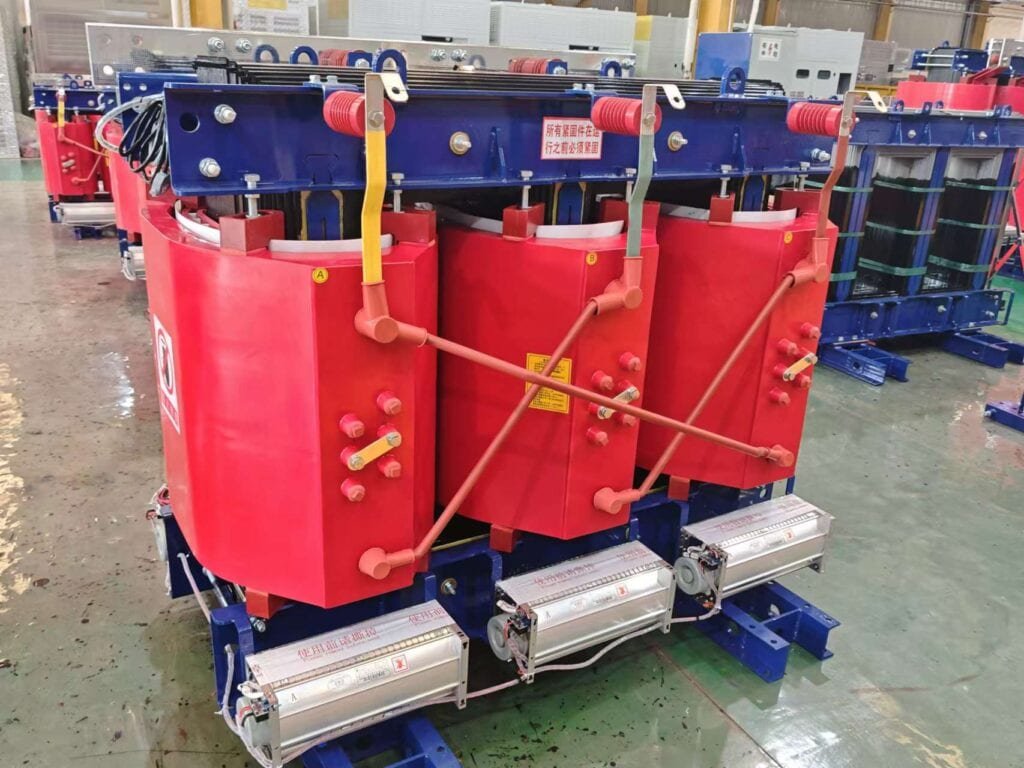
In dry-type transformers, resin plays a critical role in ensuring electrical insulation, mechanical strength, and thermal stability without the use of insulating oil. As power systems increasingly prioritize safety, environmental protection, and indoor installation, resin-based insulation has become a key technology enabling dry-type transformers to operate reliably in demanding conditions.
What Is Resin and Why Is It Used in Dry-Type Transformers?
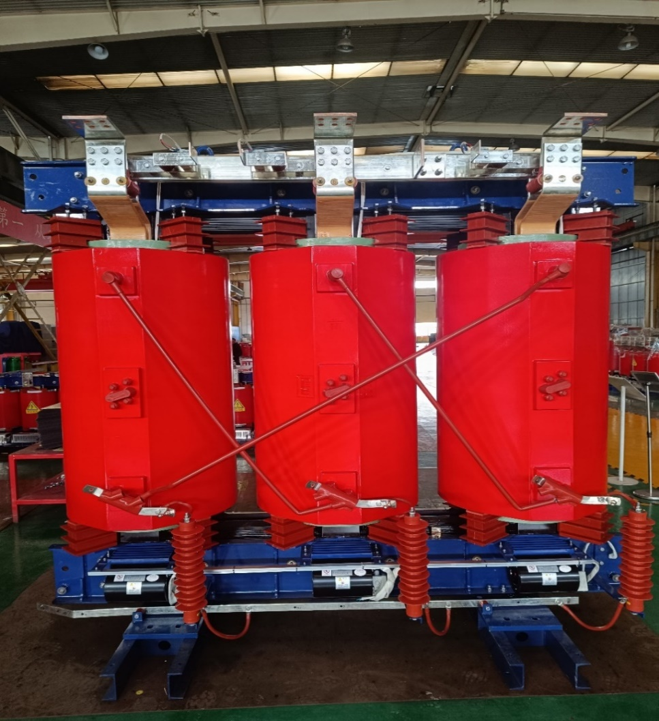
In modern power systems—especially in commercial buildings, hospitals, data centers, metros, and industrial facilities—transformers are often installed indoors or close to occupied areas. In these environments, the presence of flammable insulating oil introduces fire risk, environmental concerns, and stricter regulatory requirements. To solve this, dry-type transformers use resin-based insulation systems, eliminating liquid insulation entirely while maintaining electrical and mechanical reliability.
Resin (typically epoxy resin) is a solid polymer insulating material used in dry-type transformers to electrically insulate, mechanically support, and thermally stabilize the windings without the need for oil.
It replaces the dielectric and protective functions that oil performs in oil-immersed transformers.
What Is Resin in Transformer Applications?
In electrical engineering, resin refers to a synthetic polymer that:
- Starts as a liquid
- Is poured or vacuum-cast around windings
- Cures (hardens) into a solid insulating structure
The most commonly used type is epoxy resin, although polyester and specialized composite resins are also used.
Once cured, transformer-grade resin provides:
- High dielectric strength
- Strong mechanical rigidity
- Good thermal endurance
- Resistance to moisture and chemicals
How Resin Is Used in Dry-Type Transformers
The most common technology is cast resin construction.
Cast Resin Process:
- Copper or aluminum windings are placed in a mold
- Liquid epoxy resin is poured under vacuum
- Air bubbles are removed (critical step)
- Resin is cured into a solid block
The result is a completely encapsulated winding with no oil and minimal internal voids.
Vacuum casting is essential to prevent partial discharge.
Why Resin Is Used Instead of Oil
In oil-immersed transformers, oil provides:
- Electrical insulation
- Cooling
- Partial discharge suppression
In dry-type transformers, resin must perform all insulation and mechanical functions, while air provides cooling.
Resin is used because it:
- Electrically isolates turns and layers
- Physically bonds and stabilizes conductors
- Eliminates flammable liquid
- Reduces environmental risk
Electrical Insulation Function
Resin serves as the primary dielectric medium.
It provides:
- Turn-to-turn insulation
- Layer insulation
- Winding-to-ground insulation
Because air has lower dielectric strength than oil, resin must completely encapsulate windings to maintain reliable insulation levels.
Mechanical Strength and Short-Circuit Resistance
One major advantage of resin is mechanical reinforcement.
Resin:
- Rigidly binds windings together
- Prevents conductor movement
- Increases short-circuit withstand capability
During short-circuit events, electromagnetic forces can be extreme. Resin acts as a structural framework that keeps the winding geometry intact.
Thermal Performance Role
Although oil cools better than air, resin still supports effective thermal management by:
- Conducting heat away from conductors
- Spreading heat uniformly
- Supporting designed air-cooling channels
Resin systems are typically designed to meet:
- Class F (155°C)
- Class H (180°C)
Higher thermal class means better overload capability.
Fire Safety Advantage
One of the biggest reasons resin is used is fire safety.
Resin-based dry-type transformers:
- Do not contain flammable oil
- Can be self-extinguishing
- Produce low smoke (depending on formulation)
This makes them ideal for:
- Hospitals
- Shopping malls
- Tunnels
- Airports
- Underground substations
Environmental Benefits
Resin eliminates:
- Oil leakage risk
- Soil and groundwater contamination
- Oil containment systems
This simplifies environmental compliance and reduces lifecycle environmental impact.
Partial Discharge Control
When properly manufactured:
- Vacuum casting removes internal air voids
- Electric fields are evenly distributed
- PD inception voltage increases
Low partial discharge levels are essential for long-term reliability.
Moisture and Pollution Resistance
Resin insulation is:
- Highly resistant to humidity
- Less sensitive to moisture than cellulose
- Suitable for polluted or coastal environments
Surface contamination must still be controlled, but internal moisture sensitivity is much lower than oil-paper systems.
Comparison: Resin vs Oil-Paper Insulation
| Feature | Resin Dry-Type | Oil-Immersed |
|---|---|---|
| Insulating medium | Solid resin | Paper + oil |
| Cooling medium | Air | Oil |
| Fire risk | Very low | Higher (flammable oil) |
| Environmental risk | Minimal | Possible oil spill |
| Voltage capability | Medium | High |
| Maintenance | Low | Moderate |
| Power density | Lower | Higher |
Each technology serves different system requirements.
Where Resin Dry-Type Transformers Are Preferred
Resin-insulated transformers are commonly used in:
- Commercial buildings
- Hospitals
- Data centers
- Offshore platforms
- Urban distribution networks
- Renewable energy installations
They are ideal where safety and environmental protection are top priorities.
Limitations of Resin Systems
Despite advantages, resin insulation has limits:
- Lower maximum voltage ratings than oil-immersed units
- Larger size for same power rating
- Higher cost at high MVA levels
- Less efficient cooling compared to oil
For high-voltage transmission applications, oil-immersed systems remain dominant.
Standards Governing Resin Transformers
Dry-type transformers with resin insulation are designed and tested according to:
- IEC 60076-11
- IEEE C57.12.01 / C57.12.91
These standards define:
- Thermal performance
- Fire behavior
- Partial discharge limits
- Mechanical strength
Why Resin Choice Matters
Selecting resin insulation affects:
- Fire compliance
- Indoor installation feasibility
- Maintenance strategy
- Insurance and regulatory approval
- Lifecycle cost
It is not just a material choice—it is a system-level design decision.
How Does Resin Improve Electrical Insulation Performance?
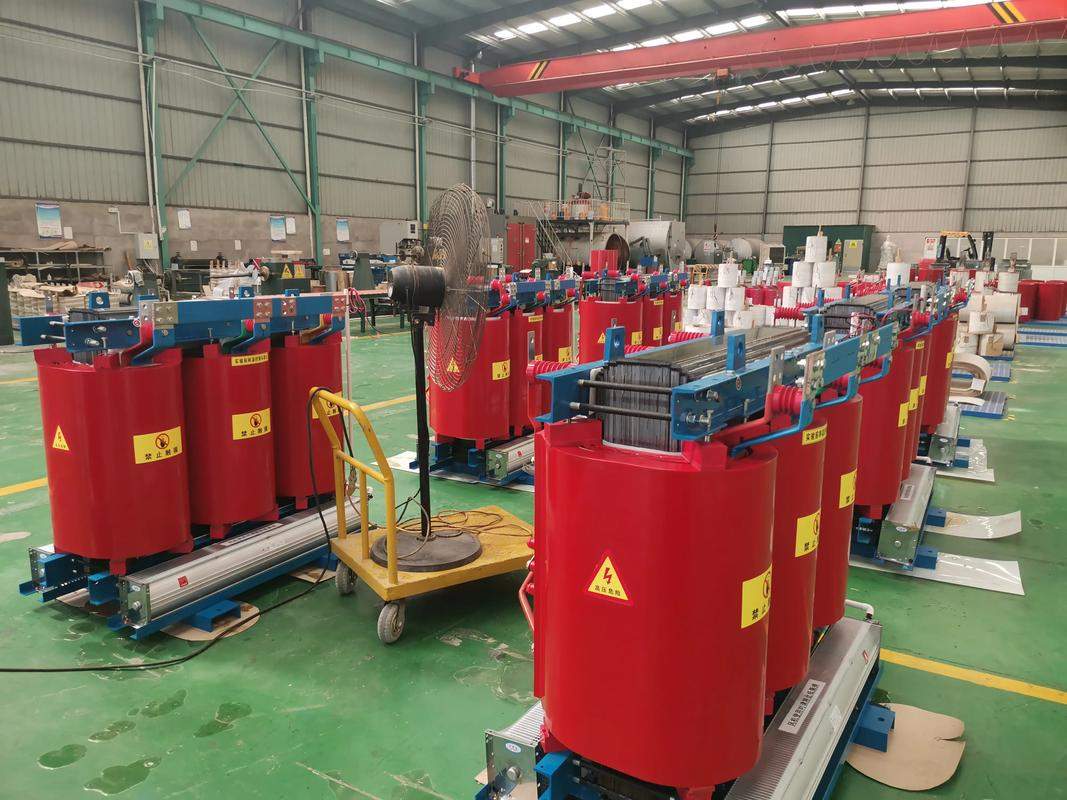
In dry-type transformers, there is no insulating oil to help distribute electric fields or suppress internal discharges. That means the solid insulation system must handle all dielectric stress alone. The challenge is that electrical stress is invisible, cumulative, and unforgiving—small internal voids, uneven electric field distribution, or weak insulation interfaces can eventually lead to partial discharge (PD), tracking, or catastrophic breakdown.
Resin—primarily epoxy resin—improves electrical insulation performance by creating a solid, void-free, high-dielectric-strength structure that uniformly distributes electric fields, suppresses partial discharge, increases insulation thickness control, and enhances long-term dielectric stability.
In other words, resin transforms a winding from a loosely insulated conductor assembly into a structurally bonded dielectric system.
1. High Intrinsic Dielectric Strength
Epoxy resin has strong dielectric properties.
Typical dielectric strength:
- 15–25 kV/mm (depending on formulation)
This allows resin to:
- Withstand high electric field intensity
- Provide strong turn-to-turn insulation
- Increase margin against breakdown
Because resin is a solid dielectric, it maintains consistent insulation thickness and electrical performance across the winding.
2. Elimination of Internal Air Voids
One of the biggest electrical risks in insulation systems is trapped air.
Air has:
- Much lower dielectric strength than resin
- High susceptibility to partial discharge
During vacuum casting, liquid resin:
- Penetrates all gaps between conductors
- Displaces trapped air
- Fills microscopic cavities
When cured, the winding becomes nearly void-free, dramatically reducing PD inception risk.
3. Partial Discharge Suppression
Partial discharge is one of the main causes of insulation aging.
Resin improves PD resistance by:
- Eliminating gas-filled voids
- Creating smooth insulation surfaces
- Reducing local electric field concentration
Higher PD inception voltage means:
- Longer insulation life
- Lower risk of insulation erosion
- Improved long-term reliability
In well-manufactured cast resin transformers, PD levels can be extremely low under rated voltage.
4. Uniform Electric Field Distribution
Electrical stress is rarely evenly distributed.
Resin helps by:
- Providing consistent dielectric properties
- Avoiding abrupt material interfaces
- Maintaining geometric stability of windings
Because resin bonds conductors into a rigid block, spacing between turns and layers remains constant, preventing local stress intensification.
5. Increased Creepage and Clearance Strength
Resin insulation improves surface dielectric performance.
Benefits include:
- Higher tracking resistance
- Better creepage path integrity
- Reduced surface discharge risk
Special formulations enhance:
- Anti-tracking performance
- Resistance to contamination and pollution
This is especially important in humid or industrial environments.
6. Improved Insulation Thickness Control
In oil-paper systems, insulation thickness depends on wrapping accuracy and assembly precision.
In cast resin systems:
- Mold design precisely defines insulation thickness
- Resin fully surrounds the conductor
- Tolerances are tightly controlled
This leads to:
- Consistent dielectric margins
- Reduced weak spots
- Repeatable manufacturing quality
7. Mechanical Stability Preserves Electrical Integrity
Electrical insulation performance depends on geometry.
If conductors move due to:
- Thermal expansion
- Short-circuit forces
Local electric field distribution changes.
Resin improves electrical reliability indirectly by:
- Rigidly bonding windings
- Preventing conductor displacement
- Maintaining designed spacing
Stable geometry equals stable electric field distribution.
8. Moisture Resistance Enhances Dielectric Reliability
Moisture significantly reduces dielectric strength.
Resin insulation:
- Is hydrophobic
- Absorbs very little moisture
- Does not rely on cellulose
Unlike paper-based systems, resin insulation does not experience major dielectric degradation due to humidity.
This makes dielectric performance more predictable in real environments.
9. Thermal Stability Maintains Dielectric Properties
Electrical insulation performance degrades at high temperatures.
High-quality epoxy systems:
- Maintain dielectric strength at elevated temperatures
- Resist thermal cracking
- Preserve structural integrity under thermal cycling
This ensures that electrical performance does not deteriorate rapidly with load changes.
10. Surface Protection and Contamination Resistance
Surface tracking can lead to electrical failure.
Resin systems can be formulated to provide:
- High CTI (Comparative Tracking Index)
- Smooth, sealed surfaces
- Resistance to industrial pollution
This protects against flashover in contaminated environments.
11. Reduced Interface Complexity
Every interface between different materials can create electric field distortion.
Resin reduces interface problems by:
- Forming a continuous dielectric mass
- Minimizing internal material boundaries
- Eliminating oil–paper interfaces
Fewer interfaces mean fewer weak points.
12. Enhanced Impulse Voltage Withstand Capability
Resin insulation systems can withstand impulse stresses when properly designed.
Advantages include:
- High dielectric rigidity
- Strong bonding between layers
- Good resistance to electrical shock stress
However, for very high impulse levels, oil-paper systems may still provide higher ultimate margins.
13. Improved Long-Term Dielectric Aging Behavior
Electrical aging mechanisms include:
- Partial discharge erosion
- Treeing
- Surface tracking
Resin slows these processes by:
- Suppressing PD
- Providing homogeneous dielectric structure
- Maintaining mechanical stability
Long-term dielectric aging becomes more predictable.
14. Manufacturing Precision and Quality Control
Electrical performance depends heavily on manufacturing.
Resin systems allow:
- Vacuum casting to remove air
- Controlled curing processes
- Repeatable production quality
When properly controlled, this leads to highly consistent insulation performance across production batches.
15. Comparison with Oil-Paper Electrical Performance
| Feature | Resin Insulation | Oil-Paper Insulation |
|---|---|---|
| Dielectric medium | Solid polymer | Liquid + cellulose |
| PD suppression | Depends on void-free casting | Oil naturally suppresses PD |
| Moisture sensitivity | Low | Higher |
| Electric field uniformity | Good (rigid structure) | Excellent (oil smooths fields) |
| High-voltage capability | Medium | High |
Resin significantly improves dielectric reliability in medium-voltage applications, especially indoors.
16. Where Resin Electrical Advantages Matter Most
Resin’s electrical insulation benefits are especially valuable in:
- Indoor substations
- Hospitals and data centers
- Renewable energy installations
- Offshore and coastal environments
- Industrial facilities with pollution exposure
These environments require stable dielectric performance without liquid insulation.
How Does Resin Enhance Mechanical Strength and Vibration Resistance?
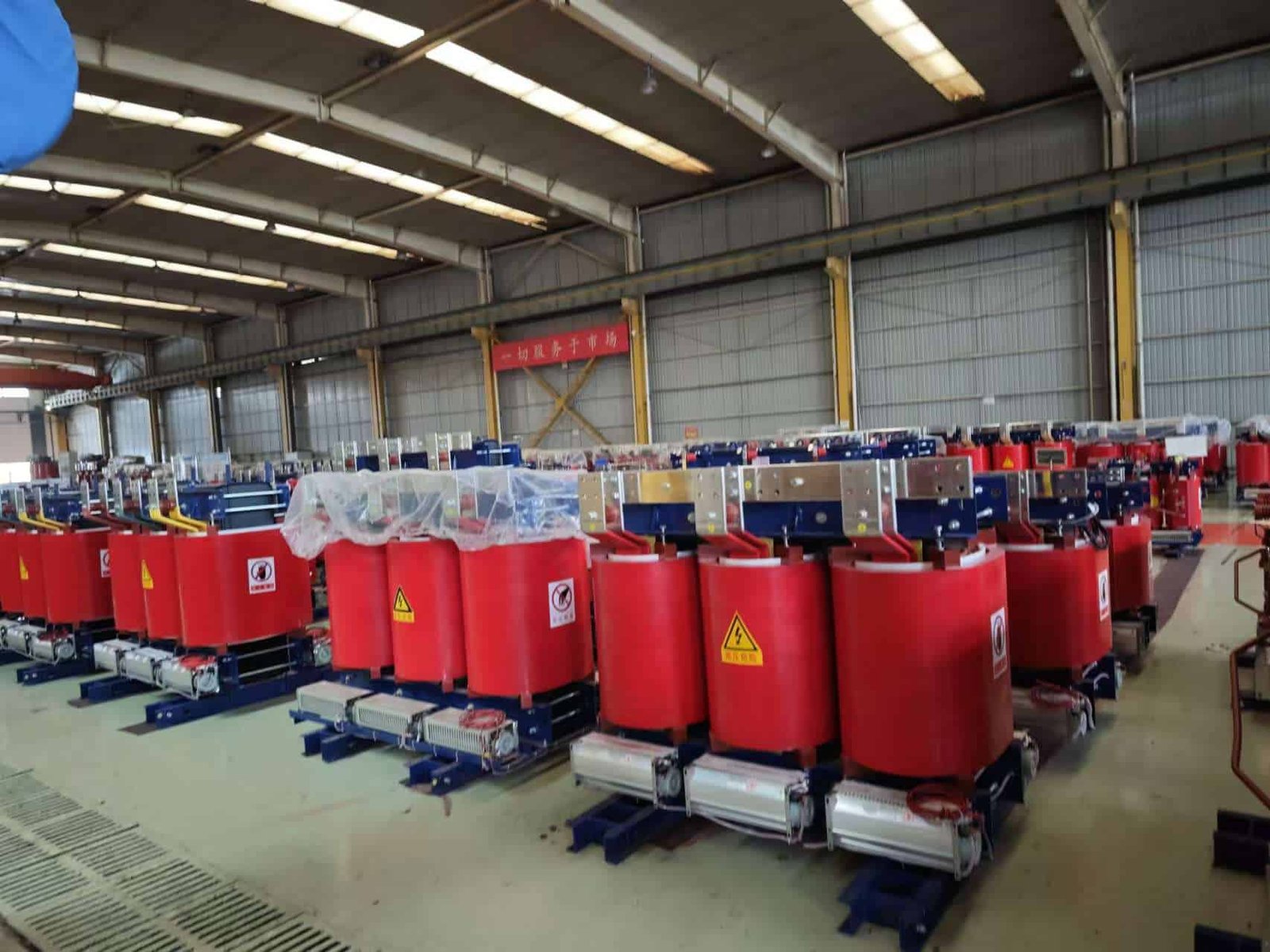
In dry-type transformers, windings are exposed to continuous electromagnetic forces, thermal expansion and contraction, and occasional short-circuit shocks. Without liquid oil to cushion movement—as in oil-immersed designs—the mechanical integrity of the winding structure depends almost entirely on the solid insulation system. If conductors shift even slightly, it can lead to insulation abrasion, partial discharge, noise increase, or catastrophic failure.
Resin (primarily epoxy resin) enhances mechanical strength and vibration resistance by rigidly encapsulating windings into a solid monolithic structure, bonding conductors together, increasing structural stiffness, absorbing mechanical energy, and maintaining precise winding geometry under thermal and electromagnetic stress.
In simple terms, resin turns a flexible coil assembly into a mechanically reinforced structural block.
1. Rigid Encapsulation of Windings
In cast resin dry-type transformers:
- Windings are placed in a mold
- Epoxy resin is vacuum-poured around them
- The resin cures into a solid mass
Once cured, the conductors are fully embedded in a rigid dielectric structure.
This eliminates:
- Loose conductor movement
- Layer shifting
- Spacer displacement
Rigid encapsulation is the foundation of improved mechanical strength.
2. Strong Conductor-to-Conductor Bonding
Resin creates mechanical bonding between:
- Adjacent turns
- Layers of winding
- Conductors and structural supports
This bonding distributes mechanical forces across the entire winding rather than concentrating stress at a single point.
During operation, electromagnetic forces are shared by the whole structure instead of acting on individual conductors.
3. High Structural Stiffness
Epoxy resin has high compressive and tensile strength compared to traditional air-insulated structures.
Typical benefits include:
- Increased modulus of elasticity
- Improved resistance to bending
- Reduced deformation under load
Greater stiffness means:
- Less vibration amplitude
- Better dimensional stability
- Reduced mechanical fatigue
4. Resistance to Short-Circuit Forces
During short-circuit events, transformers experience very high mechanical forces due to intense electromagnetic interaction between windings.
These forces can:
- Radially compress windings
- Axially push or pull winding sections
- Cause conductor displacement
Resin improves short-circuit withstand capability by:
- Locking conductors into a unified structure
- Preventing axial movement
- Resisting radial deformation
This significantly improves dynamic mechanical stability.
5. Improved Vibration Damping
Transformers naturally vibrate due to:
- Magnetostriction in the core
- Alternating electromagnetic forces
- Load fluctuations
Resin enhances vibration resistance by:
- Adding mass and rigidity
- Reducing relative movement between components
- Providing internal damping characteristics
Although resin is rigid, it still absorbs some vibrational energy, reducing mechanical resonance.
6. Thermal Expansion Control
Transformers heat up and cool down repeatedly.
Thermal cycling causes:
- Conductor expansion
- Mechanical stress at interfaces
- Fatigue over time
Resin improves thermal-mechanical stability by:
- Distributing thermal stress evenly
- Holding conductors in fixed alignment
- Reducing friction-based wear between turns
This prevents long-term loosening of windings.
7. Elimination of Spacer Dependency
In oil-immersed transformers, mechanical stability relies heavily on:
- Pressboard spacers
- Clamping structures
- Oil pressure support
In resin systems:
- The cured resin itself provides structural integrity
- The winding becomes self-supporting
This reduces the number of mechanical interfaces that can loosen over time.
8. Reduced Mechanical Fatigue Over Time
Repeated vibration can lead to:
- Insulation abrasion
- Micro-movement between conductors
- Progressive mechanical fatigue
Because resin immobilizes conductors:
- Relative movement is minimized
- Fatigue damage is reduced
- Long-term mechanical reliability improves
Stable geometry equals longer service life.
9. Improved Noise Performance
Mechanical vibration contributes to transformer noise.
Resin helps reduce noise by:
- Limiting winding vibration
- Preventing resonance
- Increasing structural rigidity
Lower vibration often translates to quieter operation—an important factor in indoor installations.
10. Resistance to Transportation and Handling Stress
Transformers experience mechanical stress during:
- Transport
- Lifting
- Installation
Resin-encapsulated windings are:
- More impact-resistant
- Less susceptible to shifting
- Structurally self-contained
This improves reliability before commissioning.
11. Resistance to Environmental Mechanical Stress
In harsh environments such as:
- Offshore platforms
- Seismic zones
- Industrial plants
Mechanical stability is critical.
Resin systems provide:
- Strong resistance to vibration
- Good shock tolerance
- Stable geometry under external forces
This makes them suitable for challenging installation conditions.
12. Crack Resistance in Modern Resin Systems
Advanced epoxy formulations include:
- Silica fillers
- Flexible modifiers
- Thermal expansion balancing additives
These improve:
- Crack resistance
- Thermal cycling durability
- Long-term mechanical stability
Material engineering plays a key role in mechanical enhancement.
13. Comparison: Resin vs Oil-Paper Mechanical Behavior
| Feature | Resin Dry-Type | Oil-Immersed |
|---|---|---|
| Conductor support | Solid encapsulation | Spacers + oil support |
| Short-circuit resistance | High (rigid structure) | High (pressboard reinforced) |
| Vibration damping | Good | Oil provides cushioning |
| Mechanical fatigue risk | Low | Moderate (possible movement) |
| Dependency on clamping | Lower | Higher |
Each system achieves mechanical strength differently.
14. Mechanical Integrity Preserves Electrical Performance
Mechanical stability directly affects electrical reliability.
If conductors move:
- Electric field distribution changes
- Insulation may abrade
- Partial discharge risk increases
By preventing movement, resin indirectly enhances long-term dielectric reliability.
Mechanical strength supports electrical performance.
15. Limitations to Consider
While resin improves mechanical rigidity, it also:
- Reduces flexibility
- Can crack if improperly manufactured
- Requires controlled curing to prevent internal stress
High-quality manufacturing is essential to achieve the intended benefits.
What Role Does Resin Play in Thermal Management and Heat Dissipation?
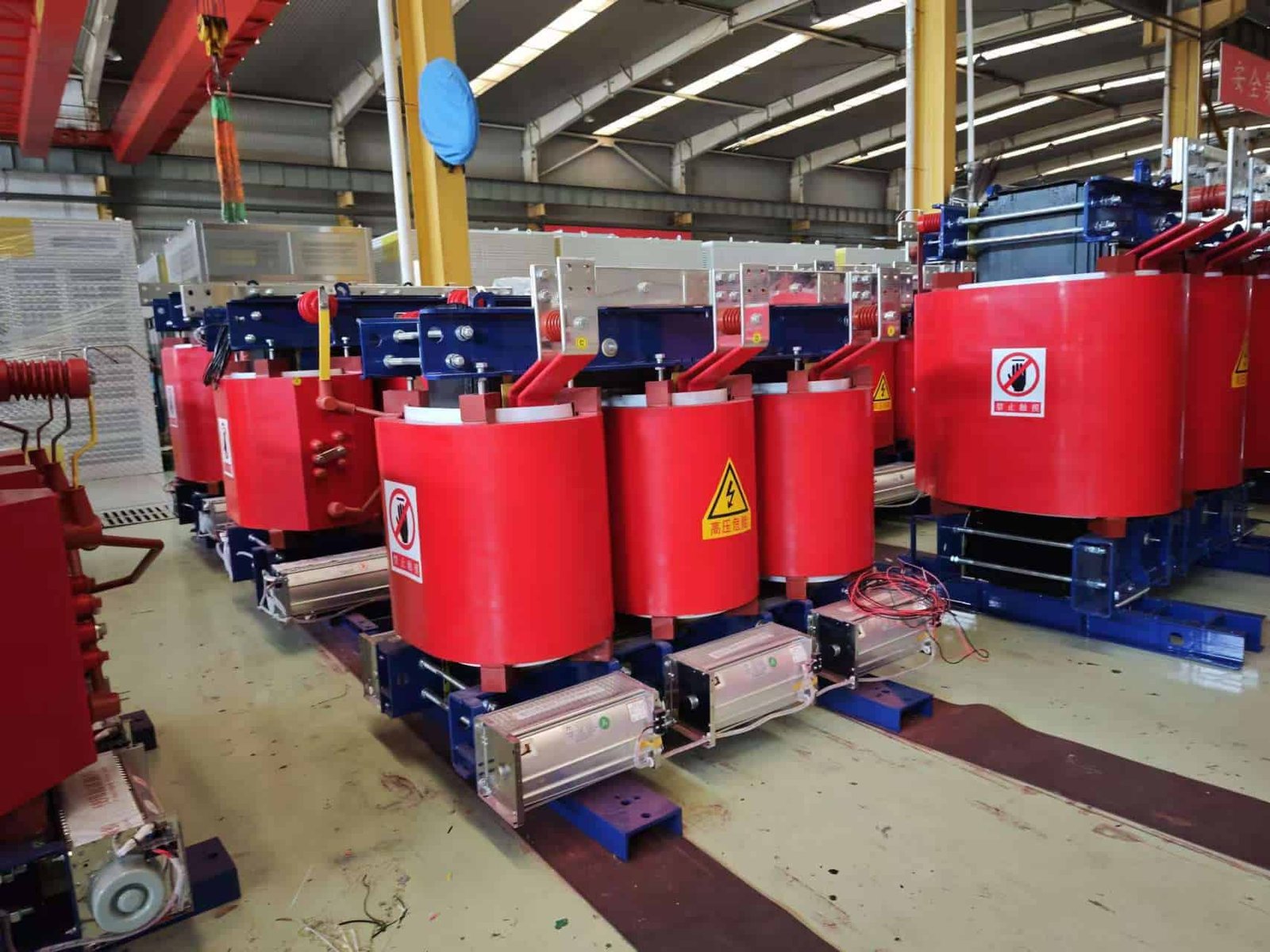
In dry-type transformers, there is no insulating oil to circulate heat away from the windings. That means the solid insulation system must not only electrically insulate the conductors but also help manage heat flow. Since temperature is the primary factor limiting transformer life, effective thermal management is critical.
Resin (typically epoxy resin) plays a key role in dry-type transformers by conducting heat away from windings, distributing thermal energy evenly, supporting controlled airflow cooling, and maintaining insulation integrity at elevated temperatures.
While resin cannot match the cooling efficiency of oil, it enables safe and reliable heat dissipation in air-cooled transformer designs.
1. Heat Transfer from Conductors
Transformer windings generate heat due to:
- Copper (I²R) losses
- Eddy current losses
- Stray magnetic flux
In cast resin transformers, the resin:
- Surrounds the conductors completely
- Forms a solid thermal path from copper to the outer surface
- Conducts heat outward toward cooling air channels
Although resin has lower thermal conductivity than copper, it spreads heat more effectively than air gaps would.
2. Elimination of Air Gaps
Air is a poor thermal conductor.
During vacuum casting:
- Resin fills voids between turns and layers
- Air pockets are eliminated
- Thermal contact improves significantly
This reduces localized overheating and hot spots, which are major contributors to insulation aging.
3. Uniform Heat Distribution
Uneven temperature distribution accelerates insulation degradation.
Resin enhances thermal uniformity by:
- Spreading heat across a larger surface area
- Reducing temperature gradients within the winding
- Minimizing localized thermal stress
Uniform heat distribution improves long-term reliability.
4. Surface Heat Dissipation to Air
In dry-type transformers, cooling occurs primarily through:
- Natural air circulation (AN – Air Natural)
- Forced air cooling (AF – Air Forced)
Resin plays an important role by:
- Transferring internal heat to the outer winding surface
- Providing a large, exposed surface area
- Supporting designed cooling channels
The outer resin surface radiates and convects heat into surrounding air.
5. Thermal Class Performance
Resin systems are designed to withstand high temperatures.
Common thermal classes:
| Thermal Class | Maximum Operating Temperature |
|---|---|
| Class F | 155°C |
| Class H | 180°C |
High thermal class resin allows:
- Higher load capacity
- Better overload tolerance
- Improved thermal aging resistance
The insulation system defines allowable temperature rise.
6. Resistance to Thermal Cycling
Transformers experience repeated heating and cooling due to load variation.
Thermal cycling causes:
- Expansion and contraction of copper
- Mechanical stress within insulation
Resin improves thermal stability by:
- Distributing expansion forces
- Maintaining structural bonding
- Reducing friction between conductors
This reduces fatigue and extends service life.
7. Prevention of Hot Spots
Hot spots accelerate insulation aging exponentially.
Resin reduces hot spot risk by:
- Maintaining close thermal contact between conductors
- Avoiding void-related overheating
- Supporting consistent geometry
Since aging rate roughly doubles for every 6–8°C rise in temperature, controlling hot spots is essential.
8. Integration with Air Cooling Design
Dry-type transformers rely on airflow engineering.
Resin windings are designed with:
- Cooling ducts
- Radial ventilation gaps
- Vertical airflow paths
Resin ensures these cooling channels remain stable and unobstructed throughout service life.
9. Mechanical Stability Supports Thermal Stability
Thermal performance depends on maintaining winding geometry.
If conductors move due to thermal expansion:
- Heat distribution changes
- Local hot spots may form
Resin prevents conductor displacement, preserving consistent thermal paths.
10. Comparison with Oil-Based Cooling
Oil-immersed transformers use circulating oil for:
- High thermal conductivity
- Convective heat transfer
- Radiator cooling
Comparison:
| Feature | Resin Dry-Type | Oil-Immersed |
|---|---|---|
| Cooling medium | Air | Oil |
| Heat transfer efficiency | Moderate | High |
| Thermal inertia | Lower | Higher |
| Overload capability | Limited | Higher |
Oil systems dissipate heat more efficiently, but resin systems offer safer, maintenance-free alternatives in many applications.
11. Thermal Conductivity Enhancements
Modern resin formulations may include:
- Silica fillers
- Mineral additives
- Thermally conductive composites
These improve:
- Thermal conductivity
- Crack resistance
- Heat spreading performance
Material engineering continues to improve resin thermal behavior.
12. Impact on Transformer Size and Rating
Because air cooling is less efficient than oil cooling:
- Dry-type transformers are typically larger
- Surface area must increase to dissipate heat
- Power density is lower
Resin enables safe operation but requires careful thermal design to compensate for air cooling limitations.
13. Long-Term Thermal Aging Control
Resin resists thermal degradation by:
- Maintaining dielectric strength at high temperatures
- Preventing moisture absorption
- Minimizing chemical breakdown
High-quality epoxy systems exhibit predictable thermal aging characteristics.
14. Fire and Thermal Safety Benefits
Resin systems:
- Do not circulate flammable liquid
- Limit fire propagation
- Withstand high temperatures without leakage
In indoor installations, this enhances overall thermal safety.
15. Applications Where Resin Thermal Role Is Critical
Resin-based thermal management is particularly valuable in:
- Hospitals
- Commercial buildings
- Data centers
- Underground substations
- Renewable energy installations
In these environments, safe air cooling is preferable to liquid systems.
How Does Resin Contribute to Fire Safety and Environmental Protection?
In many modern installations—such as hospitals, airports, commercial buildings, tunnels, offshore platforms, and urban substations—fire safety and environmental compliance are just as important as electrical performance. Traditional oil-immersed transformers contain large volumes of flammable insulating liquid, which introduces fire propagation risk and potential environmental contamination in case of leakage.
Resin (primarily epoxy resin) contributes to fire safety and environmental protection by eliminating flammable liquid insulation, reducing fire propagation risk, preventing oil leakage and soil contamination, lowering toxic emissions, and simplifying environmental compliance in indoor and sensitive installations.
In dry-type transformers, resin is not only an insulating material—it is a key safety and environmental protection element.
1. Elimination of Flammable Insulating Oil
Oil-immersed transformers typically contain:
- Hundreds to thousands of liters of insulating oil
- Combustible hydrocarbon-based fluids
Under fault conditions, oil can:
- Ignite
- Contribute to fire spread
- Require fire suppression systems
Resin-based dry-type transformers:
- Contain no liquid dielectric
- Eliminate oil as a fuel source
- Significantly reduce fire load
This dramatically lowers fire risk in confined spaces.
2. Self-Extinguishing Properties
High-quality epoxy resin systems used in transformers are:
- Flame-retardant
- Self-extinguishing
- Designed to limit flame propagation
If exposed to fire, resin typically:
- Does not sustain combustion easily
- Produces limited flame spread
- Forms a char layer that slows burning
This behavior improves fire containment compared to liquid-filled systems.
3. Reduced Fire Propagation Risk Indoors
In indoor installations, fire safety regulations are strict.
Resin dry-type transformers:
- Do not require oil containment pits
- Often reduce need for extensive fire barriers
- Minimize risk of fire spreading through liquid flow
This makes them suitable for:
- Hospitals
- Shopping malls
- High-rise buildings
- Underground substations
In such environments, eliminating liquid fuel is a major safety advantage.
4. Lower Smoke and Toxic Emissions
Modern transformer-grade resin systems are engineered to:
- Minimize toxic gas release
- Reduce dense smoke generation
- Avoid halogenated compounds (in many formulations)
Low smoke and low toxicity are critical in:
- Public buildings
- Transportation hubs
- Tunnels
Safer evacuation conditions are a significant benefit.
5. No Risk of Oil Leakage or Soil Contamination
Oil leaks can result in:
- Soil contamination
- Groundwater pollution
- Costly environmental cleanup
- Regulatory penalties
Resin-based transformers:
- Contain no liquid insulation
- Eliminate oil spill risk
- Reduce environmental liability
This is especially important in environmentally sensitive areas.
6. Simplified Environmental Compliance
Environmental regulations often require:
- Oil containment systems
- Fire suppression systems
- Spill monitoring
Resin dry-type transformers:
- Reduce or eliminate containment requirements
- Simplify installation permitting
- Lower compliance costs
For urban and industrial projects, this simplifies project approval.
7. Improved Safety in Confined and Underground Spaces
In tunnels, metros, and underground substations:
- Ventilation is limited
- Fire suppression is complex
- Evacuation routes may be restricted
Resin insulation contributes to safety by:
- Reducing fire ignition sources
- Limiting fuel availability
- Lowering smoke hazards
This makes dry-type units the preferred solution in many underground applications.
8. Reduced Risk of Secondary Fire from Electrical Faults
In oil-filled transformers, internal faults can:
- Cause arc ignition
- Vaporize oil
- Lead to tank rupture
In resin dry-type transformers:
- There is no oil vapor explosion risk
- Internal faults are more contained
- Fire escalation probability is lower
Although any electrical system carries some fire risk, resin reduces escalation severity.
9. Compatibility with Green Building Standards
Resin dry-type transformers align well with:
- Sustainable building design
- Green certification programs
- Low environmental impact infrastructure
Benefits include:
- No oil disposal issues
- Reduced environmental hazard classification
- Cleaner indoor installation
They support modern low-carbon and environmentally responsible infrastructure.
10. Reduced End-of-Life Environmental Impact
At end of service life:
Oil-filled transformers require:
- Oil draining
- Oil disposal or recycling
- Contamination handling
Resin dry-type transformers:
- Avoid liquid disposal
- Simplify decommissioning
- Reduce hazardous waste complexity
This lowers lifecycle environmental impact.
11. Comparison: Resin vs Oil-Immersed Safety Profile
| Aspect | Resin Dry-Type | Oil-Immersed |
|---|---|---|
| Flammable liquid | None | Present |
| Oil spill risk | None | Possible |
| Fire propagation risk | Lower | Higher |
| Containment requirement | Minimal | Required |
| Environmental liability | Lower | Higher |
Each system has advantages, but resin clearly enhances safety in sensitive installations.
12. Limitations and Considerations
Although resin improves fire and environmental safety:
- It does not eliminate all electrical fire risk
- Proper ventilation is still required
- Extreme overheating can still damage insulation
Safe design and proper installation remain essential.
13. Applications Where Resin Safety Is Critical
Resin insulation is particularly valuable in:
- Hospitals and medical facilities
- Airports and metro systems
- Commercial high-rise buildings
- Offshore platforms
- Chemical plants
- Renewable energy installations
In these environments, reducing fire and environmental risk is often mandatory.
Conclusion
Resin is a core component of dry-type transformer technology, providing robust insulation, structural integrity, thermal endurance, and enhanced safety without relying on oil. By protecting windings from moisture, dust, vibration, and fire risks, resin enables dry-type transformers to deliver reliable, low-maintenance performance in commercial, industrial, and renewable energy applications, making it a cornerstone of modern transformer design.
FAQ
Q1: What is the role of resin in dry-type transformers?
Resin plays a critical role in dry-type transformers by serving as the primary insulation and protective medium for the windings. In cast resin transformers, epoxy resin fully encapsulates the high-voltage windings, creating a solid insulation barrier that prevents electrical discharge, short circuits, and environmental damage.
The resin system ensures electrical insulation, mechanical strength, moisture resistance, and fire safety—making it ideal for indoor and sensitive installations such as commercial buildings, hospitals, and data centers.
Q2: How does resin improve electrical insulation?
Epoxy resin has high dielectric strength, which allows it to withstand significant electrical stress without breakdown. By fully encapsulating the windings:
It eliminates air gaps that can cause partial discharge
It prevents contamination from dust or humidity
It stabilizes the electric field distribution
This significantly enhances reliability and reduces the risk of insulation failure over time.
Q3: How does resin enhance mechanical strength?
During transformer operation, windings experience strong electromagnetic forces, especially during short-circuit conditions. Resin forms a rigid structure around the windings, which:
Secures conductors firmly in place
Reduces vibration and movement
Improves short-circuit withstand capability
This mechanical reinforcement is a major advantage of cast resin dry-type transformers.
Q4: How does resin contribute to moisture and environmental protection?
Resin encapsulation creates a sealed insulation system that resists:
High humidity
Industrial pollution
Dust accumulation
Corrosive environments
This makes resin-based dry-type transformers particularly suitable for harsh indoor or semi-outdoor environments where oil-filled transformers may pose leakage risks.
Q5: Does resin improve fire safety?
Yes. One of the biggest advantages of resin insulation is enhanced fire safety. Cast resin systems are:
Self-extinguishing
Low smoke emitting
Free from flammable insulating oil
This significantly reduces fire hazards compared to oil-immersed transformers, making them preferred in public buildings and underground installations.
Q6: How does resin affect thermal performance?
Although resin is a solid material, it is engineered to allow efficient heat dissipation. Modern resin systems are designed with:
Thermal expansion compatibility
Good thermal conductivity additives
Optimized cooling channel designs
Dry-type transformers typically use air natural (AN) or air forced (AF) cooling to remove heat generated by the windings.
Q7: What are the different resin technologies used?
The most common resin-based insulation methods include:
Cast Resin Technology (CRT) – full vacuum casting of windings
Vacuum Pressure Impregnation (VPI) – varnish-based resin impregnation
Vacuum Pressure Encapsulation (VPE) – enhanced environmental sealing
Cast resin provides the highest mechanical and environmental protection, while VPI systems are more cost-effective.
Q8: What are the limitations of resin in dry-type transformers?
While resin offers many benefits, it also has limitations:
Higher initial cost compared to oil-filled transformers
Larger physical size for the same rating
Heat dissipation depends heavily on ventilation
However, lower maintenance costs and improved safety often offset the higher upfront investment.
References
IEC 60076-11 – Dry-Type Transformers
https://webstore.iec.ch/publication/602
IEEE C57.12.01 – Dry-Type Distribution Transformers
https://standards.ieee.org
Schneider Electric – Dry-Type Transformer Guide
https://www.se.com
CIGRE – Advances in Dry-Type Transformer Insulation
https://www.cigre.org
Electrical Engineering Portal – Cast Resin Transformers Explained
https://electrical-engineering-portal.com
NEMA – Dry-Type Transformer Standards
https://www.nema.org
IEEE Power & Energy Society – Transformer Insulation Research
https://ieeexplore.ieee.org