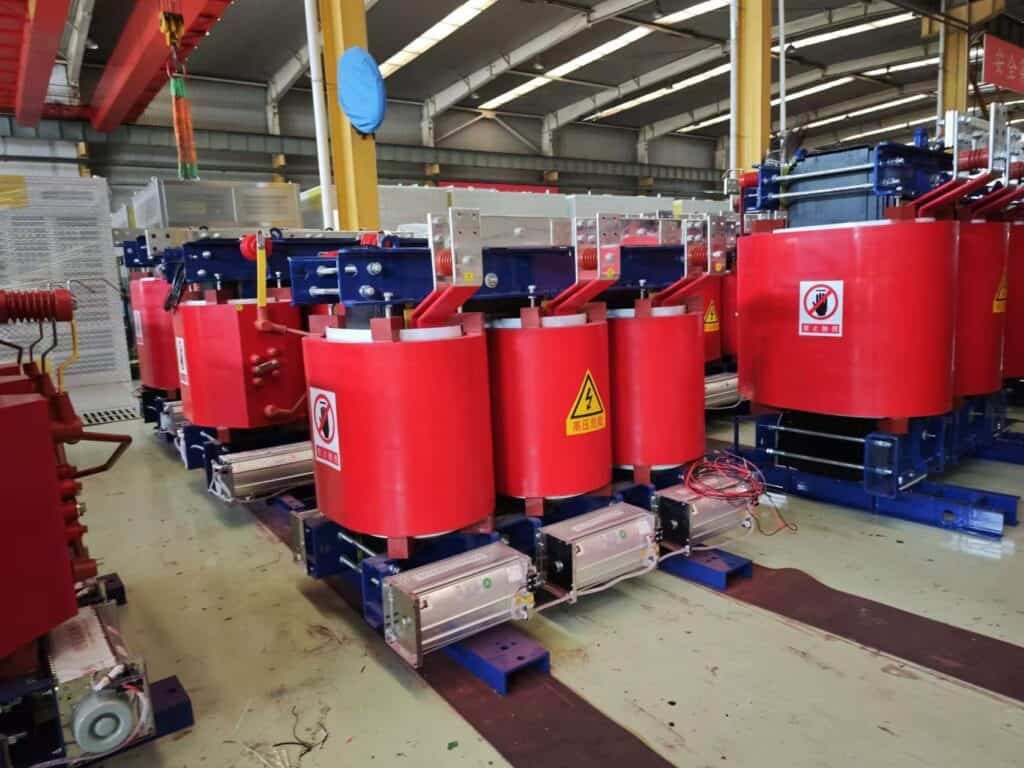
Dry-type transformers are widely used in modern power distribution systems due to their safety, environmental friendliness, and low maintenance requirements. Unlike oil-filled transformers, they do not use liquid insulation or cooling media. Instead, they rely on air and solid insulating materials to provide electrical insulation and heat dissipation. Their design makes them particularly suitable for indoor installations and locations where fire safety is a major concern.
What Exactly Is a Dry-Type Transformer?
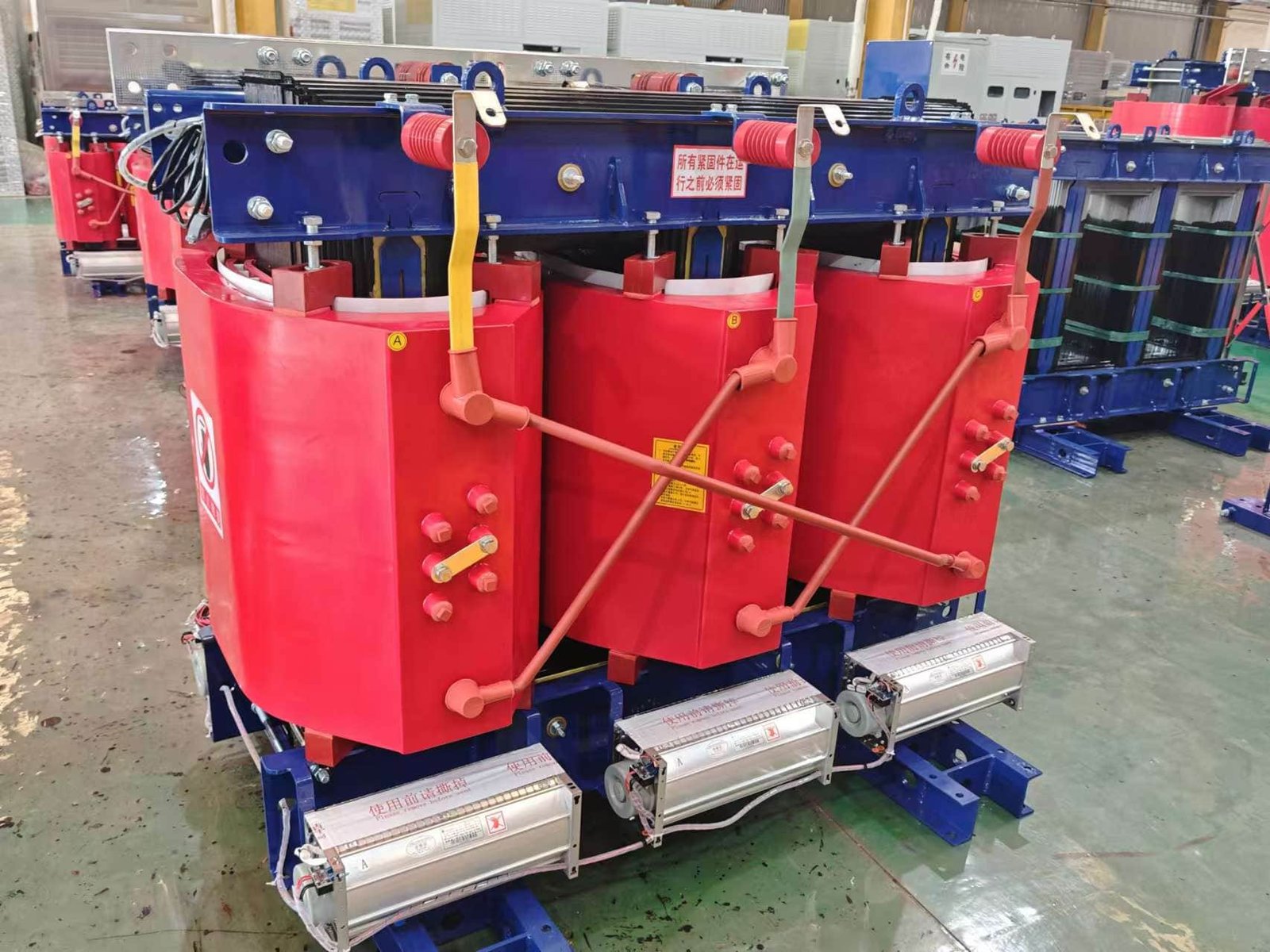
Electrical transformers are essential for voltage conversion in power generation, transmission, distribution, and industrial applications. Traditionally, many transformers have relied on insulating liquids such as mineral oil for cooling and dielectric protection. However, in locations where fire safety, environmental protection, and indoor installation are major concerns, an alternative solution is often preferred: the dry-type transformer.
Dry-type transformers have become increasingly popular in commercial buildings, hospitals, data centers, renewable energy facilities, industrial plants, and transportation systems because they eliminate the need for liquid insulation. Instead, they use air and solid insulating materials to provide electrical insulation and cooling. This design reduces fire risks, simplifies maintenance, and makes them particularly suitable for indoor and environmentally sensitive applications.
A dry-type transformer is a transformer that uses air and solid insulating materials instead of liquid-filled insulation systems such as mineral oil. Its windings are insulated using materials like epoxy resin, varnish, or cast resin, while cooling is achieved through natural or forced air circulation. Dry-type transformers are widely used in indoor installations where safety, environmental protection, and low maintenance requirements are important.
Their combination of reliability, safety, and environmental friendliness has made dry-type transformers a preferred choice for many modern electrical systems.
Dry-type transformers contain large quantities of insulating oil that provide cooling and fire protection.False
Dry-type transformers do not use insulating oil. They rely on air and solid insulation materials such as epoxy resin or varnish for cooling and dielectric protection.
Understanding the Basic Concept of a Dry-Type Transformer
A dry-type transformer performs the same electrical function as an oil-filled transformer.
Primary Purpose
| Function | Description |
|---|---|
| Voltage conversion | Step-up or step-down voltage |
| Electrical isolation | Separate circuits safely |
| Power transfer | Efficient energy delivery |
The key difference lies in the insulation and cooling method.
How Dry-Type Transformers Differ from Oil-Filled Transformers
Traditional transformers use insulating liquids.
Comparison
| Feature | Dry-Type Transformer | Oil-Filled Transformer |
|---|---|---|
| Insulation medium | Air and solid insulation | Mineral oil or ester fluid |
| Cooling medium | Air | Insulating liquid |
| Fire risk | Lower | Higher |
| Environmental risk | Minimal | Potential oil leakage |
These differences significantly influence application selection.
How a Dry-Type Transformer Works
Dry-type transformers operate using electromagnetic induction.
Basic Operating Principle
When alternating current flows through the primary winding, a magnetic field is produced in the core.
Energy Transfer Process
| Step | Action |
|---|---|
| AC voltage applied | Current flows in primary |
| Magnetic flux created | Core magnetized |
| Flux links secondary winding | Voltage induced |
| Power delivered to load | Energy transferred |
The operating principle is identical to other transformer types.
Voltage Transformation Relationship
\frac{V_p}{V_s}=\frac{N_p}{N_s}
Where:
- (V_p) = primary voltage
- (V_s) = secondary voltage
- (N_p) = primary turns
- (N_s) = secondary turns
The turns ratio determines the output voltage.
Main Components of a Dry-Type Transformer
Dry-type transformers consist of several key components.
Core Components
| Component | Function |
|---|---|
| Magnetic core | Flux path |
| Primary winding | Input power |
| Secondary winding | Output power |
| Insulation system | Electrical protection |
| Enclosure | Mechanical protection |
| Cooling system | Heat removal |
Each component contributes to safe operation.
Magnetic Core
The magnetic core transfers magnetic flux between windings.
Core Functions
| Function | Benefit |
|---|---|
| Flux concentration | Efficient energy transfer |
| Loss reduction | Higher efficiency |
| Mechanical support | Structural integrity |
High-quality silicon steel is commonly used.
Windings
The windings conduct electrical current and perform voltage transformation.
Common Materials
| Material | Characteristics |
|---|---|
| Copper | High conductivity |
| Aluminum | Lower weight and cost |
The choice depends on performance and economic considerations.
Types of Dry-Type Transformers
Dry-type transformers are generally divided into two major categories.
Cast Resin Transformers
Cast resin transformers use epoxy resin encapsulation.
Characteristics
| Feature | Benefit |
|---|---|
| Fully encapsulated windings | Moisture resistance |
| High mechanical strength | Improved durability |
| Excellent fire performance | Enhanced safety |
These are among the most popular dry-type designs.
Vacuum Pressure Impregnated (VPI) Transformers
VPI transformers use resin-impregnated insulation.
Manufacturing Process
| Step | Description |
|---|---|
| Vacuum treatment | Remove air and moisture |
| Resin impregnation | Improve insulation |
| Oven curing | Harden insulation |
This process enhances insulation reliability.
Cast Resin vs VPI Transformers
| Feature | Cast Resin | VPI |
|---|---|---|
| Moisture resistance | Excellent | |
| Mechanical strength | Excellent | |
| Weight | Higher | |
| Cost | Higher | |
| Ventilation requirements | Lower |
Both designs have important applications.
Cooling Methods
Dry-type transformers rely on air for cooling.
Common Cooling Classifications
| Cooling Class | Description |
|---|---|
| AN | Air Natural |
| AF | Air Forced |
The cooling method affects transformer capacity.
Air Natural Cooling (AN)
Natural convection removes heat without fans.
Benefits
| Advantage | Benefit |
|---|---|
| Simplicity | Lower maintenance |
| Reliability | Fewer moving parts |
| Reduced operating cost | Improved economics |
AN cooling is common in smaller units.
Air Forced Cooling (AF)
Fans increase airflow around windings.
Benefits
| Advantage | Result |
|---|---|
| Higher capacity | Increased loading |
| Better temperature control | Improved performance |
Large dry-type transformers often use forced-air cooling.
Temperature and Efficiency
Heat affects transformer performance.
Efficiency Formula
\eta=\frac{P{out}}{P{in}}\times100%
Where:
- (\eta) = efficiency
- (P_{out}) = output power
- (P_{in}) = input power
Effective cooling helps maintain high efficiency.
Advantages of Dry-Type Transformers
Dry-type transformers offer numerous benefits.
Safety Advantages
| Advantage | Benefit |
|---|---|
| No flammable oil | Reduced fire risk |
| No oil leaks | Environmental protection |
| Lower explosion risk | Improved safety |
These features make them ideal for indoor use.
Environmental Advantages
| Advantage | Benefit |
|---|---|
| No oil contamination | Reduced environmental impact |
| Minimal spill risk | Easier compliance |
| Cleaner operation | Improved sustainability |
Environmental regulations often favor dry-type designs.
Installation Advantages
| Advantage | Benefit |
|---|---|
| Indoor suitability | Flexible placement |
| Reduced containment requirements | Lower installation cost |
| Simplified infrastructure | Easier deployment |
These benefits are especially important in urban environments.
Applications of Dry-Type Transformers
Dry-type transformers are used across many industries.
Commercial Buildings
| Facility | Application |
|---|---|
| Office buildings | Power distribution |
| Shopping centers | Electrical supply |
| Hotels | Building services |
Indoor installation capability is a major advantage.
Hospitals
Hospitals require reliable and safe electrical equipment.
Benefits
| Requirement | Importance |
|---|---|
| Fire safety | Critical |
| Reliability | Critical |
| Low maintenance | High |
Dry-type transformers meet these requirements effectively.
Data Centers
Modern data centers rely on dry-type transformers.
Reasons
| Benefit | Impact |
|---|---|
| Enhanced safety | Reduced risk |
| Reliable operation | Improved uptime |
| Indoor installation | Space efficiency |
Many mission-critical facilities prefer dry-type designs.
Renewable Energy Facilities
Renewable energy projects increasingly use dry-type transformers.
Applications
| Project Type | Transformer Role |
|---|---|
| Solar plants | Voltage conversion |
| Wind farms | Distribution systems |
| Battery storage | Power integration |
Environmental benefits align well with sustainability goals.
Transportation Systems
Dry-type transformers are common in transportation infrastructure.
Applications
| System | Use |
|---|---|
| Rail systems | Traction substations |
| Airports | Facility power |
| Metro systems | Distribution networks |
Safety requirements often favor dry-type technology.
Limitations of Dry-Type Transformers
Despite their advantages, dry-type transformers have limitations.
Common Challenges
| Limitation | Impact |
|---|---|
| Lower maximum ratings | Reduced capacity range |
| Larger physical size | Space considerations |
| Higher purchase cost | Increased capital expense |
Application requirements must be carefully evaluated.
Dry-Type vs Oil-Filled Transformers
| Characteristic | Dry-Type | Oil-Filled |
|---|---|---|
| Fire safety | Excellent | Moderate |
| Environmental safety | Excellent | Moderate |
| Indoor installation | Excellent | Limited |
| High-capacity applications | Moderate | Excellent |
| Cooling efficiency | Lower | Higher |
Each technology has its optimal use cases.
Typical Voltage and Power Ratings
Dry-type transformers are available in a wide range of ratings.
Typical Range
| Parameter | Typical Value |
|---|---|
| Voltage | Up to 36 kV and beyond |
| Power rating | Hundreds of kVA to tens of MVA |
Larger units continue to become more common as technology advances.
Maintenance Requirements
Dry-type transformers generally require less maintenance.
Typical Maintenance Tasks
| Activity | Purpose |
|---|---|
| Visual inspection | Condition assessment |
| Cleaning | Dust removal |
| Thermal inspection | Hot-spot detection |
| Electrical testing | Performance verification |
Maintenance is typically simpler than for oil-filled transformers.
How Does a Dry-Type Transformer Work?
Dry-type transformers are widely used in commercial buildings, industrial facilities, renewable energy projects, hospitals, data centers, and transportation systems because they provide reliable voltage conversion without the use of insulating oil. Their enhanced fire safety, low environmental impact, and suitability for indoor installation make them a preferred choice in many modern electrical applications. Despite their different insulation and cooling methods, dry-type transformers operate according to the same fundamental electrical principles as oil-filled transformers.
At the heart of every dry-type transformer is the process of electromagnetic induction. Electrical energy is transferred from one circuit to another through a magnetic field, allowing voltage levels to be increased or decreased efficiently without direct electrical contact between windings. Understanding how a dry-type transformer works helps engineers, facility managers, and electrical professionals select and operate these transformers more effectively.
A dry-type transformer works by using electromagnetic induction to transfer electrical energy between primary and secondary windings through a magnetic core. When alternating current flows through the primary winding, it creates a changing magnetic field in the core. This magnetic field induces a voltage in the secondary winding, allowing power to be transferred while stepping voltage up or down. Unlike oil-filled transformers, dry-type transformers use air and solid insulation materials for cooling and electrical insulation.
This combination of electromagnetic induction and air-based insulation enables safe and efficient operation in a wide range of environments.
Dry-type transformers transfer power through direct electrical contact between the primary and secondary windings.False
Dry-type transformers transfer energy through electromagnetic induction. The primary and secondary windings are electrically isolated and coupled only by the magnetic flux within the transformer core.
The Fundamental Principle of Operation
Like all transformers, dry-type transformers operate according to electromagnetic induction.
What Is Electromagnetic Induction?
Electromagnetic induction occurs when a changing magnetic field generates a voltage in a nearby conductor.
Basic Process
| Step | Action |
|---|---|
| Alternating current enters primary winding | Magnetic field created |
| Magnetic flux develops in core | Energy coupling occurs |
| Flux links secondary winding | Voltage induced |
| Load connected | Power delivered |
This process occurs continuously while the transformer is energized.
Main Components Involved in Operation
Several key components work together during transformer operation.
Essential Components
| Component | Function |
|---|---|
| Magnetic core | Guides magnetic flux |
| Primary winding | Receives input power |
| Secondary winding | Delivers output power |
| Insulation system | Prevents electrical breakdown |
| Cooling system | Removes heat |
Each component contributes to efficient energy transfer.
The Primary Winding
The operating cycle begins at the primary winding.
Function
The primary winding receives alternating current from the power source.
What Happens When Voltage Is Applied?
| Event | Result |
|---|---|
| AC voltage applied | Current flows |
| Current changes continuously | Magnetic field varies |
| Magnetic flux generated | Core becomes magnetized |
The changing current is essential for induction.
Why Alternating Current Is Required
Transformers require a changing magnetic field.
Current Type Comparison
| Current Type | Transformer Operation |
|---|---|
| Alternating Current (AC) | Works effectively |
| Direct Current (DC) | Does not operate properly |
A continuously changing magnetic field is necessary for voltage induction.
The Magnetic Core
The magnetic core acts as a pathway for magnetic flux.
Core Functions
| Function | Benefit |
|---|---|
| Concentrates magnetic flux | Higher efficiency |
| Improves coupling | Better energy transfer |
| Reduces losses | Lower operating costs |
Without a core, transformer efficiency would be significantly lower.
Core Construction
Most dry-type transformers use laminated silicon steel cores.
Benefits of Laminations
| Benefit | Result |
|---|---|
| Reduced eddy currents | Lower losses |
| Lower heating | Better efficiency |
| Improved performance | Longer service life |
Core quality has a major impact on transformer efficiency.
Magnetic Flux Generation
When current flows through the primary winding, magnetic flux develops within the core.
Flux Characteristics
| Characteristic | Description |
|---|---|
| Alternating | Changes continuously |
| Shared | Links both windings |
| Proportional | Depends on current |
This flux is the medium through which energy is transferred.
The Secondary Winding
The secondary winding receives energy from the magnetic field.
How Voltage Is Produced
The changing magnetic flux induces a voltage in the secondary winding.
Secondary Process
| Step | Result |
|---|---|
| Magnetic flux cuts winding turns | Voltage induced |
| Load connected | Current flows |
| Electrical power delivered | Useful work performed |
No direct electrical connection exists between windings.
Voltage Transformation Principle
Voltage conversion depends on the winding turns ratio.
Transformer Voltage Equation
\frac{V_p}{V_s}=\frac{N_p}{N_s}
Where:
- (V_p) = primary voltage
- (V_s) = secondary voltage
- (N_p) = primary winding turns
- (N_s) = secondary winding turns
This relationship determines output voltage.
Step-Up Dry-Type Transformers
A step-up transformer increases voltage.
Configuration
| Parameter | Condition |
|---|---|
| Secondary turns | Greater than primary turns |
| Output voltage | Higher than input voltage |
| Output current | Lower than input current |
Step-up transformers are commonly used in specialized applications.
Step-Down Dry-Type Transformers
A step-down transformer reduces voltage.
Configuration
| Parameter | Condition |
|---|---|
| Secondary turns | Fewer than primary turns |
| Output voltage | Lower than input voltage |
| Output current | Higher than input current |
This is the most common dry-type transformer configuration.
Electrical Isolation
One important feature of dry-type transformers is electrical isolation.
Benefits of Isolation
| Benefit | Description |
|---|---|
| Enhanced safety | Reduced shock risk |
| Noise reduction | Improved power quality |
| Circuit separation | Better protection |
Isolation is often required in sensitive installations.
Dry-Type Transformer Insulation
Unlike oil-filled transformers, dry-type transformers use solid insulation materials.
Common Insulation Materials
| Material | Application |
|---|---|
| Epoxy resin | Cast resin transformers |
| Varnish | VPI transformers |
| Pressboard | Structural insulation |
| Air | Additional insulation |
These materials provide dielectric protection.
Cast Resin Transformer Operation
Cast resin transformers encapsulate windings in epoxy resin.
Advantages
| Benefit | Result |
|---|---|
| Moisture resistance | Improved durability |
| Mechanical strength | Enhanced reliability |
| Fire resistance | Increased safety |
These characteristics make cast resin designs highly popular.
Vacuum Pressure Impregnated (VPI) Transformer Operation
VPI transformers use resin-impregnated insulation.
Manufacturing Process
| Step | Purpose |
|---|---|
| Vacuum treatment | Remove air pockets |
| Resin impregnation | Strengthen insulation |
| Heat curing | Harden insulation |
This process improves dielectric performance.
Cooling in Dry-Type Transformers
Transformers generate heat during operation.
Sources of Heat
| Source | Description |
|---|---|
| Core losses | No-load losses |
| Copper losses | Load-related losses |
Cooling is necessary to prevent overheating.
Air Natural Cooling (AN)
Many dry-type transformers rely on natural air circulation.
How It Works
| Process | Result |
|---|---|
| Heat generated | Air warms |
| Warm air rises | Natural convection |
| Cool air enters | Continuous cooling |
This method requires no moving parts.
Air Forced Cooling (AF)
Larger transformers often use fans.
Benefits
| Benefit | Result |
|---|---|
| Increased cooling capacity | Higher loading capability |
| Better temperature control | Improved efficiency |
Forced-air cooling expands transformer capacity.
Power Transfer and Conservation
Transformers transfer power rather than create it.
Ideal Power Relationship
V_pI_p=V_sI_s
This means:
| Parameter | Effect |
|---|---|
| Voltage increases | Current decreases |
| Voltage decreases | Current increases |
| Power remains nearly constant | Energy conserved |
Only small losses occur during operation.
Transformer Efficiency
Dry-type transformers are highly efficient devices.
Efficiency Formula
\eta=\frac{P{out}}{P{in}}\times100%
Typical Efficiency Values
| Transformer Type | Efficiency |
|---|---|
| Standard dry-type | 97–99% |
| Premium dry-type | Above 99% |
Efficiency depends on design and operating conditions.
Applications of Dry-Type Transformers
Dry-type transformers are used in many industries.
Common Applications
| Sector | Application |
|---|---|
| Commercial buildings | Power distribution |
| Hospitals | Critical power systems |
| Data centers | Reliable electrical supply |
| Renewable energy facilities | Voltage conversion |
| Transportation systems | Electrical infrastructure |
Their safety advantages make them ideal for indoor environments.
Advantages of Dry-Type Transformer Operation
| Advantage | Benefit |
|---|---|
| No insulating oil | Reduced fire risk |
| Air cooling | Simpler maintenance |
| Environmental safety | No oil leaks |
| Indoor suitability | Flexible installation |
| High reliability | Long service life |
These characteristics support widespread adoption.
Summary of the Operating Process
| Step | Description |
|---|---|
| AC voltage applied to primary winding | Current flows |
| Current creates magnetic flux | Core magnetized |
| Flux links secondary winding | Voltage induced |
| Load connected | Power delivered |
| Cooling system removes heat | Stable operation maintained |
This cycle repeats continuously during operation.
What Insulation Systems Are Used in Dry-Type Transformers?
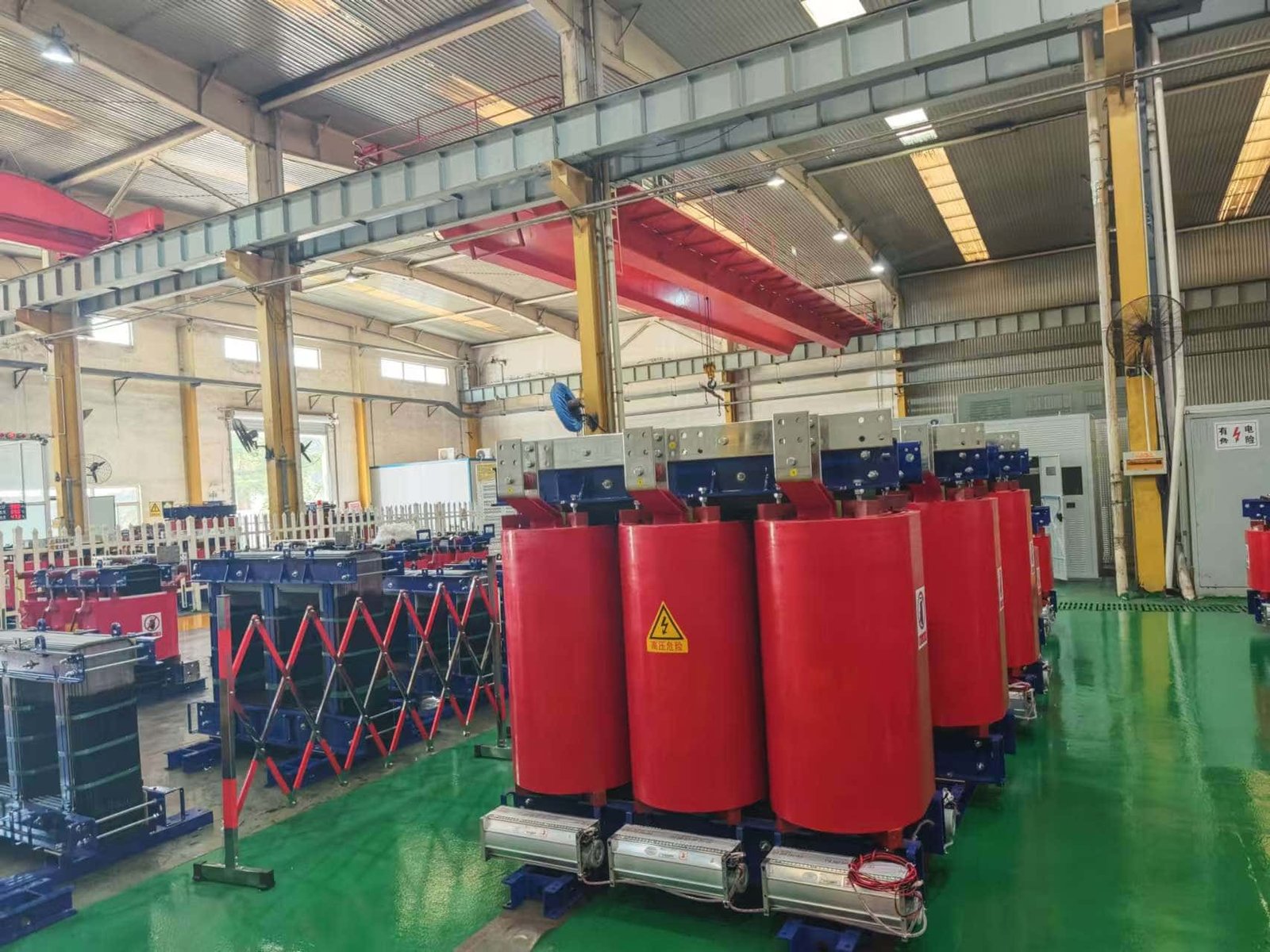
The insulation system is one of the most critical elements of any transformer because it ensures electrical separation between energized components, protects against dielectric failure, and contributes significantly to equipment reliability and service life. In dry-type transformers, the insulation system is particularly important because there is no insulating oil to provide additional dielectric strength and cooling. Instead, dry-type transformers rely on carefully engineered combinations of solid insulating materials and air to maintain safe operation under electrical, thermal, and environmental stresses.
Modern dry-type transformer insulation systems have evolved considerably over the past decades. Advances in epoxy resins, insulation papers, fiberglass materials, and vacuum processing technologies have enabled dry-type transformers to achieve higher voltage ratings, improved reliability, enhanced fire safety, and longer operational lifetimes. Understanding these insulation systems is essential for selecting the right transformer for commercial, industrial, renewable energy, and critical infrastructure applications.
Dry-type transformers use insulation systems based on solid dielectric materials and air rather than liquid insulation. The most common insulation systems include cast resin insulation, vacuum pressure impregnated (VPI) insulation, vacuum pressure encapsulated (VPE) insulation, Nomex® insulation, fiberglass-reinforced insulation, epoxy resin systems, and cellulose-based insulating materials. These systems provide electrical insulation, mechanical strength, thermal resistance, and environmental protection.
The selection of an insulation system directly affects transformer performance, safety, durability, and maintenance requirements.
Dry-type transformers rely primarily on mineral oil for insulation, similar to oil-filled transformers.False
Dry-type transformers do not use insulating oil as their primary insulation medium. They utilize solid insulating materials and air to achieve dielectric protection and thermal performance.
Why Insulation Is Important in Dry-Type Transformers
The insulation system performs several essential functions.
Primary Objectives
| Function | Purpose |
|---|---|
| Electrical isolation | Prevent short circuits |
| Dielectric protection | Withstand operating voltage |
| Mechanical support | Maintain winding integrity |
| Thermal resistance | Survive high temperatures |
Without effective insulation, transformer operation would be unsafe and unreliable.
Electrical Stress in Transformers
Transformers experience significant electrical stresses during operation.
Sources of Electrical Stress
| Source | Effect |
|---|---|
| Operating voltage | Continuous insulation stress |
| Switching surges | Temporary overvoltage |
| Lightning impulses | High-voltage transients |
| Fault conditions | Extreme stress levels |
Insulation systems must withstand all of these conditions.
Main Categories of Dry-Type Transformer Insulation
Dry-type transformer insulation systems generally fall into several categories.
Common Insulation Technologies
| Insulation Type | Typical Application |
|---|---|
| Cast resin | Distribution and power transformers |
| VPI | Industrial transformers |
| VPE | Medium-voltage systems |
| Nomex® insulation | High-temperature applications |
| Fiberglass insulation | Mechanical reinforcement |
Each technology offers unique advantages.
Cast Resin Insulation Systems
Cast resin technology is among the most widely used insulation systems.
How It Works
The windings are completely encapsulated in epoxy resin.
Construction Process
| Step | Description |
|---|---|
| Coil winding | Conductor preparation |
| Mold placement | Coil positioning |
| Vacuum casting | Resin injection |
| Curing process | Hardening insulation |
The result is a solid, moisture-resistant insulating structure.
Advantages of Cast Resin Insulation
| Advantage | Benefit |
|---|---|
| High dielectric strength | Excellent insulation |
| Moisture resistance | Outdoor capability |
| Mechanical strength | Fault withstand capability |
| Fire safety | Reduced hazard |
These benefits make cast resin transformers extremely popular.
Cast Resin Insulation Structure
A typical cast resin winding includes multiple insulation layers.
Components
| Layer | Function |
|---|---|
| Conductor insulation | Turn-to-turn protection |
| Epoxy resin | Primary dielectric barrier |
| Reinforcement fibers | Mechanical support |
| Surface coating | Environmental protection |
Together, these elements create a highly reliable insulation system.
Vacuum Pressure Impregnated (VPI) Insulation
VPI technology is widely used in industrial dry-type transformers.
Manufacturing Process
The windings are impregnated with insulating resin under vacuum and pressure.
Process Stages
| Stage | Purpose |
|---|---|
| Vacuum treatment | Remove air and moisture |
| Resin application | Insulation penetration |
| Pressure cycle | Complete saturation |
| Thermal curing | Harden resin |
This process produces a durable insulation structure.
Benefits of VPI Insulation
| Benefit | Description |
|---|---|
| Improved dielectric strength | Enhanced reliability |
| Good heat dissipation | Better cooling |
| Lower weight | Easier handling |
| Cost effectiveness | Competitive pricing |
VPI designs are common in industrial environments.
Vacuum Pressure Encapsulated (VPE) Insulation
VPE technology is an evolution of VPI insulation.
Key Difference
Multiple resin coatings provide additional environmental protection.
Characteristics
| Feature | Benefit |
|---|---|
| Multiple encapsulation layers | Enhanced protection |
| Moisture resistance | Improved durability |
| Chemical resistance | Industrial suitability |
VPE transformers are often used in harsh environments.
Epoxy Resin Insulation
Epoxy resin is a cornerstone material in many dry-type transformer designs.
Important Properties
| Property | Importance |
|---|---|
| High dielectric strength | Critical |
| Thermal stability | High |
| Mechanical strength | High |
| Moisture resistance | High |
These properties make epoxy ideal for transformer insulation.
Thermal Performance of Epoxy Systems
Temperature resistance is a key consideration.
Typical Thermal Classes
| Insulation Class | Maximum Temperature |
|---|---|
| Class F | 155°C |
| Class H | 180°C |
| Advanced epoxy systems | Up to 220°C |
Higher thermal classes allow greater operating flexibility.
Nomex® Insulation Systems
Nomex® is a high-performance aramid insulation material.
Characteristics
| Property | Benefit |
|---|---|
| High-temperature capability | Extended life |
| Mechanical durability | Reliability |
| Flame resistance | Enhanced safety |
Nomex® is commonly used in demanding applications.
Advantages of Nomex® Insulation
| Advantage | Benefit |
|---|---|
| High thermal endurance | Reduced aging |
| Excellent dielectric strength | Reliable insulation |
| Long service life | Lower lifecycle cost |
These features are valuable in mission-critical installations.
Fiberglass Insulation Systems
Fiberglass materials often complement other insulation technologies.
Functions
| Function | Purpose |
|---|---|
| Mechanical reinforcement | Structural strength |
| Thermal stability | Heat resistance |
| Electrical insulation | Dielectric protection |
Fiberglass helps improve transformer durability.
Cellulose-Based Insulation Materials
Some dry-type transformers use cellulose-derived materials.
Applications
| Material | Application |
|---|---|
| Insulation paper | Turn insulation |
| Pressboard | Structural insulation |
Although less prominent than in oil-filled transformers, cellulose materials remain useful.
Air as an Insulating Medium
Air itself contributes to insulation performance.
Functions
| Function | Benefit |
|---|---|
| Dielectric separation | Electrical protection |
| Cooling medium | Heat removal |
Proper air clearances are critical for safe operation.
Insulation and Voltage Withstand Capability
The insulation system determines the transformer's voltage rating.
Typical Voltage Classes
| Transformer Type | Voltage Range |
|---|---|
| Low-voltage dry-type | Up to 1 kV |
| Medium-voltage dry-type | 1–36 kV |
| Specialized designs | Above 36 kV |
Advanced insulation systems enable higher voltage capabilities.
Insulation Thermal Classes
Transformer insulation is classified according to temperature tolerance.
Common Thermal Classes
| Class | Maximum Operating Temperature |
|---|---|
| Class B | 130°C |
| Class F | 155°C |
| Class H | 180°C |
| Advanced systems | 220°C and above |
Thermal class significantly influences transformer lifespan.
Insulation Aging
All insulation systems gradually age.
Aging Factors
| Factor | Effect |
|---|---|
| Heat | Accelerated degradation |
| Moisture | Reduced dielectric strength |
| Electrical stress | Insulation deterioration |
| Contamination | Surface tracking |
Proper operating conditions help slow aging.
Impact of Temperature on Insulation Life
Temperature is the most important aging factor.
General Rule
A moderate increase in operating temperature can significantly reduce insulation life.
Typical Trend
| Temperature Increase | Effect on Life |
|---|---|
| Moderate increase | Reduced lifespan |
| Significant increase | Accelerated aging |
Effective cooling is therefore essential.
Fire Performance of Dry-Type Insulation Systems
One reason dry-type transformers are popular is their fire safety.
Fire Safety Characteristics
| Property | Benefit |
|---|---|
| Self-extinguishing materials | Improved safety |
| No flammable oil | Reduced fire risk |
| Low smoke generation | Enhanced protection |
These characteristics support indoor installation.
Environmental Resistance
Insulation systems must withstand environmental challenges.
Environmental Factors
| Factor | Requirement |
|---|---|
| Humidity | Moisture resistance |
| Dust | Surface protection |
| Chemicals | Corrosion resistance |
| UV exposure | Outdoor durability |
Different insulation technologies provide varying levels of protection.
Comparison of Major Insulation Systems
| Feature | Cast Resin | VPI | VPE |
|---|---|---|---|
| Moisture resistance | Excellent | Good | Very good |
| Mechanical strength | Excellent | Good | Good |
| Cost | Higher | Lower | Moderate |
| Thermal performance | Excellent | Good | Good |
| Environmental protection | Excellent | Moderate | High |
Selection depends on application requirements.
Factors Affecting Insulation System Selection
Key Considerations
| Factor | Importance |
|---|---|
| Installation environment | High |
| Voltage rating | High |
| Fire safety requirements | High |
| Maintenance expectations | High |
| Budget considerations | Moderate |
Proper selection ensures optimal performance and longevity.
Summary of Dry-Type Transformer Insulation Systems
| Insulation System | Primary Strength |
|---|---|
| Cast resin | Moisture and environmental resistance |
| VPI | Cost-effective reliability |
| VPE | Enhanced environmental protection |
| Nomex® | High-temperature performance |
| Fiberglass reinforcement | Mechanical strength |
| Air insulation | Cooling and dielectric support |
Each system addresses specific operational requirements.
What Are the Main Types of Dry-Type Transformers?
As electrical systems continue to prioritize safety, environmental protection, and operational reliability, dry-type transformers have become increasingly popular across commercial buildings, industrial facilities, renewable energy projects, hospitals, data centers, and transportation infrastructure. Unlike oil-filled transformers, dry-type transformers use air and solid insulation materials rather than liquid dielectric fluids, making them well suited for indoor installations and environmentally sensitive locations.
However, not all dry-type transformers are built the same. Manufacturers have developed several distinct dry-type transformer technologies to address different operating environments, voltage levels, maintenance requirements, and performance expectations. Understanding the main types of dry-type transformers helps engineers, facility managers, and project developers select the most suitable solution for their specific applications.
The main types of dry-type transformers include Cast Resin Transformers (CRT), Vacuum Pressure Impregnated (VPI) Transformers, Vacuum Pressure Encapsulated (VPE) Transformers, Open Ventilated Dry-Type Transformers, and High-Temperature Insulated Transformers. Each type offers unique advantages in terms of insulation performance, environmental resistance, cooling capability, maintenance requirements, and installation suitability.
Choosing the right transformer type can significantly improve reliability, safety, and lifecycle performance.
All dry-type transformers use identical insulation systems and construction methods, differing only in power rating.False
Dry-type transformers use various insulation technologies such as cast resin, VPI, VPE, and high-temperature insulation systems. These construction differences directly affect performance, environmental resistance, and application suitability.
Understanding Dry-Type Transformer Classification
Dry-type transformers are typically classified according to their insulation and manufacturing methods.
Primary Classification Categories
| Classification Basis | Examples |
|---|---|
| Insulation technology | Cast resin, VPI, VPE |
| Cooling method | AN, AF |
| Installation environment | Indoor, outdoor |
| Thermal class | Class F, Class H, higher |
The insulation system is generally the most important classification factor.
Cast Resin Transformers (CRT)
Cast resin transformers are among the most widely used dry-type transformers worldwide.
What Is a Cast Resin Transformer?
The transformer windings are completely encapsulated in epoxy resin.
Manufacturing Process
| Step | Description |
|---|---|
| Coil winding | Conductors prepared |
| Mold assembly | Windings positioned |
| Vacuum casting | Resin injected |
| Thermal curing | Resin hardened |
The result is a highly durable and sealed insulation structure.
Construction Features
| Feature | Benefit |
|---|---|
| Encapsulated windings | Moisture resistance |
| Solid insulation system | High dielectric strength |
| Strong mechanical structure | Improved fault tolerance |
These transformers perform well in demanding environments.
Advantages of Cast Resin Transformers
| Advantage | Benefit |
|---|---|
| Excellent moisture resistance | Suitable for humid environments |
| High fire safety | Reduced risk |
| Low maintenance | Lower operating costs |
| Strong environmental protection | No oil leakage |
These characteristics make cast resin transformers highly popular.
Typical Applications of Cast Resin Transformers
| Application | Reason |
|---|---|
| Hospitals | Fire safety |
| Data centers | Reliability |
| Commercial buildings | Indoor installation |
| Renewable energy projects | Environmental resistance |
Many modern facilities prefer cast resin technology.
Vacuum Pressure Impregnated (VPI) Transformers
VPI transformers represent another major category of dry-type transformers.
What Is VPI Technology?
Windings are impregnated with insulating resin under vacuum and pressure.
VPI Manufacturing Process
| Stage | Purpose |
|---|---|
| Vacuum treatment | Remove moisture and air |
| Resin immersion | Saturate insulation |
| Pressure cycle | Deep penetration |
| Oven curing | Harden insulation |
This creates a robust insulation system.
Characteristics of VPI Transformers
| Feature | Benefit |
|---|---|
| Lightweight design | Easier transportation |
| Good heat dissipation | Effective cooling |
| Lower cost | Economic advantage |
VPI transformers are widely used in industrial applications.
Advantages of VPI Transformers
| Advantage | Benefit |
|---|---|
| Cost effectiveness | Lower capital investment |
| Reliable insulation | Long service life |
| Good thermal performance | Stable operation |
These units provide an excellent balance between performance and cost.
Typical Applications of VPI Transformers
| Application | Purpose |
|---|---|
| Manufacturing plants | Process power |
| Industrial facilities | Distribution systems |
| Commercial buildings | General power supply |
VPI transformers are common in indoor installations.
Vacuum Pressure Encapsulated (VPE) Transformers
VPE technology is an enhanced version of VPI insulation.
How VPE Differs from VPI
Additional resin coatings are applied after impregnation.
Construction Process
| Step | Description |
|---|---|
| Vacuum impregnation | Initial insulation |
| Resin encapsulation | Additional protection |
| Thermal curing | Final hardening |
This creates enhanced environmental protection.
Advantages of VPE Transformers
| Advantage | Benefit |
|---|---|
| Better moisture resistance | Improved durability |
| Enhanced contamination resistance | Harsh environments |
| Greater environmental protection | Longer service life |
These transformers perform well in challenging conditions.
Typical Applications of VPE Transformers
| Environment | Benefit |
|---|---|
| Coastal installations | Salt resistance |
| Industrial facilities | Chemical resistance |
| Outdoor enclosures | Improved durability |
VPE transformers bridge the gap between VPI and cast resin designs.
Open Ventilated Dry-Type Transformers
Open ventilated transformers represent one of the earliest dry-type transformer designs.
Construction Characteristics
| Feature | Description |
|---|---|
| Exposed windings | Direct airflow |
| Open structure | Improved ventilation |
| Minimal encapsulation | Lower cost |
Cooling occurs through natural air circulation.
Advantages
| Advantage | Benefit |
|---|---|
| Excellent cooling | Efficient heat dissipation |
| Lower manufacturing cost | Economic solution |
| Simple construction | Easier inspection |
These designs remain useful in controlled environments.
Limitations
| Limitation | Impact |
|---|---|
| Dust sensitivity | Requires clean environment |
| Moisture exposure | Reduced suitability |
| Contamination risk | Increased maintenance |
Careful installation planning is necessary.
High-Temperature Insulated Transformers
These transformers utilize advanced insulation materials.
Common Insulation Materials
| Material | Characteristics |
|---|---|
| Nomex® | High thermal endurance |
| Aramid insulation | Long service life |
| Advanced composites | Enhanced performance |
These materials support higher operating temperatures.
Benefits of High-Temperature Insulation
| Advantage | Benefit |
|---|---|
| Higher overload capability | Greater flexibility |
| Reduced aging | Longer lifespan |
| Improved reliability | Lower failure risk |
These transformers are used in demanding applications.
Typical Applications
| Application | Reason |
|---|---|
| Transportation systems | Thermal stress tolerance |
| Industrial facilities | Heavy-duty operation |
| Critical infrastructure | Reliability requirements |
Their performance justifies the higher initial cost.
Classification by Cooling Method
Dry-type transformers can also be categorized according to cooling systems.
Air Natural (AN)
Natural convection provides cooling.
Characteristics
| Feature | Benefit |
|---|---|
| No fans | Simplicity |
| Low maintenance | Reduced costs |
| High reliability | Fewer moving parts |
AN cooling is common in smaller transformers.
Air Forced (AF)
Fans enhance heat dissipation.
Benefits
| Advantage | Result |
|---|---|
| Increased capacity | Higher loading capability |
| Better temperature control | Improved performance |
AF cooling is often used for larger transformers.
Classification by Voltage Level
Low-Voltage Dry-Type Transformers
| Voltage Range | Application |
|---|---|
| Up to 1 kV | Building distribution |
Medium-Voltage Dry-Type Transformers
| Voltage Range | Application |
|---|---|
| 1–36 kV | Industrial and utility systems |
Specialized High-Voltage Dry-Type Transformers
| Voltage Range | Application |
|---|---|
| Above 36 kV | Special projects |
Advancements continue to expand voltage capabilities.
Classification by Installation Environment
Indoor Dry-Type Transformers
| Feature | Benefit |
|---|---|
| Compact installation | Space efficiency |
| Fire safety | Building protection |
These are the most common installations.
Outdoor Dry-Type Transformers
| Feature | Benefit |
|---|---|
| Weather-resistant enclosures | Environmental protection |
| Reduced infrastructure requirements | Flexible deployment |
Special enclosures are often required.
Comparing the Main Dry-Type Transformer Types
| Feature | Cast Resin | VPI | VPE | Open Ventilated | High-Temperature |
|---|---|---|---|---|---|
| Moisture resistance | Excellent | Moderate | Good | Low | Good |
| Mechanical strength | Excellent | Good | Good | Moderate | Good |
| Cost | Higher | Lower | Moderate | Lower | Higher |
| Fire safety | Excellent | Good | Good | Good | Excellent |
| Maintenance requirements | Low | Moderate | Moderate | Higher | Low |
This comparison helps identify the best solution for specific applications.
Factors Influencing Transformer Type Selection
Key Considerations
| Factor | Importance |
|---|---|
| Installation environment | High |
| Fire safety requirements | High |
| Moisture exposure | High |
| Maintenance expectations | High |
| Budget constraints | Moderate |
| Voltage level | High |
Proper evaluation ensures optimal transformer selection.
Typical Industry Preferences
| Industry | Preferred Type |
|---|---|
| Hospitals | Cast resin |
| Data centers | Cast resin |
| Manufacturing plants | VPI |
| Renewable energy projects | Cast resin or VPE |
| Transportation systems | High-temperature insulated |
Application requirements often determine the preferred technology.
Performance and Efficiency Considerations
Transformer efficiency remains high across all major dry-type technologies.
Efficiency Formula
\eta=\frac{P{out}}{P{in}}\times100%
Typical Efficiency Range
| Transformer Type | Efficiency |
|---|---|
| VPI | 97–99% |
| VPE | 97–99% |
| Cast Resin | 98–99% |
| High-Temperature | 97–99% |
Actual performance depends on design and operating conditions.
What Advantages Do Dry-Type Transformers Offer?

Electrical power systems require transformers that are not only efficient and reliable but also safe, environmentally responsible, and suitable for increasingly complex installation environments. While oil-filled transformers continue to play a major role in utility and large-scale power applications, dry-type transformers have become the preferred solution for many commercial, industrial, institutional, and renewable energy projects. Their growing popularity is driven by a combination of safety, environmental, operational, and maintenance advantages.
Unlike oil-filled transformers, dry-type transformers use air and solid insulation systems such as cast resin, epoxy resin, or vacuum pressure impregnated insulation. This eliminates the need for flammable insulating liquids and significantly reduces several operational risks. As a result, dry-type transformers are now widely used in hospitals, data centers, office buildings, airports, schools, manufacturing facilities, and renewable energy installations.
Dry-type transformers offer significant advantages including enhanced fire safety, environmental protection, lower maintenance requirements, improved indoor installation flexibility, reduced risk of oil leaks, high reliability, strong moisture resistance, long service life, and compliance with modern sustainability goals. These benefits make them an ideal choice for many commercial, industrial, and critical infrastructure applications.
Their ability to combine safety, reliability, and environmental responsibility has made dry-type transformers a cornerstone of modern electrical distribution systems.
Dry-type transformers require more fire protection systems than oil-filled transformers because their insulation materials are highly flammable.False
Dry-type transformers generally provide superior fire safety because they do not contain large quantities of flammable insulating oil and often use self-extinguishing insulation materials.
Enhanced Fire Safety
One of the most important advantages of dry-type transformers is their superior fire performance.
Why Fire Safety Matters
Transformer installations are often located inside occupied buildings where fire protection is critical.
Fire Risks Associated with Oil-Filled Transformers
| Risk | Potential Consequence |
|---|---|
| Oil ignition | Fire propagation |
| Oil explosions | Equipment damage |
| Oil-fed fires | Building hazards |
Dry-type transformers eliminate many of these concerns.
Fire Safety Advantages of Dry-Type Transformers
| Advantage | Benefit |
|---|---|
| No flammable oil | Reduced fire risk |
| Self-extinguishing insulation | Enhanced safety |
| Lower combustion potential | Improved protection |
This makes them particularly suitable for indoor installations.
Environmental Protection
Environmental concerns are increasingly important in modern infrastructure projects.
Oil Spill Elimination
Dry-type transformers contain no insulating oil.
Environmental Benefits
| Benefit | Impact |
|---|---|
| No oil leaks | Reduced contamination risk |
| No groundwater pollution | Environmental protection |
| No spill containment systems | Simplified installation |
These features help organizations meet sustainability objectives.
Support for Sustainable Development
Many projects now prioritize environmentally responsible technologies.
Sustainability Contributions
| Feature | Benefit |
|---|---|
| Reduced environmental risk | Regulatory compliance |
| Cleaner operation | Improved sustainability |
| Lower ecological impact | Long-term environmental protection |
Dry-type transformers align well with modern environmental policies.
Lower Maintenance Requirements
Maintenance costs significantly affect lifecycle economics.
Why Maintenance Is Reduced
Dry-type transformers do not require oil management.
Maintenance Comparison
| Maintenance Task | Dry-Type | Oil-Filled |
|---|---|---|
| Oil sampling | Not required | Required |
| Oil filtration | Not required | Required |
| Leak inspections | Minimal | Frequent |
| Spill management | Not required | Necessary |
This reduces maintenance complexity and cost.
Typical Dry-Type Maintenance Activities
| Activity | Purpose |
|---|---|
| Visual inspection | Condition assessment |
| Cleaning | Dust removal |
| Thermal inspection | Hot-spot identification |
| Electrical testing | Performance verification |
Maintenance procedures are generally straightforward.
Improved Indoor Installation Flexibility
Dry-type transformers are particularly well suited for indoor environments.
Common Indoor Locations
| Facility | Application |
|---|---|
| Hospitals | Electrical distribution |
| Data centers | Critical power systems |
| Office buildings | Building infrastructure |
| Educational facilities | Campus power systems |
Their safety profile simplifies indoor deployment.
Reduced Infrastructure Requirements
Oil-filled transformers often require additional infrastructure.
Typical Oil-Filled Requirements
| Requirement | Purpose |
|---|---|
| Oil containment pit | Spill control |
| Fire barriers | Fire protection |
| Drainage systems | Environmental compliance |
Many of these requirements are reduced or eliminated with dry-type transformers.
High Reliability
Modern dry-type transformers are designed for long-term dependable operation.
Reliability Factors
| Factor | Contribution |
|---|---|
| Solid insulation | Consistent dielectric performance |
| No liquid degradation | Stable operation |
| Robust construction | Mechanical durability |
These characteristics support long service life.
Moisture Resistance
Many dry-type transformer designs offer excellent resistance to moisture.
Cast Resin Advantage
Cast resin transformers completely encapsulate windings.
Benefits
| Feature | Result |
|---|---|
| Encapsulated coils | Moisture protection |
| Reduced contamination risk | Improved reliability |
| Stable insulation properties | Long-term performance |
This is particularly valuable in humid environments.
Strong Mechanical Strength
Dry-type transformers are designed to withstand mechanical stresses.
Sources of Mechanical Stress
| Source | Example |
|---|---|
| Short-circuit forces | Fault conditions |
| Transportation | Shipping and handling |
| Vibration | Industrial environments |
Modern insulation systems provide excellent structural integrity.
Excellent Performance in Critical Facilities
Certain applications demand exceptional reliability and safety.
Critical Infrastructure Examples
| Facility | Importance |
|---|---|
| Hospitals | Life-safety systems |
| Airports | Continuous operation |
| Data centers | Uptime requirements |
| Transit systems | Public safety |
Dry-type transformers are commonly selected for these installations.
Reduced Risk of Catastrophic Failure
The absence of oil reduces several failure mechanisms.
Comparison
| Issue | Dry-Type | Oil-Filled |
|---|---|---|
| Oil leakage | No | Possible |
| Oil ignition | No | Possible |
| Oil contamination | No | Possible |
This contributes to safer operation.
Compatibility with Modern Buildings
Building designs increasingly emphasize safety and space utilization.
Advantages
| Feature | Benefit |
|---|---|
| Indoor installation | Space efficiency |
| Reduced fire protection requirements | Lower construction costs |
| Cleaner operation | Improved building integration |
These benefits are especially valuable in urban developments.
Support for Renewable Energy Projects
Renewable energy facilities frequently use dry-type transformers.
Applications
| Project Type | Transformer Function |
|---|---|
| Solar power plants | Voltage conversion |
| Wind farms | Distribution systems |
| Battery storage facilities | Grid integration |
Environmental benefits align with renewable energy objectives.
Reduced Regulatory Burden
Environmental and fire regulations often influence equipment selection.
Compliance Benefits
| Area | Advantage |
|---|---|
| Environmental regulations | Easier compliance |
| Fire safety codes | Improved acceptance |
| Building regulations | Greater flexibility |
These factors can simplify project approval processes.
Low Noise Options
Advanced dry-type transformer designs can provide low acoustic emissions.
Noise Reduction Measures
| Method | Purpose |
|---|---|
| Optimized core design | Reduced vibration |
| Improved clamping systems | Lower sound levels |
| Enhanced construction | Better acoustic performance |
Low-noise models are ideal for occupied buildings.
Long Service Life
Dry-type transformers are designed for decades of operation.
Factors Supporting Longevity
| Factor | Benefit |
|---|---|
| Stable insulation systems | Reduced aging |
| Minimal environmental risk | Improved durability |
| Simplified maintenance | Better asset management |
Properly maintained units often achieve long operational lives.
Safety for Occupied Spaces
People frequently work near transformer installations.
Safety Benefits
| Benefit | Importance |
|---|---|
| Reduced fire risk | High |
| No oil exposure | High |
| Improved environmental safety | High |
These characteristics support workplace safety goals.
Economic Advantages Over the Lifecycle
Initial purchase price is only one part of total ownership cost.
Lifecycle Cost Benefits
| Benefit | Financial Impact |
|---|---|
| Lower maintenance | Reduced operating cost |
| Fewer environmental controls | Lower infrastructure cost |
| Improved reliability | Reduced downtime |
These savings can offset higher initial costs.
Typical Applications Benefiting from Dry-Type Technology
| Industry | Primary Advantage |
|---|---|
| Healthcare | Fire safety |
| Data centers | Reliability |
| Commercial buildings | Indoor installation |
| Transportation | Public safety |
| Renewable energy | Environmental performance |
| Education | Low maintenance |
Different sectors benefit from different aspects of dry-type technology.
Comparison with Oil-Filled Transformers
| Characteristic | Dry-Type Transformer | Oil-Filled Transformer |
|---|---|---|
| Fire safety | Excellent | Moderate |
| Environmental protection | Excellent | Moderate |
| Indoor installation | Excellent | Limited |
| Maintenance requirements | Lower | Higher |
| Spill risk | None | Present |
| Moisture resistance (cast resin) | Excellent | Good |
This comparison highlights the key advantages of dry-type designs.
Summary of Key Advantages
| Advantage | Benefit |
|---|---|
| Fire safety | Reduced risk |
| Environmental protection | No oil contamination |
| Low maintenance | Lower operating costs |
| Indoor suitability | Flexible installation |
| High reliability | Long service life |
| Moisture resistance | Improved durability |
| Regulatory compliance | Simplified approvals |
| Sustainability support | Environmental responsibility |
These strengths explain their growing popularity worldwide.
Where Are Dry-Type Transformers Commonly Used?
As electrical infrastructure continues to evolve, safety, environmental responsibility, and operational reliability have become increasingly important factors in equipment selection. Dry-type transformers have emerged as a preferred solution for many applications because they eliminate the need for flammable insulating oil while providing efficient voltage conversion, excellent fire safety, and reduced maintenance requirements. These characteristics make them especially suitable for locations where people, sensitive equipment, or environmental concerns are present.
Unlike oil-filled transformers, dry-type transformers use solid insulation materials and air cooling systems. This design significantly reduces fire hazards, eliminates oil leakage risks, and simplifies installation in occupied buildings. As a result, dry-type transformers are now widely used across commercial, industrial, institutional, transportation, renewable energy, and critical infrastructure sectors.
Dry-type transformers are commonly used in commercial buildings, hospitals, data centers, schools, airports, industrial facilities, renewable energy projects, transportation systems, high-rise buildings, shopping centers, underground installations, and environmentally sensitive locations. Their fire safety, low maintenance requirements, and indoor installation capabilities make them ideal for these applications.
Their versatility and safety advantages continue to drive widespread adoption worldwide.
Dry-type transformers are only suitable for small residential applications and cannot be used in commercial or industrial facilities.False
Dry-type transformers are widely used in commercial buildings, industrial plants, hospitals, airports, renewable energy projects, and many other medium- and large-scale electrical applications.
Why Application Selection Matters
Transformer selection depends on many factors beyond voltage and power rating.
Key Considerations
| Factor | Importance |
|---|---|
| Fire safety | High |
| Environmental impact | High |
| Maintenance requirements | High |
| Installation location | High |
| Reliability expectations | High |
Dry-type transformers often provide advantages in these areas.
Commercial Buildings
One of the largest application sectors for dry-type transformers is commercial construction.
Common Commercial Facilities
| Facility Type | Transformer Application |
|---|---|
| Office buildings | Electrical distribution |
| Shopping malls | Power supply systems |
| Hotels | Building services |
| Convention centers | Facility infrastructure |
Indoor installation flexibility makes dry-type transformers particularly attractive.
Benefits for Commercial Buildings
| Benefit | Impact |
|---|---|
| No oil leakage risk | Improved safety |
| Reduced fire hazard | Easier code compliance |
| Compact installation | Better space utilization |
These benefits simplify building design and operation.
High-Rise Buildings
Modern skyscrapers require reliable electrical distribution systems.
Why Dry-Type Transformers Are Preferred
| Requirement | Benefit |
|---|---|
| Indoor placement | Excellent suitability |
| Fire protection | Enhanced safety |
| Occupant safety | Reduced risk |
Transformers are often installed in dedicated electrical rooms throughout the building.
Hospitals and Healthcare Facilities
Hospitals demand exceptional reliability and safety.
Critical Requirements
| Requirement | Importance |
|---|---|
| Continuous power availability | Critical |
| Fire safety | Critical |
| Low maintenance | High |
| Environmental cleanliness | High |
Dry-type transformers help meet these demanding standards.
Typical Hospital Applications
| Area | Function |
|---|---|
| Main distribution systems | Facility power |
| Emergency power systems | Backup infrastructure |
| Medical equipment supply | Voltage conversion |
Patient safety makes transformer reliability especially important.
Data Centers
Data centers are among the fastest-growing users of dry-type transformers.
Why Data Centers Use Dry-Type Transformers
| Requirement | Benefit |
|---|---|
| High reliability | Maximum uptime |
| Fire safety | Equipment protection |
| Indoor installation | Space efficiency |
Modern data centers often deploy multiple redundant transformers.
Data Center Electrical Architecture
| Component | Purpose |
|---|---|
| Utility connection | Incoming power |
| Dry-type transformer | Voltage conversion |
| UPS systems | Power continuity |
| Server infrastructure | Load supply |
Dry-type transformers are a key part of this chain.
Educational Institutions
Schools and universities frequently utilize dry-type transformers.
Common Installations
| Facility | Application |
|---|---|
| Schools | Building distribution |
| Universities | Campus power systems |
| Research facilities | Laboratory power |
Safety around students and staff is a major advantage.
Airports
Airports operate complex electrical systems that require dependable equipment.
Typical Applications
| System | Purpose |
|---|---|
| Terminal buildings | Facility power |
| Runway lighting | Critical infrastructure |
| Air traffic systems | Operational support |
Dry-type transformers help maintain safe and reliable operation.
Railway and Transportation Systems
Transportation infrastructure often relies on dry-type transformers.
Common Applications
| Transportation Sector | Use |
|---|---|
| Railways | Traction power distribution |
| Metro systems | Station infrastructure |
| Airports | Ground facilities |
| Transit hubs | Electrical distribution |
Fire safety is particularly important in public transportation environments.
Underground Installations
Underground facilities require equipment with minimal environmental risk.
Examples
| Location | Application |
|---|---|
| Subway stations | Power distribution |
| Utility tunnels | Electrical supply |
| Underground commercial spaces | Building services |
Oil-free operation is highly beneficial in these environments.
Industrial Manufacturing Facilities
Dry-type transformers are widely used throughout industrial facilities.
Common Industries
| Industry | Application |
|---|---|
| Automotive manufacturing | Process power |
| Food processing | Production systems |
| Electronics manufacturing | Facility power |
| Pharmaceutical production | Clean environments |
The specific transformer type depends on environmental conditions.
Industrial Advantages
| Benefit | Result |
|---|---|
| Reduced maintenance | Lower downtime |
| No oil contamination | Cleaner operation |
| Enhanced safety | Worker protection |
These benefits support efficient plant operation.
Renewable Energy Facilities
Renewable energy projects increasingly utilize dry-type transformers.
Solar Power Plants
Solar installations often require multiple voltage conversion stages.
Typical Configuration
| Stage | Voltage |
|---|---|
| Inverter output | 400–800 V |
| Collection system | 11–33 kV |
| Grid connection | 132 kV and above |
Dry-type transformers are frequently used within inverter and collection systems.
Wind Energy Projects
Wind farms also benefit from dry-type transformer technology.
Applications
| Location | Function |
|---|---|
| Turbine base | Voltage step-up |
| Collection substations | Power aggregation |
| Auxiliary systems | Facility supply |
Environmental advantages align well with renewable energy goals.
Battery Energy Storage Systems (BESS)
Energy storage facilities require reliable electrical conversion equipment.
Transformer Roles
| Function | Purpose |
|---|---|
| Grid interconnection | Power exchange |
| Voltage adaptation | System compatibility |
| Auxiliary supply | Facility operations |
Dry-type transformers support safe operation in these installations.
Shopping Centers and Retail Complexes
Large retail facilities often house transformers inside the building envelope.
Benefits
| Benefit | Importance |
|---|---|
| Fire safety | High |
| Public protection | High |
| Ease of installation | High |
Dry-type transformers are commonly selected for these environments.
Government and Public Buildings
Public infrastructure often prioritizes safety and reliability.
Typical Facilities
| Facility | Application |
|---|---|
| Government offices | Building power |
| Courthouses | Electrical distribution |
| Public service centers | Infrastructure support |
Dry-type transformers align well with public safety requirements.
Cultural and Entertainment Venues
Large public gathering spaces require dependable electrical systems.
Examples
| Facility | Use |
|---|---|
| Stadiums | Event power |
| Theaters | Facility distribution |
| Museums | Environmental control systems |
Fire safety requirements strongly influence equipment selection.
Marine and Offshore Facilities
Some marine installations use dry-type transformers where environmental concerns are paramount.
Applications
| Facility | Function |
|---|---|
| Ships | Electrical distribution |
| Offshore platforms | Auxiliary systems |
| Port facilities | Infrastructure power |
Specialized designs may be required.
Environmentally Sensitive Locations
Dry-type transformers are often selected where environmental protection is critical.
Examples
| Location | Reason |
|---|---|
| Water treatment plants | Pollution prevention |
| Nature reserves | Environmental protection |
| Urban centers | Public safety |
Oil-free operation provides a significant advantage.
Areas with Strict Fire Regulations
Many jurisdictions impose strict fire codes.
Facilities Often Affected
| Facility Type | Fire Safety Priority |
|---|---|
| Hospitals | Very high |
| Schools | Very high |
| High-rise buildings | Very high |
| Data centers | Very high |
Dry-type transformers help satisfy these requirements.
Typical Installation Locations
| Installation Area | Common Use |
|---|---|
| Electrical rooms | Building distribution |
| Mechanical floors | High-rise infrastructure |
| Basements | Facility power systems |
| Rooftop equipment areas | Specialized applications |
Indoor flexibility remains one of the strongest advantages.
Comparison of Application Suitability
| Application | Dry-Type Suitability |
|---|---|
| Commercial buildings | Excellent |
| Hospitals | Excellent |
| Data centers | Excellent |
| Educational facilities | Excellent |
| Airports | Excellent |
| Renewable energy projects | Excellent |
| Industrial plants | Very good |
| Underground facilities | Excellent |
| Environmentally sensitive sites | Excellent |
This broad suitability explains their widespread adoption.
Why These Applications Prefer Dry-Type Transformers
| Advantage | Application Benefit |
|---|---|
| No flammable oil | Improved safety |
| No oil leaks | Environmental protection |
| Low maintenance | Reduced operating costs |
| Indoor installation capability | Greater flexibility |
| High reliability | Continuous operation |
These advantages address many of the challenges faced by modern facilities.
Conclusion
A dry-type transformer is a transformer that uses air and solid insulation materials—such as epoxy resin, varnish, or cast resin—instead of insulating oil. It operates on the principle of electromagnetic induction while providing safe and reliable voltage conversion without the risk of oil leakage or fire hazards associated with liquid-filled designs. Due to their safety, environmental benefits, and ease of maintenance, dry-type transformers are widely used in commercial buildings, industrial facilities, renewable energy systems, data centers, hospitals, and other indoor applications.
FAQ
Q1: What exactly is a dry type transformer?
A dry type transformer is a transformer that uses air and solid insulating materials instead of insulating oil for cooling and electrical insulation. Unlike oil-immersed transformers, dry type transformers do not contain flammable liquid, making them safer for indoor installations and environmentally sensitive locations.
They are commonly used in commercial buildings, hospitals, data centers, schools, industrial facilities, and renewable energy projects where fire safety and low maintenance are priorities.
Q2: How does a dry type transformer work?
A dry type transformer operates on the principle of electromagnetic induction.
The process is as follows:
Alternating current (AC) flows through the primary winding.
A magnetic field is generated in the transformer core.
The changing magnetic field induces voltage in the secondary winding.
Electrical energy is transferred without direct electrical contact between windings.
The key difference from oil-filled transformers is that cooling and insulation are achieved using air, epoxy resin, or other solid insulation materials rather than transformer oil.
Q3: What are the main types of dry type transformers?
The two most common types are:
Cast Resin Transformers
Windings are encapsulated in epoxy resin.
Excellent protection against moisture, dust, and contaminants.
Suitable for harsh environments.
Vacuum Pressure Impregnated (VPI) Transformers
Windings are impregnated with insulating varnish under vacuum pressure.
Good heat dissipation.
Often used in industrial and commercial applications.
Both designs offer reliable performance and enhanced safety.
Q4: What are the advantages of dry type transformers?
Dry type transformers provide several benefits:
No risk of oil leakage
Reduced fire hazards
Environmentally friendly operation
Lower maintenance requirements
Suitable for indoor installation
Excellent moisture resistance (especially cast resin types)
Easier compliance with building safety regulations
These advantages make them increasingly popular in urban and commercial settings.
Q5: How do dry type transformers compare to oil-immersed transformers?
Feature Dry Type Transformer Oil-Immersed Transformer
Cooling Medium Air Insulating Oil
Fire Risk Low Higher
Environmental Risk Minimal Possible Oil Leakage
Maintenance Lower Higher
Indoor Installation Excellent Limited
Typical Capacity Small to Medium Medium to Very Large
Cooling Efficiency Moderate Higher
The best choice depends on application requirements, safety concerns, and operating environment.
Q6: Where are dry type transformers commonly used?
Dry type transformers are widely used in:
Commercial buildings
Hospitals
Airports
Data centers
Shopping malls
Educational institutions
Industrial plants
Solar and wind energy facilities
Underground substations
Their safety and reliability make them ideal for locations with high public occupancy.
Q7: How are dry type transformers cooled?
Dry type transformers typically use:
Air Natural (AN)
Heat dissipates through natural air circulation around the windings.
Air Forced (AF)
Fans are used to increase airflow and improve cooling capacity.
Cast resin transformers also benefit from the thermal conductivity of epoxy resin, which helps transfer heat away from the windings.
Q8: What is the expected lifespan of a dry type transformer?
With proper installation and maintenance, a dry type transformer can operate for 20 to 30 years or more.
Factors affecting lifespan include:
Operating temperature
Load conditions
Environmental cleanliness
Ventilation quality
Maintenance practices
Routine inspections and thermal monitoring help maximize service life and reliability.
References
IEC 60076-11 – Dry-Type Transformers
https://webstore.iec.ch/publication/627
IEC 60076 – Power Transformers
https://webstore.iec.ch/publication/602
IEEE C57.12.01 – General Requirements for Dry-Type Transformers
https://standards.ieee.org
Electrical Engineering Portal – Dry Type vs Oil Filled Transformers
https://electrical-engineering-portal.com
National Electrical Manufacturers Association (NEMA) – Transformer Standards
https://www.nema.org
IEEE Power & Energy Society – Transformer Research and Publications
https://ieeexplore.ieee.org